Networks, Hardware and Trading Infrastructure · Technology
27The Vendor Map
Eurex’s list of independent software vendors runs to thirty-three companies, each marked by the part of a trading firm it serves: back office, middle office, front office. Its other lists name market data vendors, brokers and sponsored access providers. A new trading firm buys most of its stack, and its first map of the market is a map of vendors: whom it buys colocation from, which ticker plant decodes its feeds, whose servers run its strategies, whose clocks stamp its records.
The earlier chapters met these vendors one product at a time: switches and layer-1 devices in chapter 2, network cards in chapter 3, clocks in chapter 4, capture in chapter 5, FPGA cards in chapters 6 and 7, servers in chapter 8, colocation and routes in chapters 9 to 15. This chapter puts them on one map by category, attaches a firm’s stack to it as a graph, and measures what the map shows: how concentrated the firm’s spend is and which vendors’ failure would stop it trading. Vendors are named only from a venue’s list or their own publications; the example stack is synthetic.
27.1 Market data
Definition 27.1 (Ticker plant)
A ticker plant is a system, bought or built, that receives a firm’s market data feeds once, decodes and normalises them into one format, maintains the order books, and distributes the results to the firm’s trading, risk and monitoring applications over its internal network.
A firm can decode each feed inside each strategy (Book 13’s feed handler) or once, centrally, in a ticker plant. Vendors sell both. Exegy describes centralised ticker plants as “the dominant architectural response to the scaling limitations of embedded feed handlers”, and names their cost: “distribution complexity and latency overhead” (Box 27.1). Pico’s product page defines the ticker plant as software that connects to the feeds, normalises the messages and keeps the books in memory, for more than 230 venues. The choice is chapter 1’s multicast question turned into procurement: one decode and a second network, or many decodes and none.
27.2 Execution software and order management
Definition 27.2 (Independent software vendor)
An independent software vendor is a firm that sells trading, order management, risk or post-trade software to trading firms and that an exchange certifies to connect to its systems on their behalf, without itself being a member.
Exchanges publish their certified vendors. Eurex’s list gives each company’s services by office: Trading Technologies for back and front office, Broadridge and OnixS for front office among many others. For a new firm the list is a shopping list and a constraint: a vendor that is not certified for a venue cannot connect the firm to it, and every venue’s certification is a separate project (Book 13).
As of September 2026 — Vendors on the map, from venues’ lists and vendors’ own publications
- Eurex independent software vendors: 33 companies, each with its offices served, among them Trading Technologies (back and front office), Broadridge (front office), OnixS (front office).
- Market data: Exegy (centralised ticker plants, FPGA feed handling); Pico (InRush Ticker Plant, more than 230 venues).
- Timing: Meinberg (IEEE 1588 grandmaster clocks, LANTIME time servers). Monitoring: Pico (Corvil Analytics).
- From earlier chapters: switches (Cisco, Arista), network cards and FPGA cards (AMD), overclocked servers (Blackcore, Business Systems International), colocation (Equinix), a microwave route (Quincy Data).
27.3 Network hardware and servers
The hardware categories are the ones measured in chapters 2 to 8, and each has a handful of vendors that low-latency firms use: a switch vendor for the aggregation layer and a layer-1 device vendor for fan-out; a network card that supports kernel bypass; an FPGA card for the hardware path; overclocked servers. A firm usually standardises on one vendor per category, for spares, skills and drivers; that choice is what makes a vendor a single point of failure, and chapter 28’s recovery plan has to cover it.
27.4 Timing and monitoring
Timing and monitoring are the categories a firm can survive losing for an hour and must not lose for a day. A grandmaster clock feeds every timestamp the regulators ask for (chapter 4); network analytics and capture appliances (chapter 5) see what the firm’s own systems do not. Neither sits on the path from data to orders, so neither stops trading; both stop the firm from proving what it did, which is its own kind of halt.
27.5 Reading the map: lock-in, concentration and exit
A stack is a graph: market data comes in, passes through components, and leaves as orders. Each component is supplied by one or more vendors, or built in house. Two questions follow. Which components, failing alone, cut every path from data to orders? And which vendors, failing, take out every component they alone supply and so cut it?
    def connected(self, removed=()):
        """Is there a path from source to sink avoiding the removed components?"""
        gone = set(removed)
        seen, todo = {self.source}, [self.source]
        while todo:
            a = todo.pop()
            for x, y in self.edges:
                if x == a and y not in seen and y not in gone:
                    seen.add(y)
                    todo.append(y)
        return self.sink in seen

    def single_points(self):
        return [c.name for c in self.components if not self.connected((c.name,))]

    def vendor_points(self):
        """Vendors whose failure removes every component they alone supply and so cuts the path."""
        vendors = sorted({v for c in self.components for v in c.vendors if v != IN_HOUSE})
        out = []
        for v in vendors:
            gone = [c.name for c in self.components if c.vendors == (v,)]
            if gone and not self.connected(gone):
                out.append(v)
return outProposition 27.3 (Vendor points of failure)
A vendor halts trading if and only if the components it alone supplies form a cut between data and orders; a component supplied by two vendors is never removed by one vendor’s failure, so dual-sourcing a component removes it from every vendor’s cut, but not from its own.
Proof. A vendor’s failure removes exactly the components that have no other supplier; trading halts if and only if no path from data to orders survives their removal. A dual-sourced component survives either vendor’s failure, but the component itself, failing for another cause (its software, its configuration), still cuts the path if it is the only route. ∎
The chapter’s example firm trades from Secaucus. Its stack: colocation and cross-connects from Equinix; a layer-1 fan-out from Arista and switches from Cisco, in parallel; an Exegy ticker plant and in-house feed handlers, in parallel; Blackcore servers with AMD network cards; its own execution gateway; and, off the path, order management from Trading Technologies, Meinberg grandmasters, Pico network analytics and a Quincy Data microwave route. It spends USD 3.19 million a year on them (synthetic figures).
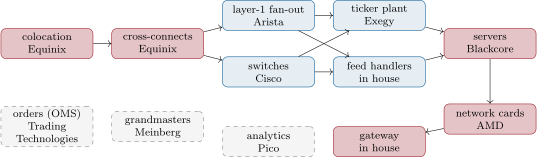
nw_vendors.report().Five components cut the path alone: colocation, cross-connects, the strategy servers, their network cards and the in-house gateway. Three vendors do: AMD, Blackcore and Equinix; Arista, Cisco and Exegy do not, because each has a parallel path. The Herfindahl–Hirschman index of the firm’s spend by vendor (shares of total spend, in-house work excluded from the index) is 1 149 on a scale of zero to 10 000, which reads as spread; but the index measures spend, not dependence: the firm’s largest vendor by spend, Equinix at 22.6%, is a point of failure, and its second, Quincy Data at 15.0%, is not.
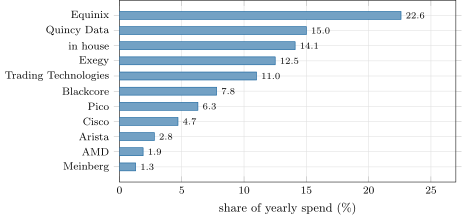
fig_vendors.py, nw_vendors.report().Adding a second server vendor on half the servers lowers the index to 1 119 and removes Blackcore from the vendor points; the strategy servers remain a single component that can fail for other reasons. The exit times of the five single-point components add to 48 weeks: leaving Equinix alone is half a year. That is the practical meaning of vendor lock-in (Book 16, chapter 20, treats it as a business decision): not a contract clause but the weeks it takes to replace a component on the trading path.
Method 27.4 (Reading a firm’s vendor map)
- List every component on the path from market data to orders and every one off it; attach each to its vendors, with the source that names the vendor and the date.
- Draw the graph; find the single components and the vendors whose failure cuts it.
- Compute the concentration of spend, and read it beside the vendor points: they answer different questions.
- For each vendor point, estimate the exit time and decide: dual-source, keep spares, or accept and cover in the recovery plan (chapter 28).
- Export the bill of materials to the connectivity plan (chapter 29) and re-run the map at every contract renewal.
27.6 Tutorial: one vendor too many
Goal. Build the vendor map as data, attach a stack, and find its single points of vendor failure. End state: Figures 27.1 and 27.2.
- Inventory.
firm_vendormap.load_inventoryreads the dated vendor rows, each with its ledger source. - Stack.
nw_vendors.COMPONENTSandEDGESdescribe the example firm;Stackholds them. - Measures.
single_points,vendor_points(Listing 27.1),hhiandbom;second_server_vendorfor the change.
What to change next. Weight each vendor point by its exit time and the probability of its failure, and rank the fixes by risk removed per dollar.
27.7 Build: the vendor map
Purpose. A vendor inventory and a firm’s stack as a graph, with concentration, single points of failure and a bill of materials: the vendor rows of chapter 29’s plan.
Interface. firm_vendormap: InventoryRow, load_inventory, Component, Stack (connected, single_points, vendor_points, shares, hhi, bom).
Rules. Every vendor row names its ledger source and date; the stack and its spend are the firm’s own (here synthetic).
Acceptance tests. code/firm/vendormap/tests/: inventory sources, a three-component graph by hand, and in-house components excluded from vendor points.
Stretch. Failure probabilities and exit costs; shared sub-suppliers (two vendors on one chip).
Sources and further reading
- Eurex, participant lists: independent software vendors.
- Exegy, Design Patterns for Market Data, Part 2: Centralized Ticker Plant; Pico, InRush Ticker Plant; Meinberg, product range.
- This book’s chapters 2 to 14 for the hardware, colocation and route vendors.
27.8 Exercises
Exercise 27.1 ★
What does a ticker plant do, and what does centralising it cost?
Solution
Solution of Exercise 27.1.
It receives the feeds once, decodes and normalises them, keeps the books and distributes them inside the firm. Centralising saves duplicated decoding and servers, at the cost of a distribution network and its latency.
Exercise 27.2 ★
What is an independent software vendor, and why does an exchange certify it?
Solution
Solution of Exercise 27.2.
A company that sells trading or post-trade software to firms and connects them to exchanges on their behalf. The exchange certifies it so that its software behaves correctly on the exchange’s interfaces, which protects the exchange and every other participant.
Exercise 27.3 ★
Why do the grandmaster clocks not appear among the example firm’s points of failure, and why should the firm still care?
Solution
Solution of Exercise 27.3.
They are not on the path from data to orders, so their failure does not stop trading. But every timestamp the regulators require depends on them, so a long failure leaves the firm unable to prove its records.
Exercise 27.4 ★★
Using Proposition 27.3, why is Exegy not a vendor point of failure for the example firm?
Solution
Solution of Exercise 27.4.
The ticker plant has a parallel path through the in-house feed handlers, so removing it leaves a path from data to orders.
Exercise 27.5 ★★
Compute the example firm’s index with Equinix’s spend doubled.
Solution
Solution of Exercise 27.5.
1 782: Equinix’s spend rises to USD 1.44 million of 3.91 million, and its share’s square dominates the index.
Exercise 27.6 ★★
The firm’s second server vendor buys its network cards from the same maker. What does the map miss?
Solution
Solution of Exercise 27.6.
A common sub-supplier: two server vendors with the same network cards, firmware or chips fail together for the same defect. The map should record the parts’ makers, not only the sellers.
Exercise 27.7 ★★★
Coding. With firm_vendormap.Stack, add a second colocation site, from another operator, with its own cross-connects feeding the same servers. Which vendor points remain?
Solution
Solution of Exercise 27.7.
AMD and Blackcore; Equinix drops out, as do the colocation and cross-connects from the single components, and the index falls to 1 104.
Exercise 27.8 ★★★
Find the flaw. “Our largest vendor is only 23% of our spend, so we are not dependent on anyone.”
Solution
Solution of Exercise 27.8.
Share of spend is not dependence: a vendor with a small share can supply a component on the only path from data to orders, and the largest vendor here is also a point of failure whose exit takes half a year.
27.9 Problem: One Vendor Too Many
Problem 27.1
Weekend problem — concentration and single points of vendor failure
A new firm trades from Secaucus with the chapter’s example stack. Its board asks which vendors could stop it trading and what it would take to change that.
Part I — The map.
- Which categories does the firm buy, and from whom?
- What sources name each vendor?
- What does the firm spend in a year, and on whom most?
- What is the concentration index?
Part II — The graph.
- Which components cut the path alone?
- Which vendors do?
- Why are Arista, Cisco and Exegy not among them?
- What are the exit times of the single-point components?
Part III — The changes.
- What does a second server vendor change?
- What would remove AMD from the vendor points?
- Why can Equinix not be removed cheaply?
- What does the off-path software do to the firm if it fails?
Part IV — The verdict.
- State the named result: the concentration index of the firm’s stack and the list of components whose single vendor’s failure halts trading.
- Which inputs are published and which the firm’s own?
- Why do the index and the vendor points disagree?
- What should go into the recovery plan of chapter 28?
- What should the board ask at each contract renewal?
- How does the map change for a firm that builds its own ticker plant?
- Where does this go in chapter 29’s plan?
- In one sentence: what makes a vendor dangerous?
Solution
Solution of Problem 27.1.
Part I.
- Colocation and cross-connects (Equinix), a layer-1 fan-out (Arista), switches (Cisco), a ticker plant (Exegy), servers (Blackcore), network cards (AMD), order management (Trading Technologies), grandmasters (Meinberg), analytics (Pico), a microwave route (Quincy Data), and its own feed handlers and gateway.
- A venue’s certified vendor list, the vendors’ own product pages, and the earlier chapters’ rows.
- USD 3.19 million; Equinix 22.6%, Quincy Data 15.0%, in-house work 14.1%, Exegy 12.5%.
- 1 149.
Part II.
- Colocation, cross-connects, the strategy servers, their network cards and the gateway.
- AMD, Blackcore and Equinix.
- Each has a parallel component from another vendor or built in house.
- 26, 12, 6, 4 and 0 weeks: 48 in all.
Part III.
- The index falls to 1 119 and Blackcore leaves the vendor points; the servers remain a single component.
- A second network card maker on some servers, or cards of another make in the second server vendor’s machines.
- The colocation site is where the exchange is; a second site means another operator’s building, its own cross-connects and a longer path, and half a year to move.
- Nothing to automated trading; manual and agency flow stops, and records and monitoring degrade.
Part IV.
- Named result: the example firm’s stack has a concentration index of 1 149 on spend, and five components whose single vendor (or the firm itself) stops trading: colocation and cross-connects (Equinix), the strategy servers (Blackcore), their network cards (AMD) and the in-house gateway; the vendor points are AMD, Blackcore and Equinix.
- Published: the vendors and what they sell. The firm’s own: the stack, its graph, spend and exit times.
- The index counts money; the vendor points count paths. A cheap component on the only path matters more than an expensive one with a spare.
- Each vendor point: how the firm keeps trading or stops safely, spares, the second site, and who calls whom.
- What would it take to leave, how long, and has anything changed that makes the vendor a point of failure.
- The ticker plant vendor drops out and in-house work rises; the firm now owns that component’s failures and its exit is its own.
- In the bill of materials and the risk register of the connectivity plan.
- Being the only supplier of a component on the only path from data to orders.
27.10 Interview questions
Interview question 27.1 ★ developer
Ticker plant or embedded feed handlers: what are the trade-offs?
Solution
Solution of Interview question 27.1.
A ticker plant decodes once and distributes, saving servers and duplicated work at the cost of a network hop and a central point of failure; embedded handlers decode in each strategy, faster and independent, at the cost of duplicated work and many copies to keep up to date.
What the interviewer is looking for: Duplication against latency; distribution; failure domains.
Interview question 27.2 ★★ developer
How would you find the single points of failure in a trading firm’s infrastructure?
Solution
Solution of Interview question 27.2.
Draw the path from market data to orders as a graph with every component and its supplier, remove each component and each supplier in turn, and see whether a path survives; then test the answers in failover exercises.
What the interviewer is looking for: Graph; cuts by component and by vendor; testing.
Interview question 27.3 ★★ developer, researcher
Your ticker plant vendor announces the end of support for your version in six months. What do you do?
Solution
Solution of Interview question 27.3.
Price the options: upgrade with the vendor, move to another vendor, or build; plan the certification and testing each needs, and start the one with the longest lead time now.
What the interviewer is looking for: Exit time; certification; lead time.
Interview question 27.4 ★★ developer
Why would a firm standardise on one server vendor, and when should it not?
Solution
Solution of Interview question 27.4.
For spares, drivers, skills and consistent performance; not when that vendor becomes the only supplier of the servers on the trading path, where a second vendor for some machines removes a point of failure.
What the interviewer is looking for: Standardisation against dependence.
Interview question 27.5 ★★ trader
Your order management vendor is down for an hour. What still works, and what do you do?
Solution
Solution of Interview question 27.5.
Automated strategies with their own gateways keep trading; manual orders and allocations stop. Work through the broker or the exchange’s own tools for urgent manual orders, and reconcile from drop copies afterwards.
What the interviewer is looking for: What is on the path; fallbacks; reconciliation.
Interview question 27.6 ★★★ developer, researcher
Design the vendor strategy of a new trading firm for its first two years: what to buy, what to build, and how to keep the exits open.
Solution
Solution of Interview question 27.6.
Buy the commodity layers (colocation, hardware, certified connectivity software), build what differentiates (strategies, execution gateway), dual-source the components on the trading path where it is cheap, record every vendor with its exit time, and review the map at each renewal.
What the interviewer is looking for: Buy against build; trading path; exits.