Networks, Hardware and Trading Infrastructure · Technology
11The European Map
On 6 June 2022 Euronext finished moving its Core Data Centre, and the colocation that went with it, from Basildon, east of London, to Aruba’s IT3 data centre near Bergamo, in northern Italy. The building it left was ICE’s; the building it moved to handles, in the words of Euronext’s chief executive, a quarter of European trading volumes. From Slough, where Euronext had put one of its London points of presence, light in a vacuum had needed to reach Basildon; it now needs to reach Bergamo. The firms that trade Euronext’s markets from London started that week four and a half milliseconds of straight glass further away, and two years later Euronext itself was selling them a microwave link to close part of the gap.
Europe has no single New Jersey. Its trading sites are spread over London, Frankfurt, Zurich, northern Italy, Stockholm and Paris, and the routes between them (London to Frankfurt above all) are the continent’s latency races. This chapter builds the European half of the site table with the same rules as chapter 10, adds the registry that says which venue matches in which building on which date, and measures what the migration did.
11.1 The London-area sites
Definition 11.1 (Carrier-neutral data centre)
A carrier-neutral data centre is one whose operator lets any telecom carrier bring its network into the building and sells cross-connects between any tenants and any carriers, rather than tying tenants to its own network or to one carrier.
A venue can be in a carrier-neutral building or in its own; what matters to a firm is that it can reach the venue’s systems, and its own carriers, from its cabinet. Euronext describes IT3 as “carrier-neutral by design”, with four carrier entry points (north, south, east and west) and dark fibre to the Milan Internet eXchange; Deutsche Börse’s co-location in Frankfurt is in a building where the housing contracts are between the firm and the operator, Equinix, and the exchange is “one of many customers”.
London has three sites for this chapter. Equinix’s LD4, on the Slough Trading Estate west of London, is where Euronext put one of its two London points of presence and where its microwave service to Bergamo starts; it is also one end of the London–Frankfurt routes below. The London Stock Exchange moved its primary data centre from a site at Liverpool Street, in the City, to Telehouse’s Docklands campus: planned for October 2022, the cutover of Millennium Trading, Turquoise and the Group Ticker Plant was moved to 18 February 2023. ICE’s European Liquidity Centre, in Basildon, Essex, runs ICE Futures Europe, and until June 2022 it also hosted Euronext.
Definition 11.2 (Point of presence)
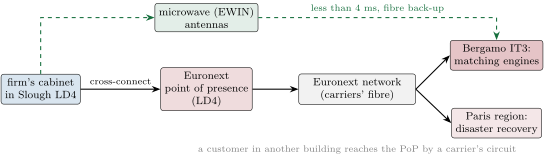
A point of presence (PoP) of a network is a place, usually racks in a carrier-neutral data centre, where the network’s owner (a venue, a carrier) accepts customers’ connections and carries their traffic to its own sites, so that a customer can reach a distant venue with a cross-connect in a building near it.
The three London sites are close: 44 kilometres from Slough to Docklands, 34 from Docklands to Basildon, 77 from Slough to Basildon, that is 147, 114 and of light in vacuum. Inside such a triangle a firm can serve all three venues from one building, with a few hundred microseconds of glass to each; the migration took one corner of it to Italy.
As of September 2026 — Who matches where in Europe
- Bergamo (Aruba Global Cloud Data Centre IT3, Via San Clemente 53, Ponte San Pietro): Euronext’s Core Data Centre since 6 June 2022, with its colocation, run by Euronext; the disaster-recovery site stays in the Paris region; London points of presence at InterXion and Slough LD4.
- Frankfurt (Equinix FR2, Kruppstrasse 121–127): the primary Eurex and Xetra back-ends and Deutsche Börse’s co-location.
- Zurich (Equinix ZH4, Josefstrasse 225): SIX Swiss Exchange’s co-location, managed by SIX; a SIX microwave network links ZH4 to FR2.
- London Docklands (Telehouse campus, Coriander Avenue): the London Stock Exchange Group’s primary data centre since the migration from the City.
- Basildon (ICE’s European Liquidity Centre): ICE Futures Europe; the street is from a directory and the site is approximate.
- Upplands Väsby (Smedbyvägen 6), 25 kilometres from Stockholm: Nasdaq’s Nordic primary data centre; its secondary moved to Equinix SK2, south of Stockholm, in 2025.
11.2 Frankfurt and Zurich
Deutsche Börse’s page is precise: the Equinix FR2 data centre in Frankfurt is the co-location data centre “in which the primary Eurex and Xetra back-ends are located”. Its co-location connections are 10 gigabits, with transaction and market data on separate connections so that they do not queue behind each other (chapter 1), priced by the month: 6 000 EUR for one Xetra market-data or order-entry connection, 8 400 for two market-data products together, and 400 EUR for its PTP time service. Chapter 9’s American fee schedules are filed with the SEC; the European ones are published as price lists, and they are just as volatile.
SIX runs its co-location in Equinix ZH4 in Zurich and publishes an average latency of for a co-located 10-gigabit connection to its matcher. It also runs a microwave network from ZH4 to FR2, at 10 megabits a second, with equal access for all trading participants: an exchange selling the corridor to a neighbouring market’s building, as Euronext does from London. Frankfurt and Zurich are apart, in vacuum and in straight fibre.
| From | To | Geodesic | Vacuum | Fibre |
| (km) | () | () | ||
| Slough LD4 | Frankfurt FR2 | 677.7 | 2 260.6 | 3 305.0 |
| Slough LD4 | Bergamo IT3 | 992.2 | 3 309.7 | 4 838.7 |
| Frankfurt FR2 | Bergamo IT3 | 497.6 | 1 659.9 | 2 426.8 |
| Slough LD4 | Basildon | 77.4 | 258.0 | 377.2 |
| Docklands | Basildon | 34.0 | 113.5 | 166.0 |
| Slough LD4 | Docklands | 44.0 | 146.9 | 214.8 |
| Basildon | Frankfurt FR2 | 603.2 | 2 012.2 | 2 941.8 |
| Basildon | Bergamo IT3 | 936.2 | 3 122.9 | 4 565.7 |
| Frankfurt FR2 | Zurich ZH4 | 306.7 | 1 023.1 | 1 495.8 |
| Zurich ZH4 | Bergamo IT3 | 204.5 | 682.2 | 997.4 |
| Frankfurt FR2 | Upplands Väsby | 1 195.0 | 3 986.0 | 5 827.6 |
| Slough LD4 | Upplands Väsby | 1 462.5 | 4 878.2 | 7 132.0 |
nw_europe.pair_rows().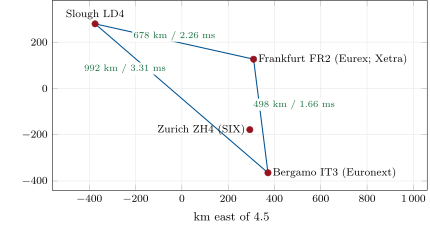
fig_europe.py on firm.geomap.11.3 The northern-Italy migration
Euronext’s frequently asked questions about the move, as it stood in November 2021, describe the old arrangement and the new one. Euronext relied on ICE’s Basildon data centre under a long-term service agreement; colocation was, in its press release’s word, “outsourced”. It chose a third-party building in Bergamo, in the country of Borsa Italiana, which it had just bought, to use the experience of the team that ran Borsa Italiana’s colocation. It kept its disaster-recovery site in the Paris region. It opened two points of presence in London, at InterXion and at Slough LD4, from which a client could reach Bergamo, the disaster-recovery site and Borsa Italiana’s Milan data centre, but not Basildon. And it opened the roof: wireless providers and trading firms could install antennas on a dedicated area of the roof, with Euronext guaranteeing equalisation from the back of the antenna to the meet-me room, the rule of chapter 9 applied to the air.
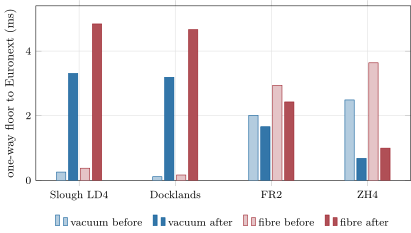
nw_europe.migration() on firm.venuesites.Figure 11.3 is the migration in numbers. From Slough the floor in vacuum went from to , more; in fibre from to , more. From Docklands, much the same. From Frankfurt the floor fell by (2.01 to ), and from Zurich by . The London firm that had traded Euronext’s markets against London’s, a few hundred microseconds apart, now trades them against each other from opposite ends of a three-millisecond corridor, and chooses where to put the servers that react to each.
def migration(from_sites=("ld4", "docklands", "fr2", "zh4")):
    reg = registry()
    old, new = reg.primary("XPAR", on=BEFORE), reg.primary("XPAR", on=AFTER)
    rows = []
    for f in from_sites:
        d0, d1 = distance(f, old, reg), distance(f, new, reg)
        rows.append({"from": f, "old": old, "new": new, "km_before": d0 / 1e3, "km_after": d1 / 1e3,
                     "vac_before": gm.floor_us(d0), "vac_after": gm.floor_us(d1),
                     "fib_before": gm.floor_us(d0, "fibre"), "fib_after": gm.floor_us(d1, "fibre")})
return rowsProposition 11.3 (Moving the engine moves the triangle)
Let a firm trade two venues at sites and from a third site . The time a signal takes from one venue to the other through the firm is at least divided by the speed of the medium, and at least over it along the direct route; the firm’s position matters only through the first sum, which is smallest when lies on the geodesic between and .
Proof. The triangle inequality for geodesics: , with equality exactly when lies on the shortest path between and . ∎
Before the migration, London, Frankfurt and Euronext formed a sliver: 678, 603 and 77 kilometres, with Euronext’s engine almost on top of London. After it, the triangle is wide: 678, 498 and 992 kilometres. A firm that relays between Frankfurt and Bergamo through London pays kilometres of path for a direct distance of 498; a firm that wants to be between Euronext and Eurex should sit on the Frankfurt–Bergamo line, which is where Zurich almost lies (307 plus 205 kilometres, 511 against 498).
11.4 The Nordics and the rest
Nasdaq’s Nordic primary data centre stands in Upplands Väsby, 25 kilometres north of Stockholm, and its secondary moved in 2025 to Equinix SK2, south of the city. It is from Slough ( in vacuum) and from Frankfurt: the farthest of the chapter’s sites from London, and a site to which chapters 22 and 23 return.
The rest of Europe follows the same pattern and the same method: each venue’s documents name a building, often in a carrier-neutral data centre in its own city; the registry holds one row per venue, role and period, with its source. Euronext’s 2024 release speaks of a single liquidity pool on one trading platform covering seven European markets, with its core data centre in Bergamo; the registry records there the six markets that the migration’s sources name, and leaves Borsa Italiana’s until a source dates its move.
    def rows(self, mic=None, role=None, on=None):
        keep = [r for r in self._rows if mic is None or r.mic == mic]
        return [r for r in keep if (role is None or r.role == role) and r.holds_on(on)]

    def primary(self, mic, on=None):
        found = {r.site for r in self.rows(mic, "primary", on)}
        if len(found) != 1:
            raise LookupError(f"{mic} on {on or 'today'}: {len(found)} primary sites")
        return found.pop()

    def venues_at(self, site_id, on=None):
        return sorted({r.mic for r in self.rows(role="primary", on=on) if r.site == site_id})

    def nearest(self, from_site, role="primary", on=None, medium="vacuum"):
        a = self.sites[from_site]
        out = []
        for r in self.rows(role=role, on=on):
            b = self.sites[r.site]
            d = gm.geodesic_m(a.lat, a.lon, b.lat, b.lon)
            out.append((r.mic, r.site, d / 1e3, gm.floor_us(d, medium)))
        return sorted(out, key=lambda x: (x[2], x[0]))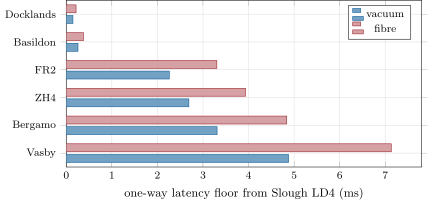
fig_europe.py, Registry.nearest from LD4.11.5 The London–Frankfurt corridor
Definition 11.4 (Latency corridor)
A latency corridor is a pair of trading sites between which several networks compete to carry latency-sensitive traffic, each selling its route by its one-way latency: London–Frankfurt, Chicago–New Jersey, Zurich–Frankfurt.
The corridor’s floor is set by the geodesic: from Slough LD4 to Frankfurt FR2, in air and in straight fibre. In March 2015 McKay Brothers announced a route between the two buildings at round trip, one way: a route factor of 1.026 in air, above the floor, over a path that must cross the English Channel. It was already a millisecond faster than straight glass could ever be.
| Microwave route | Geodesic | Published | Floor in | Route | Fibre floor |
| (km) | (ms) | air (ms) | factor | (ms) | |
| LD4 – FR2 (2015) | 677.7 | 2.32 | 2.261 | 1.026 | 3.305 |
| LD4 – Bergamo IT3 (2024) | 992.2 | 3.311 | 4.839 |
nw_europe.route_rows().The London–Bergamo corridor is Euronext’s own. Its EWIN service, launched in July 2024 with McKay Brothers, carries orders by microwave from LD4 to IT3 in “less than 4 milliseconds”, with full fibre back-up. The floor in air is , so the published bound allows a route factor of up to 1.21; straight fibre could not do better than . A published bound is not a measurement: it tells a firm what the venue will stand behind, and the firm measures the rest (chapter 15).
Remark 11.5 (Orders one way, data the other)
EWIN carries orders from London to Bergamo; the firm still needs Euronext’s market data in London, by fibre from the points of presence or by any other route it buys. A corridor is two races, one per direction, and a firm may buy them from different networks.
Method 11.6 (Adding a venue to the registry)
- Find the venue’s MIC in the ISO 10383 list, and its site in the venue’s own connectivity documents or filings.
- Add the building to the site table with its address source and geocode (chapter 10’s method), and a precision note if the geocode is only street-level.
- Add one registry row per role (primary, secondary, disaster recovery, point of presence, market-data distribution) with its source and the date read; a migration is two rows, the old one closed the day before the new one opens.
- Recompute distances and floors, and date the whole table: venues move, as Euronext and the London Stock Exchange did within a year.
    def holds_on(self, on):
        if on is None:
            return not self.valid_to
        started = not self.valid_from or self.valid_from <= on
return started and (not self.valid_to or on <= self.valid_to)11.6 Tutorial: the European registry
Goal. Extend the site table to Europe, build the venue-to-site registry, and measure Euronext’s migration. End state: Figures 11.1, 11.3 and 11.4 and Tables 11.1 and 11.2.
- Sites. Seven European rows in
data/networks/sites.csv, each with its ledger rows; three are street-level and say so. - Registry.
code/firm/venuesites/data/venue_sites.csv: one row per venue, role and period;Registry.load()refuses a row without a source, with an unknown site, or with its dates reversed. - The migration.
nw_europe.migration()(Listing 11.1) asks the registry for Euronext’s primary site on 5 and on 6 June 2022 and computes the floors;Registry.moveslists the move itself for XPAR. - Joining Book 1.
join_venuespairs the registry with One Quant Book 1’sfirm.venuessample by MIC, without editing it; MICs absent from the sample are skipped, not invented. - Figures.
python fig_europe.pywrites the map, the migration bars and the distances from LD4.
What to change next. Add Borsa Italiana’s Milan data centre and the Paris-region disaster-recovery site once their buildings are sourced; ask Registry.nearest from Frankfurt instead of Slough.
11.7 Build: the venue-to-site registry
Purpose. Which venue matches, keeps its disaster recovery, and accepts connections in which building, on which date, with sources: the input of the connectivity chapters 22 to 26 and of the plan of chapter 29.
Interface. firm_venuesites: VenueSite(mic, venue, role, site, valid_from, valid_to, source, as_of), Registry.load, rows(mic, role, on), primary(mic, on), venues_at(site, on), nearest(site, role, on, medium), moves(mic), stale(today, days), join_venues(registry, venues).
Rules. Every row has a source and a read date; every site is in firm.geomap’s table; a venue has exactly one primary site on any date or the query fails; Book 1’s registry is read, never edited.
Acceptance tests. code/firm/venuesites/tests/: the Euronext migration by date, the nearest venues from LD4 in order, the join with Book 1’s sample, and each malformed row refused.
Stretch. Read the site table and the registry from one versioned file with a history of changes; add each venue’s market-data distribution points and their multicast groups.
Sources and further reading
- Euronext, releases of 15 June 2022 (Core Data Centre migration) and 11 July 2024 (EWIN); Frequently Asked Questions about the Euronext Data Centre Migration, v6.1 (November 2021).
- Deutsche Börse, Xetra co-location services; SIX, co-location service fees (January 2026) and connectivity page; Nasdaq, Primary Datacenter Stockholm (Väsby) and the 2025 secondary-site notice; ICE, European Liquidity Centre operating policies; LSEG, Data Centre Migration plan (2022).
- McKay Brothers, release of 10 March 2015; ISO 10383 market identifier codes; site coordinates from OpenStreetMap Nominatim.
11.8 Exercises
Exercise 11.1 ★
By how much did the one-way floor in fibre from Slough LD4 to Euronext’s primary data centre change on 6 June 2022?
Solution
Solution of Exercise 11.1.
From (LD4 to Basildon, ) to (LD4 to Bergamo, ): more, one way.
Exercise 11.2 ★
McKay Brothers’ 2015 figure for LD4–FR2 was a round trip of . What is its route factor in air?
Solution
Solution of Exercise 11.2.
One way, ; the floor in air over is ; , above the floor, and under the straight-fibre floor.
Exercise 11.3 ★
What is the difference between a point of presence and colocation?
Solution
Solution of Exercise 11.3.
Colocation puts the firm’s equipment in the building where the venue matches, next to its engines; a point of presence is an access point of the venue’s network in another building, from which the venue’s network carries the firm’s traffic to the engines. The first saves the distance; the second only saves the firm from building its own long-distance link.
Exercise 11.4 ★★
Why did Euronext’s FAQ promise equalisation “from the back of the antenna to the Meet Me Room”? What would happen without it?
Solution
Solution of Exercise 11.4.
Antennas on a roof sit at different distances from the meet-me room, and the cable from each antenna to the room would otherwise give the nearest position an advantage of a few nanoseconds per metre (chapter 9). Equalising from the back of the antenna makes every wireless provider start the building’s race at the same point, which is what the equal-conditions rule of chapter 9 requires; without it, providers would compete for roof positions rather than for straighter routes.
Exercise 11.5 ★★
A firm relays signals between Eurex and Euronext. Compare the path through Slough with the path through Zurich, and with the direct one.
Solution
Solution of Exercise 11.5.
Through Slough: , in vacuum. Through Zurich: , . Direct: , . Zurich costs a detour, ; Slough more than triples the path.
Exercise 11.6 ★★
EWIN is published as “less than ”. What does that tell you, and what does it not?
Solution
Solution of Exercise 11.6.
It is an upper bound on a one-way time for orders from LD4 to IT3: the route factor in air is at most , at most above the floor, and at least better than straight glass could be. It does not give the typical figure, its distribution, the market-data direction, the behaviour in bad weather (the fibre back-up), or where exactly the clock starts and stops.
Exercise 11.7 ★★★
Coding. Add a row to the registry that gives Euronext Paris two primary sites on the same day, and ask for its primary site. What happens, and why is that the right behaviour?
Solution
Solution of Exercise 11.7.
Asking primary for XPAR on that day raises LookupError: the table gives two primary sites for that day. That is right: a venue matches in one place, so two rows mean the table is wrong (an overlap in dates, a missing end date), and a silent choice would put a wrong number into every floor computed from it.
Exercise 11.8 ★★★
Find the flaw. “Since the migration, London firms are three milliseconds behind Italian firms on Euronext, so London market makers cannot compete there.”
Solution
Solution of Exercise 11.8.
The race that matters for a market maker on Euronext is among the firms quoting there, and any firm can colocate in Bergamo, including a London firm. What the migration changed is the distance between Euronext and London’s other venues: a firm quoting Euronext from Bergamo is three milliseconds from its London hedges, and one quoting from London is three milliseconds from Euronext’s book. It must choose where each engine sits; it is not excluded.
11.9 Problem: Basildon to Bergamo
Problem 11.1
Weekend problem — what Euronext’s migration did to the map
A market maker quotes Euronext’s markets from Slough LD4 and hedges on Eurex in Frankfurt FR2. On 6 June 2022 Euronext’s Core Data Centre moves from Basildon to Bergamo.
Part I — Before.
- What were the geodesic distance and the one-way floors (vacuum, fibre) from LD4 to Basildon?
- From Basildon to FR2?
- What was the shape of the LD4–FR2–Euronext triangle?
- Where could the firm put one server to be near both Euronext and London’s other venues?
Part II — After.
- What are the distances and floors from LD4 to Bergamo, in vacuum and in fibre?
- By how much did each floor change?
- From FR2 to Bergamo, and by how much did that change?
- What is the triangle’s new shape?
Part III — The firm’s choices.
- The firm keeps its servers in LD4 and reaches Bergamo over fibre with a route factor of 1.2. What is its one-way latency?
- It buys EWIN instead. At most how long do its orders take, and what does it save against part III’s first answer?
- Should its quoting engine for Euronext’s markets move to Bergamo? What does it lose if it does?
- How far from the Frankfurt–Bergamo geodesic is Zurich, as a detour?
Part IV — The verdict.
- State the named result: the change in the one-way floor from LD4 to Euronext’s matching engines, and the new triangle.
- Why did Euronext open points of presence in London before the move?
- What does the registry record, and why two rows rather than an edited one?
- What other European move of 2022–2023 should the registry record?
- What does Proposition 11.3 say about where to put a relay between Eurex and Euronext?
- Which of the chapter’s sites are only street-level, and does it matter for the named result?
- What would a hollow-core fibre (chapter 13) change on the London–Bergamo corridor?
- In one sentence: what did the migration change for a London firm?
Solution
Solution of Problem 11.1.
Part I.
- : in vacuum, in straight fibre.
- : and .
- A sliver: 678, 603 and ; Euronext was almost in London.
- Anywhere in the London triangle, LD4 among them: a few hundred microseconds from Basildon, the Docklands and the London points of presence.
Part II.
- : in vacuum, in fibre.
- in vacuum and in fibre.
- , in vacuum: less than from Basildon ( less in fibre).
- Wide: 678, 498 and ; Frankfurt is now nearer to Euronext than London is.
Part III.
- .
- Less than : at least saved.
- For quoting Euronext’s book, yes: its cancels and requotes then travel metres, not a thousand kilometres, and Eurex is nearer to Bergamo () than to LD4 (). It loses nearness to London’s venues (about from Bergamo) and its London staff’s easy access; many firms run both.
- , of light in vacuum.
Part IV.
- Named result: the one-way floor from Slough LD4 to Euronext’s matching engines rose from to in vacuum () and from 0.38 to in fibre (); the London–Frankfurt–Euronext triangle went from 678, 603 and to 678, 498 and .
- So that London clients could connect to Bergamo, test and move before the cutover, without building their own links to Italy.
- Two rows, Basildon until 5 June 2022 and Bergamo from 6 June, each with its source: a query by date then gives the right answer for any day, and history is kept for backtests that must use the latencies of their own dates.
- The London Stock Exchange’s move from the City to the Docklands, planned for October 2022 and made in February 2023.
- That a relay should lie on or near the Frankfurt–Bergamo geodesic; Zurich costs , London .
- Basildon, Bergamo and Upplands Väsby. An error of a kilometre or two moves a floor by a few microseconds, against a change of three thousand: not for this result.
- A fibre whose light travels nearly as in air would bring the fibre floor close to the air floor, , removing most of microwave’s advantage on this corridor, with fibre’s bandwidth and weather-independence (chapter 13).
- It moved Euronext three milliseconds away and made the firm choose, engine by engine, between being near Euronext and being near London.
11.10 Interview questions
Interview question 11.1 ★ developer, trader
Where are the main European matching engines, and what is the London–Frankfurt latency floor?
Solution
Solution of Interview question 11.1.
Euronext in Bergamo (Aruba IT3), Eurex and Xetra in Frankfurt (Equinix FR2), the London Stock Exchange in the Docklands, ICE Futures Europe in Basildon, SIX in Zurich (ZH4), Nasdaq Nordic near Stockholm. London (Slough) to Frankfurt is about : one way in air, in straight fibre.
What the interviewer is looking for: Buildings rather than cities; the 2022 Euronext move; one-way floors in both media.
Interview question 11.2 ★ developer
What is a point of presence, and why would an exchange open one in another country?
Solution
Solution of Interview question 11.2.
An access point of the venue’s network in a building where its clients already are, so that they connect with a cross-connect and the venue carries the traffic to its engines. An exchange opens one abroad when its clients are there: Euronext opened two in London before moving to Italy.
What the interviewer is looking for: PoP against colocation; the venue’s network and its latency; resilience (two PoPs); the cross-connect.
Interview question 11.3 ★★ developer
How would you keep a table of which venue is in which data centre correct over time?
Solution
Solution of Interview question 11.3.
Keep it as data with a source and a read date per row, one row per venue, role and period; re-verify against the venues’ notices on a schedule; flag rows older than a limit; never overwrite a row when a venue moves, close it and add another.
What the interviewer is looking for: Provenance; history kept for backtests; automated staleness checks; subscription to venue notices.
Interview question 11.4 ★★ trader, developer
An exchange announces it will move its matching engine to another country. What do you do, and in what order?
Solution
Solution of Interview question 11.4.
Read the venue’s migration documents; compute the new floors from each of the firm’s sites; decide where each strategy’s engine should sit; order space, power and connectivity in the new building and links to it, with lead times; test in the venue’s rehearsals; plan the cutover weekend and the fallback; update the site registry and every latency assumption in research.
What the interviewer is looking for: Order of operations and lead times; the rehearsal; research assumptions updated, not just production.
Interview question 11.5 ★★ trader
Why do exchanges sell microwave links to their own data centres?
Solution
Solution of Interview question 11.5.
Because their clients are elsewhere and their own building’s appeal depends on how fast those clients can reach it; a venue-run microwave link with equal access (SIX from Zurich to Frankfurt, Euronext from London to Bergamo) sells speed under the venue’s fair-access rules and brings order flow.
What the interviewer is looking for: Fair access; revenue; competition with third-party networks; one direction or both.
Interview question 11.6 ★★★ developer, researcher
Where would you place servers to trade Eurex against Euronext, and how would you check the choice?
Solution
Solution of Interview question 11.6.
The floors say: near the Frankfurt–Bergamo line, or in one of the two buildings with a fast link to the other; Zurich is only off the direct line. Check with the registry and the geodesics, then with published routes and their route factors, and finally by measuring a candidate link with timestamped captures at both ends.
What the interviewer is looking for: Triangle inequality; which side’s latency matters more for the strategy; measurement, not only floors.