Networks, Hardware and Trading Infrastructure · Technology
9Colocation Products and How They Are Sold
European rules require a trading venue that sells co-location to give every user of the same service access to its network under the same conditions, and the rule’s list of conditions includes, between cooling and access to data, the length of the cable. In New Jersey, Nasdaq has told the SEC that it is rebuilding the cabling of its data-centre campus so that every telecom carrier’s connection reaches its customers over an equal distance, and it has named the work the “Equalization Project”. The customer whose cabinet stands next to the matching engine and the customer at the far end of the hall are meant to wait the same nanoseconds for the same bits, and where the room does not make the cables equal, a coil of fibre does.
Part III of this book is about where the exchanges are and what it costs to be near them. This chapter describes what a venue’s data centre sells and on what terms: space, power, cooling and hands; cross-connects and the meet-me room; the fairness rules; the connections into the venue’s own network; and the fee schedules, which in the United States are public filings.
9.1 What colocation sells: space, power, cooling and hands
Definition 9.1 (Colocation, proximity hosting)
Colocation is the rental of space, power and cooling for a customer’s equipment in the data centre that houses a trading venue’s matching engines, with connections to the venue’s network. Proximity hosting is the same service offered in a nearby data centre that the venue does not run, under an arrangement with the venue or with a third party.
Definition 9.2 (Colocation cabinet, colocation cage, power density)
A colocation cabinet is a lockable rack rented to one customer with a fixed allowance of power. A colocation cage is a fenced area of the hall rented to one customer, holding several cabinets and access controlled separately. The power density of a cabinet is the power, in kilowatts, it is allowed to draw; it sets its price as much as its space does.
A venue’s data centre is an industrial building. ICE’s Mahwah data centre, which houses the NYSE exchanges, is a building of 398 000 square feet on a 28-acre site 34 miles from Wall Street, with 28 megawatts of electrical power; its colocation cabinets come in 4, 8 and 12 kilowatts, scalable to 15, with partial cabinets of 1 to 2 kilowatts, each fed by two independent power circuits. Cabinets are sold by power density because power and the cooling that removes it are the building’s scarce resources: chapter 8’s arithmetic of servers per cabinet is the customer’s side of the same constraint.
Definition 9.3 (Remote hands)
Remote hands is the data-centre operator’s service of performing physical work on a customer’s equipment at its request (replacing a part, moving a cable, pressing a button), billed by the task or the hour, so that the customer need not send its own staff.
9.2 Cross-connects and the meet-me room
Definition 9.4 (Cross-connect, meet-me room)
A cross-connect is a cable, usually a pair of fibres, installed and managed by the data-centre operator between two points of its building: a customer’s cabinet and the venue’s network, another customer’s cabinet, or a telecom carrier’s equipment. A meet-me room (MMR) is the area of the building where telecom carriers terminate their networks and from which cross-connects run to customers.
Every connection that enters or crosses a colocation hall is a cross-connect that someone pays for each month. ICE’s operating policies for Mahwah are typical of the rules: carriers may only sit in the meet-me rooms, with at most 16 kilowatts each; they reach a customer only through a cross-connect, for which a monthly carrier connection fee is charged; and a customer trading on the venue must use the venue’s network, not a direct cross-connect to the venue’s systems. Nasdaq’s filings describe the same structure in Carteret: a carrier cage, a patch panel, cabling managed by the exchange to a distribution point, then to the customer’s cabinet, each piece “color-coded, inventoried, and auditable”.
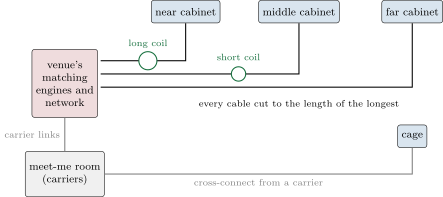
9.3 Equal cable lengths and the fairness rules
Definition 9.5 (Latency equalisation)
Latency equalisation is a venue’s practice of making every customer’s path to its systems equally long in time, whatever the customer’s position in the building, by cutting every connection to the length of the longest (coiling the surplus) or by adding delay to the shorter ones.
Proposition 9.6 (What a coil costs)
If the longest path to the venue’s network is metres of fibre of group index , a cabinet whose direct path would be metres waits more than it would without equalisation: about per metre for standard fibre.
Proof. Its cable is cut to length ; light covers the extra metres at . ∎
A cabinet 5 metres from the engine in a hall whose longest run is 150 metres therefore gives up , the price of fairness paid by the customer who would otherwise have won by standing close. The European rule makes the principle law for venues in its scope, adding that the venue must monitor “all connections and latency measurements” and must sell each co-location service on its own rather than in bundles. In the United States, colocation services are exchange services whose fees are filed with the SEC, and exchanges describe their equalisation in those filings. What equalisation removes is the race for the nearest rack; what it leaves is every other race: faster servers, faster switches, better code and, for firms that trade across venues, the routes between buildings of chapters 10 to 14.
9.4 Port speeds and connectivity products
A customer’s cabinet reaches the venue’s systems through the venue’s own network, over ports that the venue sells in several speeds and kinds: market-data ports and order-entry ports, one or ten or more gigabits, a standard network and, at some venues, a lower-latency one at a higher price, and connections to the venue’s disaster-recovery site (chapter 28). The price of a connection is set by filing, like the cabinet’s. The fastest product of Box 9.1, an options exchange’s 10-gigabit ultra-low-latency connection, costs ten times its 1-gigabit connection. Some venues also sell connectivity between data centres (the wireless links of chapter 14 among them), and the rule of equal conditions applies to what they sell within each product.
9.5 Fee schedules and how a footprint is bought
As of September 2026 — Colocation and connectivity fees, from exchange filings
Nasdaq’s filing of October 2024 set, for its NY11-4 expansion hall in Carteret, a monthly fee of 7 230 USD for an Ultra High Density Cabinet (above 10 and up to ), a cabinet installation fee of 5 940 USD (cabinet included), and power installation fees of 3 600 USD (single phase) and 4 560 USD (three phase); it described its existing monthly cabinet fees as ranging from about 475 to 916 USD per kilowatt, and its fee increase of November 2024 excluded the NY11-4 fees. Its 2026 filings extend the same installation fees to NY11-5 and list monthly power-circuit fees from 2 640 USD (single-phase, 20 A, 240 V) to 12 650.53 USD (three-phase, 32 A, 415 V). MIAX Pearl’s filing of May 2026 raised its monthly fee for a 10-gigabit ultra-low-latency connection to its primary and secondary facilities from 13 500 to 15 000 USD, for a 1-gigabit connection from 1 400 to 1 500 USD, and for a 10-gigabit connection to its disaster-recovery facility from 2 750 to 3 500 USD.
Method 9.7 (Buying a colocation footprint)
- Size the power first (chapter 8): the servers, switches, timing and capture that must be in the building, at their real draw.
- Choose cabinets by power density; a cage when the footprint is large or the firm wants its own access control.
- List the connections: the venue’s market-data and order-entry ports, cross-connects to carriers for the firm’s own links, and the disaster-recovery connections the venue requires.
- Price it from the venue’s current fee schedule, one-time and monthly, and amortise the one-time fees over the contract’s term.
- Read the venue’s operating policies: what may be cross-connected to what, who may enter, remote-hands rates, notice periods.
- Plan the lead times: cabinets, power and cross-connects take weeks to deliver, and the venue’s certification of a new connection takes its own.
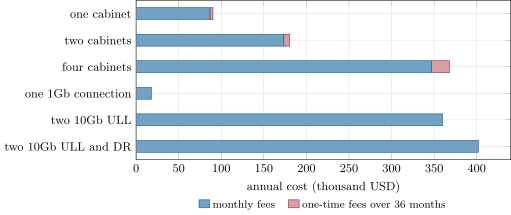
fig_colo.py on firm.colobill.The chart shows where the money goes. A cabinet at Nasdaq costs about 90 000 USD a year once its installation is spread over three years; two ultra-low-latency connections to an options exchange cost 360 000 USD a year, with nothing to install. The building is the cheap part; the venue’s fastest connections are not, and a firm pays for them at every venue it trades.
def bill(schedule, footprint, term_months=36):
    lines, monthly, one_time = [], 0.0, 0.0
    for key, qty in footprint:
        it = schedule.items[key]
        lines.append((it.name, qty, qty * it.monthly, qty * it.one_time))
        monthly += qty * it.monthly
        one_time += qty * it.one_time
    amort = one_time / term_months
    return {"monthly": monthly, "one_time": one_time, "amortised": amort, "total_monthly": monthly + amort,
            "annual": 12 * (monthly + amort), "lines": lines}


def stale(schedule, today, days=60):
    t = dt.date.fromisoformat(today)
    return [k for k, it in schedule.items.items() if (t - dt.date.fromisoformat(it.as_of)).days > days]
9.6 Tutorial: pricing a footprint
Goal. Turn two venues’ published fees into data, price six footprints and a firm’s, and compute what equalisation costs a near cabinet. End state: Figure 9.2, the firm’s bill of the problem, and the coil arithmetic.
- Schedules.
firm.colobill.SCHEDULESholds each fee with the ledger row that sources it and the date it was read. - Footprints.
nw_colo.FOOTPRINTSlists items and quantities;bills()prices them (Listing 9.1) andpython fig_colo.pywrites the chart’s data. - Staleness.
stale(schedule, today)lists the fees older than 60 days: the dated box’s rule, enforced in code. - The coil.
coil(distances, longest)evaluates Proposition 9.6.
What to change next. Add a third schedule from another venue’s filing and price the same footprint there; change the term to 60 months and see how little the one-time fees then weigh.
9.7 Build: the colocation bill
Purpose. The firm’s colocation and connectivity costs computed from published schedules, with provenance and dates, for chapter 29’s annual budget.
Interface. firm_colobill: Item(name, monthly, one_time, unit, source, as_of), Schedule(venue, currency, items), SCHEDULES, bill(schedule, footprint, term_months), stale(schedule, today, days), break_even, equalisation_ns.
Rules. Every fee names its ledger row and date; one-time fees are amortised over a stated term; an unknown item is an error, not a zero; a fee older than 60 days is reported as stale.
Acceptance tests. code/firm/colobill/tests/: a bill’s arithmetic by hand, staleness at two dates, break-even, the coil, and an unknown item refused.
Stretch. Read a schedule from a filing’s text; add tiered fees (a price that falls with the number of connections).
Sources and further reading
- Commission Delegated Regulation (EU) 2017/573 (RTS 10), article 1.
- SEC Releases 34-101267 (Nasdaq, SR-NASDAQ-2024-056) and 34-105010 (Nasdaq ISE, SR-ISE-2026-09); Federal Register documents 2024-27759, 2026-06357 (Nasdaq) and 2026-10452 (MIAX Pearl).
- ICE, ICE Global Network & Colocation Technical Specifications and Mahwah Operating Policies.
9.8 Exercises
Exercise 9.1 ★
The longest cable in a hall is 120 metres. What delay does equalisation add to a cabinet whose direct path would be 30 metres?
Solution
Solution of Exercise 9.1.
.
Exercise 9.2 ★
From Box 9.1, what does one NY11-4 Ultra High Density Cabinet cost per kilowatt a month at 10 and at ?
Solution
Solution of Exercise 9.2.
USD per kilowatt a month at , USD at : the filing’s own figures.
Exercise 9.3 ★
What did MIAX Pearl’s May 2026 filing do to the annual cost of two 10-gigabit ultra-low-latency connections?
Solution
Solution of Exercise 9.3.
It raised it by USD, from 324 000 to 360 000 USD a year.
Exercise 9.4 ★★
Why does a venue sell cabinets by power density rather than by rack units?
Solution
Solution of Exercise 9.4.
Power, and the cooling that removes it, are the building’s scarce and expensive resources; a cabinet’s cost to the operator is mostly the power and cooling capacity it reserves, which the rack units do not measure.
Exercise 9.5 ★★
A firm proposes to cross-connect its cabinet directly to another firm’s cabinet in Mahwah to send it orders. What do ICE’s operating policies say, and why do venues write such rules?
Solution
Solution of Exercise 9.5.
They forbid a direct cross-connect between participants that could result in a trade inside the building, and require trading on an authorised venue to go through the venue’s network. Venues write such rules so that trading happens on regulated venues, under their surveillance and fairness rules, and so that no private link inside the building bypasses them.
Exercise 9.6 ★★
Equalisation removes the race for the nearest cabinet. Name three races it leaves.
Solution
Solution of Exercise 9.6.
Faster servers and code inside the cabinet; faster devices and fewer hops inside the firm’s own cage; faster links between buildings for firms trading across venues (and faster venue connection products, where a venue sells more than one class).
Exercise 9.7 ★★★
Coding. With firm.colobill, price four NY11-4 cabinets with installation, three-phase power and PDUs over 36 and over 60 months. By how much does the longer term lower the annual cost?
Solution
Solution of Exercise 9.7.
368 053 USD a year over 36 months, 359 648 USD over 60: 8 405 USD less, because the 63 040 USD of one-time fees weigh less per month.
Exercise 9.8 ★★★
Find the flaw. “The venue equalises cable lengths, so every colocated firm sees market data at the same time.”
Solution
Solution of Exercise 9.8.
Equal cable lengths equalise the venue’s side only: each firm’s own switches, cards, servers and software still differ, and firms taking different products (a standard or a lower-latency network, different port speeds) are equal only within each product.
9.9 Problem: The Cage That Paid for Itself
Problem 9.1
Weekend problem — a footprint, its bill and its break-even
A market-making firm colocates two Ultra High Density Cabinets in Nasdaq’s NY11-4 hall (each with installation and three-phase power) and buys two 10-gigabit ultra-low-latency connections to an options exchange at MIAX Pearl’s fee. It amortises one-time fees over 36 months and trades 50 000 contracts a day, 20 days a month.
Part I — The bill.
- What are the monthly fees of the two cabinets?
- What are the one-time fees, and their monthly amortisation?
- What do the two connections cost a month?
- What is the footprint’s total monthly cost, and its annual cost?
Part II — The break-even.
- How many contracts does the firm trade a month?
- What must each contract earn, net of every other cost, to pay for the footprint?
- What if volume halves?
- Which line of the bill would you cut first if it did?
Part III — Fairness and position.
- The firm’s cabinet is 10 metres from the venue’s network and the longest run is 150 metres. What does equalisation cost it?
- Why may the firm not buy a shorter cable?
- What does the European rule add to that?
- What does the firm get for its 15 000 USD a month per connection that a 1-gigabit connection does not give?
Part IV — The verdict.
- State the named result: the footprint’s monthly all-in cost and the break-even per contract.
- Over three years, how much of the total is one-time fees?
- How often must the fee schedule be re-read, and why?
- What else goes into the footprint that the schedules do not show?
- How would the bill change at a venue whose connections are cheaper but whose cabinets cost more?
- Why is the connection, not the cabinet, the expensive part?
- What would you negotiate, and with whom (One Quant Book 16, chapter 23)?
- In one sentence: what does a colocation footprint buy?
Solution
Solution of Problem 9.1.
- USD.
- USD, about 583 USD a month over 36 months.
- USD.
- USD a month, 540 520 USD a year.
- contracts.
- About 0.045 USD per contract.
- About 0.09 USD per contract: the footprint’s cost is fixed.
- The connections: 30 000 of the 45 043 USD; one connection instead of two, if the firm accepts the loss of redundancy.
- .
- The venue cuts every connection to the same length; buying a shorter one would give it an advantage the fairness rules forbid.
- That the same conditions (space, power, cooling, cable length, connectivity) apply to all users of the same service, that latency is monitored, and that services are sold unbundled.
- The venue’s lower-latency network and a 10-gigabit port for bursts (chapter 1), as a product sold equally to all who buy it.
- Named result. About 45 043 USD a month all in, 0.045 USD per contract at 50 000 contracts a day.
- : 1.3%.
- At least every 60 days and after every fee filing: fees change by filing, and U.S. exchanges file often.
- The firm’s own equipment, market-data fees, cross-connects to carriers, remote hands, and the disaster-recovery site’s footprint (chapter 28).
- The total would shift toward space and power; the break-even rises or falls with the sum, not with any line.
- Connectivity into the venue is a product only the venue sells, priced by filing on the value of speed; space and power are commodities.
- Volume-linked tiers and incentive programmes with the venue, carrier and cross-connect prices with the data-centre operator, and the term of the contract.
- Proximity on equal terms: the right to be in the building, on the same cable as everyone else, at a price.
9.10 Interview questions
Interview question 9.1 ★ developer, trader
What is colocation, and what does a firm actually pay for?
Solution
Solution of Interview question 9.1.
Space for equipment in the venue’s data centre, power and cooling for it, cross-connects to the venue’s network and to carriers, the venue’s market-data and order-entry ports, and services such as remote hands; most of the cost is power and the venue’s connectivity products.
What the interviewer is looking for: power and connectivity as the real costs.
Interview question 9.2 ★★ developer
What is a cross-connect and what is a meet-me room? How does a carrier’s circuit reach your cabinet?
Solution
Solution of Interview question 9.2.
A cross-connect is an operator-installed cable between two points of the building; the meet-me room is where carriers terminate. A carrier’s circuit ends on its equipment in the meet-me room, and a cross-connect (often through a patch panel and a distribution point) carries it to the customer’s cabinet.
What the interviewer is looking for: the physical path and who manages it.
Interview question 9.3 ★★ trader, developer
Why do venues equalise cable lengths, and what advantage remains for a colocated firm?
Solution
Solution of Interview question 9.3.
To give every customer of the same service the same latency to the venue, as fairness rules require. What remains is everything outside the venue’s cable: the firm’s own hardware and software, its choice of connectivity products, and its links between venues.
What the interviewer is looking for: equal on the venue’s side, competition everywhere else.
Interview question 9.4 ★★ developer
You are moving into a venue’s data centre in three months. What do you order, in what order?
Solution
Solution of Interview question 9.4.
Power and cabinet space first (long lead times), then cross-connects and the venue’s ports, the carriers’ circuits for the firm’s own links, timing (an antenna feed or the operator’s service), then the equipment, installation by remote hands or the firm’s staff, and the venue’s certification of the new connections.
What the interviewer is looking for: lead times and dependencies in the right order.
Interview question 9.5 ★★★ trader
How would you decide whether a colocation footprint at a venue pays for itself?
Solution
Solution of Interview question 9.5.
Price the footprint all in, from the current schedules, with one-time fees amortised; compare it with the strategy’s expected net edge per unit times its volume at that venue, with and without the latency the footprint buys; include the cost of its disaster-recovery twin.
What the interviewer is looking for: a break-even per unit traded, and the counterfactual without colocation.
Interview question 9.6 ★★ developer
Where do you find a U.S. exchange’s colocation fees, and how do you know they are current?
Solution
Solution of Interview question 9.6.
In the exchange’s fee schedule in its rulebook, and in the rule filings that change it, published by the SEC and in the Federal Register; check the filing dates and re-read after every filing.
What the interviewer is looking for: public filings and a date on every figure.