Markets III: Commodities, Energy and Crypto · Markets
13Getting Access: Commodities and Power
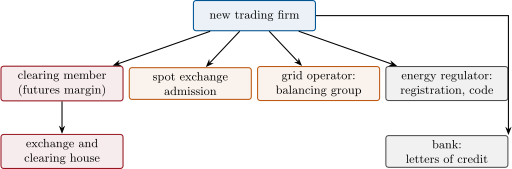
A new trading firm wants to trade German power spreads. Before its first order it needs a clearing member that will accept its exchange trades and post its margin, an admission to the spot exchange, a balancing-group contract with a grid operator if it will ever hold physical power at delivery, a registration with an energy regulator that gives it the identifier it must put on every reported trade, and, for each physical counterparty that will not trade on credit, a letter of credit from a bank. Each of these takes weeks, some months, and most of them take collateral. This chapter, the last of the commodities part, covers the access layer of commodity and power markets: exchange and clearing membership, the metal exchange’s categories, balancing groups and nominations, the credit and trade finance of physical trade, and the registrations and exemptions a firm needs before it trades.
13.1 Exchanges and clearing for commodity futures
Commodity futures clear like other futures (One Quant Book 1, chapters 5 and 30): a firm either becomes a clearing member of the clearing house, which few new firms can, or trades through a clearing member (in the United States, a futures commission merchant) that stands between it and the clearing house and posts its margin.
Definition 13.1 (Designated contract market)
A designated contract market (DCM) is a board of trade registered with the US Commodity Futures Trading Commission under section 5 of the Commodity Exchange Act, which may list futures and options on any commodity for all types of traders, including retail.
Access to a commodity exchange is the same as to any futures exchange, with two additions: position limits and the physical delivery at expiry. A firm that holds positions near expiry must either be able to make or take delivery (a pipeline account at Cushing, a warehouse account, a balancing group) or close before the delivery period; its clearing member will insist on one or the other.
Definition 13.2 (Accountability level)
An accountability level is a position size set by an exchange above which a trader must, on request, explain its position and its purpose, and may be told not to increase it; unlike a position limit (One Quant Book 1, chapter 27), it is not a hard cap.
As of September 2026 — US position limits
The Commodity Futures Trading Commission’s position-limits rule, published on 14 January 2021 and effective on 15 March 2021, sets federal spot-month limits (at or below 25% of deliverable supply) on 25 core referenced futures contracts in agricultural, metal and energy commodities and their economically equivalent swaps; exchanges set limits or accountability levels on other contracts and outside the spot month.
13.2 The metal exchange’s membership categories
The London Metal Exchange is the one commodity exchange whose membership categories a trader must know by name, because they decide who may trade in its open-outcry ring, who may issue its contracts and who may deal with clients.
Definition 13.3 (Ring dealing member)
A ring dealing member (Category 1) of the London Metal Exchange may trade in the Ring, where the official prices are set, issue LME contracts to clients and clear them.
As of September 2026 — LME categories
| Category | Name | May | Minimum net worth |
|---|---|---|---|
| 1 | Ring dealing | trade in the Ring, issue contracts, clear | GBP 5 million |
| 2 | Associate broker clearing | issue contracts, clear | GBP 5 million |
| 3 | Associate trade clearing | clear its own trades with 1, 2 or 4 | GBP 2.5 million |
| 4 | Associate broker | issue contracts | GBP 5 million |
| 5 | Associate trade / client | association only | — |
Annual subscriptions in the published schedule: GBP 55 000 for categories 1 and 2, GBP 45 000 for category 4 and GBP 19 000 for category 3.
13.3 Balancing groups and nominations
Physical power and gas are delivered through networks, and the network operator must know, for every market time unit, who will put energy in and who will take it out.
Definition 13.4 (Balancing group, schedule nomination)
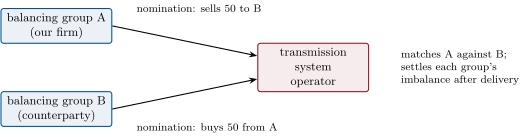
A balancing group is a virtual account with a transmission system operator that aggregates a set of injection and withdrawal points and the group’s trades with other groups, and whose net position the operator settles as the group’s imbalance; its balancing responsible party (Chapter 6) signs the contract. A schedule nomination is the group’s declaration to the operator, before a deadline, of its planned injections, withdrawals and trades with other groups for each market time unit.
Method 13.5 (Building a balanced nomination)
For each MTU: (i) sum the group’s forecast injections and withdrawals; (ii) add every trade with another group, positive for purchases; (iii) check that the net is zero, and trade (intraday) or adjust forecasts until it is; (iv) check that every trade matches the counterparty group’s opposite nomination; (v) submit before the deadline, and resubmit as intraday trades change the schedule.
As of September 2026 — Germany’s standard balancing group contract
The Bundesnetzagentur’s standard contract (version BK6-23-102 of 23 November 2023) makes the group’s manager responsible for a balanced quarter-hourly account. Day-ahead schedules reach the transmission operator by 14:30 the day before; within Germany, intraday schedules can change up to a quarter-hour before delivery, and may be temporarily unbalanced by up to 10% of the group’s declared maximum export, at most 50 MW in the last two hours.
13.4 Physical logistics: credit lines, letters of credit and trade finance
Physical commodities are paid for after delivery, often thirty days after the bill of lading (Chapter 1). Between delivery and payment the seller is a lender to the buyer.
Definition 13.6 (Letter of credit)
A letter of credit is an undertaking by a bank, issued at the request of a buyer, to pay the seller a stated amount when the seller presents documents that conform to its terms (the bill of lading, invoices, inspection certificates): it replaces the buyer’s credit by the bank’s.
Definition 13.7 (Trade finance)
Trade finance is the bank credit that funds physical commodity trade: letters of credit, borrowing against specific cargoes or inventory, and the credit facilities from which trading houses draw them.
Example 13.8 (What a letter of credit must cover)
A seller has delivered EUR 3 million of energy not yet paid, and the remaining deliveries under its contract would cost EUR 1 million less to replace today than their contract price, so the buyer’s default would cost the seller nothing on them. With a letter of credit of EUR 2 million, EUR 1 million is uncovered. Had the replacement cost been EUR 0.5 million more than the contract price, the uncovered exposure would be EUR 1.5 million.
13.5 Licences and registrations before the first trade
A paper trader that moves into physical energy meets regulation that applies to the commodity, not to the instrument.
Definition 13.9 (REMIT)
REMIT is the European Union’s regulation on wholesale energy market integrity and transparency (Regulation (EU) No 1227/2011): it prohibits insider trading and manipulation in wholesale electricity and gas markets and requires market participants to register with a national regulator, which gives them an identifier (the ACER code), and to report their transactions and inside information.
Definition 13.10 (Ancillary activity exemption)
The ancillary activity exemption lets a firm deal on its own account in commodity derivatives or emission allowances without authorisation as an investment firm under the European Union’s markets-in-financial-instruments rules, provided that the activity is ancillary to a main business, at group level, that is neither investment services nor banking.
Definition 13.11 (Market-based rate authorisation)
Market-based rate authorisation is the permission by the US Federal Energy Regulatory Commission for a seller to make wholesale sales of electric energy, capacity and ancillary services at negotiated prices, granted to sellers that show they and their affiliates lack, or have mitigated, market power.
As of September 2026 — European registrations
REMIT II (Regulation (EU) 2024/1106) extends reporting to storage and balancing contracts and to products with potential delivery in the Union, requires market participants established outside the Union to designate a representative in it, and makes LNG data reporting permanent; its new implementing regulation applies from 29 April 2026. The criteria of the ancillary activity exemption are set by Delegated Regulation (EU) 2021/1833, applicable since 9 November 2021, without an annual notification.
13.6 Tutorial: nominations and the cost of access
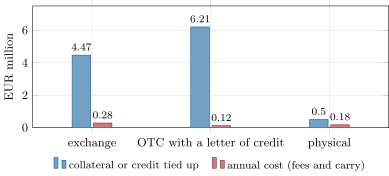
Goal. Build and check a balancing group’s nominations, then compare the collateral and annual cost of three routes into a power market. End state: Figure 13.3 and the numbers of the weekend problem.
Nominations. A group’s per-MTU net and the matching of trades with a counterparty group.
@dataclass
class Nomination:
    group: str
    injections: dict[int, float] = field(default_factory=lambda: defaultdict(float))
    withdrawals: dict[int, float] = field(default_factory=lambda: defaultdict(float))
    trades: dict[tuple[int, str], float] = field(default_factory=lambda: defaultdict(float))   # + bought from

    def add_trade(self, mtu: int, counterparty: str, qty: float) -> None:
        if counterparty == self.group:
            raise ValueError("a group cannot trade with itself")
        self.trades[(mtu, counterparty)] += qty

    def net(self, mtu: int) -> float:
        """Injections + purchases - withdrawals - sales: zero for a balanced schedule."""
        traded = sum(q for (m, _), q in self.trades.items() if m == mtu)
        return self.injections[mtu] + traded - self.withdrawals[mtu]

    def unbalanced(self, mtus: range, tol: float = 1e-6) -> dict[int, float]:
        return {m: self.net(m) for m in mtus if abs(self.net(m)) > tol}


def counterparty_mismatches(a: Nomination, b: Nomination, mtus: range) -> dict[int, float]:
    """MTUs in which what A says it trades with B is not the opposite of what B says it trades with A."""
    out = {}
    for m in mtus:
        diff = a.trades.get((m, b.group), 0.0) + b.trades.get((m, a.group), 0.0)
        if abs(diff) > 1e-6:
            out[m] = diff
    return out
Listing 13.1. A balancing group’s nomination, its balance and counterparty matching. code/firm/nominate/firm_nominate.py Deadlines and credit.
def in_time(submitted: dt.datetime, delivery_day: dt.date, deadline: dt.time, days_before: int = 1) -> bool:
    """Whether a nomination was submitted before its deadline on the day(s) before delivery."""
    cutoff = dt.datetime.combine(delivery_day - dt.timedelta(days=days_before), deadline)
    return submitted <= cutoff


def uncovered_exposure(unpaid_deliveries: float, forward_mtm: float, letter_of_credit: float) -> float:
    """Credit exposure to a physical counterparty not covered by its letter of credit: energy delivered
    and not yet paid, plus the replacement value of future deliveries if positive to us."""
    return max(unpaid_deliveries + max(forward_mtm, 0.0) - letter_of_credit, 0.0)


def carry_cost(collateral: float, rate: float, years: float = 1.0) -> float:
    """Cost of funding posted collateral (simple interest)."""
    return collateral * rate * years
Listing 13.2. Deadlines, uncovered credit exposure and the carry of collateral. code/firm/nominate/firm_nominate.py - Run
m3_access.routes(),first_trade()andfig_access.py.
What to change next. Double the margin rate for a volatile winter and see which route wins; add the imbalance cost of Chapter 6 to the physical route.
13.7 Build: nominations and physical credit
Purpose. The miniature firm’s physical power book must produce correct, balanced, matched nominations before every deadline, and know how much of its physical credit is covered.
Interface. Nomination(group).add_trade(mtu, counterparty, qty), .net(mtu), .unbalanced(mtus); counterparty_mismatches(a, b, mtus); in_time(submitted, delivery_day, deadline); uncovered_exposure(unpaid, forward_mtm, lc); carry_cost.
Rules. A group cannot trade with itself; a nomination is balanced within a tolerance; matching is per MTU and counterparty; exposure counts only positive replacement values.
Acceptance tests. code/firm/nominate/tests/: an unbalanced MTU found; a mismatch found; deadlines; uncovered exposure; the carry of collateral.
Stretch. Build nominations from firm.balancing (Chapter 6); the operator’s message formats; gas nominations by gas day (Chapter 4).
Sources and further reading
- CFTC, Designated Contract Markets; Federal Register, Position Limits for Derivatives, 14 January 2021.
- London Metal Exchange membership guide (CFTC-hosted copy) and Become a member.
- Regulation (EU) No 1227/2011 (REMIT) and Regulation (EU) 2024/1106 (REMIT II); Baker McKenzie, “REMIT II explained”, April 2026.
- Commission Delegated Regulation (EU) 2021/1833 (ancillary activity criteria).
- Federal Energy Regulatory Commission, electric market-based rates and 18 CFR Part 35, subpart H.
- Bundesnetzagentur, Bilanzkreisvertrag Strom (standard balancing group contract), BK6-23-102, 23 November 2023, as published by 50Hertz.
13.8 Exercises
Exercise 13.1 ★
How many MWh is 50 MW baseload for a year of 8 760 hours, and what is its notional at ?
Solution
Solution of Exercise 13.1.
MWh; at , EUR 37.23 million.
Exercise 13.2 ★
What is the difference between an accountability level and a position limit?
Solution
Solution of Exercise 13.2.
A position limit is a hard cap; an accountability level is a threshold above which the exchange may ask for explanations and order the trader not to increase the position.
Exercise 13.3 ★
Which LME category may trade in the Ring, and which may clear only its own trades?
Solution
Solution of Exercise 13.3.
Category 1 (ring dealing) may trade in the Ring; category 3 (associate trade clearing) clears its own trades and deals only with categories 1, 2 and 4.
Exercise 13.4 ★★
A group forecasts 120 MWh of injection and 30 of withdrawal in an MTU and has sold 80 to another group. Is it balanced? What must it do?
Solution
Solution of Exercise 13.4.
Net MWh: it is 10 long. It must sell 10 MWh more (intraday) or revise its forecast before the deadline; otherwise it will be settled as a long imbalance.
Exercise 13.5 ★★
Compute the uncovered exposure of Example 13.8 in both cases.
Solution
Solution of Exercise 13.5.
First case: EUR 1 million. Second: EUR 1.5 million.
Exercise 13.6 ★★
Why might a trading firm that only trades exchange futures still need a REMIT registration?
Solution
Solution of Exercise 13.6.
REMIT covers wholesale energy products, including derivatives on electricity and gas traded on organised markets; the firm is a market participant that must register and report unless it trades only products outside its scope.
Exercise 13.7 ★★★
Coding. With routes, give each route’s collateral and annual cost for 50 MW, and the margin rate at which the exchange route costs as much a year as the OTC route.
Solution
Solution of Exercise 13.7.
Exchange: EUR 4.47 million of collateral, EUR 0.283 million a year; OTC: EUR 6.21 million of credit, EUR 0.118 million; physical: EUR 0.5 million, EUR 0.175 million. The exchange route costs as much as the OTC route when : a margin rate of 3.1%.
Exercise 13.8 ★★★
Find the flaw. “We hedge our physical sales with exchange futures, so we do not need letters of credit from our buyers.”
Solution
Solution of Exercise 13.8.
Futures hedge the price, not the buyer’s credit: if the buyer defaults after taking delivery, the firm loses the unpaid energy and must replace the future deliveries at market prices while its futures hedge moves the other way. Credit and price are separate risks.
13.9 Problem: First Trade in German Power
Problem 13.1
Weekend problem — what a new entrant posts before trading
A new firm will buy 50 MW of German baseload for next year on the exchange and sell the same power to an industrial buyer under a physical contract, as a balancing responsible party. Take the illustrative inputs of the chapter: , 12% initial margin, a EUR 500 000 balancing-group security, a letter of credit covering two months of deliveries at 1.5% a year, and a 5% funding rate.
Part I — The position.
- What volume and notional does the firm trade?
- What initial margin does the exchange leg require?
- Why does the physical leg need a balancing group?
- What letter of credit does the firm require from its buyer, and why two months?
- Who pays for that letter of credit?
Part II — The collateral.
- Give the total collateral and credit tied up.
- Give its annual carrying cost.
- What happens to the margin if prices double?
- Why is the letter of credit not collateral posted by the firm?
- What else must be in place before the first nomination?
Part III — The regulation.
- Which registration does REMIT require, and what does it give the firm?
- Does the firm need authorisation as an investment firm?
- What changes if the firm is established outside the Union?
- Which transactions must it report?
- What position rules apply to the exchange leg?
Part IV — Judgement.
- Which route would you choose for a first year, and why?
- Where is the firm’s largest risk in the first month?
- What would a bank ask before issuing credit lines to the firm?
- State the named result: the collateral and credit the firm ties up before its first trade, and its annual carry.
- In one sentence: what does access to a physical market cost?
Solution
Solution of Problem 13.1.
1. 438 000 MWh, EUR 37.23 million. 2. EUR 4.47 million. 3. Physical delivery through the grid must be scheduled and its imbalances settled by a responsible party. 4. EUR 6.21 million: payment follows delivery, and two months covers a billing cycle plus the time to stop deliveries and replace the buyer. 5. The buyer, whose bank issues it for a fee (about EUR 93 000 a year at 1.5%). 6. The firm posts EUR 4.97 million (margin and security); its buyer’s bank adds EUR 6.21 million of credit. 7. EUR 248 380 at 5%. 8. It roughly doubles, since the margin rate applies to a larger notional, and variation margin flows with the price in between. 9. It is a bank’s promise to pay the firm, obtained by the buyer, not cash the firm has posted. 10. The balancing-group contract, a metering and scheduling system, nomination procedures with the operator, and the regulator’s registration. 11. Registration with a national regulator, which assigns an ACER code to put on its transaction reports. 12. Not if its commodity dealing is ancillary to a main business that is neither investment services nor banking and meets the delegated regulation’s tests; a pure trading firm must check this. 13. It must designate a representative in the Union and register in a member state where it is active. 14. Its wholesale energy contracts, including exchange trades (usually reported for it by the exchange) and bilateral physical contracts. 15. The exchange’s position limits or accountability levels. 16. The exchange route: collateral is cash but the operations are simplest; physical balancing can come once systems and staff are in place. 17. Liquidity: margin calls if prices move, before any revenue from the physical sale. 18. Capital, ownership and management, risk controls, the trading plan and its limits, and the collateral it can post. 19. Named result: EUR 4.97 million posted by the firm (EUR 4.47 million of margin and EUR 0.5 million of security), EUR 6.21 million of credit from the buyer’s bank, and EUR 248 380 a year of carry. 20. Collateral, credit and compliance before any price risk is taken.
13.10 Interview questions
Interview question 13.1 ★ trader
What is a balancing group, and what does it cost to run one?
Solution
Solution of Interview question 13.1.
A virtual account with the grid operator that aggregates a portfolio’s injections, withdrawals and trades and is settled for its imbalances. Costs: security or guarantees, scheduling systems and staff working to deadlines, imbalance costs, and fees.
What the interviewer is looking for: operational and financial costs, not only the definition.
Interview question 13.2 ★ trader, bank
How does a letter of credit protect a seller of a physical cargo?
Solution
Solution of Interview question 13.2.
The buyer’s bank undertakes to pay against conforming documents: the seller’s credit risk moves from the buyer to the bank, and payment does not depend on the buyer’s cooperation once documents are presented.
What the interviewer is looking for: documentary payment and the substitution of credit.
Interview question 13.3 ★★ risk
Compare the liquidity risk of hedging physical power with exchange futures and with OTC forwards.
Solution
Solution of Interview question 13.3.
Futures: daily variation margin in cash and initial margin that rises with volatility, so large moves drain liquidity before the physical position pays. OTC forwards: collateral under credit support agreements (or none), more credit risk and less liquidity drain. The 2022 energy crisis showed the futures route’s cash risk.
What the interviewer is looking for: cash margin against credit risk.
Interview question 13.4 ★★ trader
What must a firm have in place before it can hold an LME position through the prompt date?
Solution
Solution of Interview question 13.4.
A clearing relationship that will deliver and receive warrants, a warehouse or warrant account, cash to pay for metal it takes, and a plan for lending if it holds a dominant position.
What the interviewer is looking for: the physical settlement chain behind the contract.
Interview question 13.5 ★★ risk, bank
What regulatory registrations does a hedge fund need before trading European gas and power?
Solution
Solution of Interview question 13.5.
REMIT registration (and ACER code) with a national regulator, transaction reporting arrangements, a check of authorisation needs under MiFID II (the ancillary activity exemption rarely fits a fund), exchange and clearing agreements, and, for physical trading, balancing-group and network contracts.
What the interviewer is looking for: REMIT, MiFID II status, and the physical layer.
Interview question 13.6 ★★★ developer
Design the nomination system of a power trading firm with three balancing groups in two countries.
Solution
Solution of Interview question 13.6.
A position store by group, zone and MTU fed by all trade capture; forecast inputs; a nomination builder that balances and matches per counterparty; validation against deadlines and operator formats; submission with acknowledgement tracking and automatic resubmission after intraday trades; reconciliation with the operator’s matched schedules and with imbalance settlements.
What the interviewer is looking for: balancing, matching, deadlines and reconciliation.