Markets III: Commodities, Energy and Crypto · Markets
24The Crypto Trading Business
A token project about to list on exchanges needs someone to quote it. It lends a market maker two percent of its token supply for a year and grants it call options on the same amount, and the market maker agrees to keep a bid and an offer on several venues. Neither side pays cash; both think they have a good deal. In October 2024 the US securities regulator charged three firms calling themselves market makers with selling, to token promoters, trading that was not trading at all: volume printed between their own accounts to make tokens look liquid. This chapter is about the business around the markets of the previous chapters: the agreements under which firms make markets in new tokens and how to value them, the over-the-counter desks that trade in size, the custody and treasury operations that keep the coins safe, the operations of a market that never closes, and the regulation that is now arriving.
24.1 Token market-making agreements
Definition 24.1 (Token market-making agreement, loan-plus-call structure)
A token market-making agreement is a contract in which a token’s issuer engages a firm to provide quotes in the token on stated venues, with obligations on spread, depth and presence. In a loan-plus-call structure the issuer pays for the service by lending the firm tokens for the term, to be returned at the end, and granting it European call options on tokens at agreed strikes.
The loan gives the market maker the inventory it needs to offer tokens it does not own; the calls are its pay. The loan by itself carries no net exposure for the market maker: it holds the tokens and owes the same number back. The calls make it long the token. A market maker that wants to earn the calls’ value rather than bet on the token sells, on day one, as many tokens as the calls’ delta (One Quant Book 1, chapter 25), and keeps that hedge adjusted as the price moves: it sells as the price rises and buys as it falls. The hedge is sold into the market that has just opened, from the lent tokens.
Proposition 24.2 (Value and hedge of a loan-plus-call deal)
Let the issuer lend tokens at price for years and grant calls on tokens at strikes . With volatility and no drift or discounting, the package is worth , where is Black’s call price, and its value divided by is the fee the deal implies. The market maker is delta-neutral after selling tokens, with .
Proof. Tokens received and tokens owed cancel, so the only exposure is the calls’. Their value and delta under a driftless lognormal price are Black’s formula and per token (One Quant Book 4 for the Monte Carlo version the tutorial uses). ∎

The structure has a conflict built in. A market maker long calls gains if the price rises above the strikes, and one that is paid in tokens rather than cash may be tempted to push it there; an issuer that wants a high listing price and a volume ranking may want the same. Obligations measured on spread and depth can be met honestly; obligations measured on volume invite the wash trading of Chapter 16.
As of September 2026 — Market-manipulation-as-a-service
On 9 October 2024 the SEC announced fraud charges against three companies purporting to be market makers (ZM Quant, Gotbit and CLS Global) and nine individuals, alleging that token promoters hired ZM Quant and Gotbit to provide “market-manipulation-as-a-service”, including artificial trading volume, for tokens offered to retail investors, and that ZM Quant and CLS Global did the same for a token created at the direction of the FBI as part of a parallel investigation. The same day the US Attorney’s Office in Boston unsealed criminal charges against eighteen individuals and entities, including four market makers, seized more than USD 25 million in crypto and deactivated trading bots that had wash traded about 60 tokens.
Definition 24.3 (Token unlock)
A token unlock is the scheduled release, from a lock-up, of tokens allocated to a project’s team, investors or treasury, after which their holders may sell them.
Unlocks add supply at known dates, and the market maker’s hedge and its quotes must allow for them: a large unlock is a known future seller, as an index deletion is in One Quant Book 1, chapter 15.
24.2 OTC desks
Large trades in crypto are done off exchange, by request for quote (One Quant Book 2, chapter 22): a fund asks a desk for a price in 500 bitcoin, the desk quotes and, if hit, hedges on exchanges over minutes or hours. The desk’s price is the hedge’s expected cost (the depth it will consume across venues, fees, the stablecoin and fiat legs) plus the risk of the price moving while it hedges, plus a margin. The settlement is the difficult part: fiat moves through banks in banking hours and coins on chains at any hour, so one side of the trade is always in flight. Desks settle against pre-funded balances, or deliver first to clients with credit lines, and the credit risk of the settlement window is priced like the settlement risk of the currency markets (One Quant Book 2, chapter 20).
24.3 Treasury and custody operations
Definition 24.4 (Self-custody, hot wallet, cold wallet, multi-party computation)
Self-custody is holding crypto assets under private keys the owner controls, rather than as a balance at a venue or custodian. A hot wallet is one whose keys are on internet-connected systems, able to sign at once; a cold wallet is one whose keys are kept offline, so that signing requires a deliberate offline process. Multi-party computation (MPC) is a cryptographic method by which several parties, each holding a share of a key, jointly produce a signature without the key ever existing in one place.
A trading firm’s treasury holds most coins cold and moves only what trading needs to hot wallets and venues, with MPC or multi-signature approval so that no single person or server can move funds. The failures are old ones in new dress. FTX kept almost all its crypto in hot wallets without multi-signature controls (Chapter 15). At QuadrigaCX, a Canadian exchange that collapsed in 2019, the Ontario Securities Commission’s staff found that the co-founder and chief executive had credited himself fictitious balances under aliases and traded them against clients, and had lost more on outside platforms; over 76 000 clients lost at least 169 million Canadian dollars in all. Staff called it “an old-fashioned fraud wrapped in modern technology”. Segregation of duties, reconciliation of on-chain balances against books every day, and limits on who can approve a transfer are the defences, as in any other asset class.

24.4 Round-the-clock operations
Crypto markets do not close. A firm needs systems and people for every hour: monitoring of positions, margins and collateral on every venue, coverage of weekends when banks are shut but coins move, procedures for chain upgrades and venue maintenance windows, and on-call engineers for the connectivity of Chapter 26. The liquidity of a weekend is thinner and its moves larger relative to depth; the liquidations of Chapter 18 happen when they happen. The firm’s risk limits must be enforced by machines that do not sleep, with humans alerted by exception, and its fiat liquidity must be positioned before the banks close on Friday.
24.5 Regulation
Definition 24.5 (Crypto-asset service provider, Markets in Crypto-Assets Regulation)
A crypto-asset service provider (CASP) is a firm that provides crypto-asset services such as custody, operating a trading platform, exchange of crypto assets, execution or reception and transmission of orders, for which EU law requires authorisation. The Markets in Crypto-Assets Regulation (MiCA) is the European Union regulation, Regulation (EU) 2023/1114, that sets rules for issuers of crypto assets and stablecoins and for CASPs.
As of September 2026 — MiCA’s timetable
ESMA states that MiCA entered into force in June 2023; its titles on asset-referenced tokens and e-money tokens (stablecoins) applied from 30 June 2024 and the rest from 30 December 2024; under its Article 143(3), entities already providing crypto-asset services may continue until 1 July 2026 or until they are granted or refused authorisation.
Definition 24.6 (Travel rule)
The travel rule is the requirement, in the FATF’s Recommendation 16 on wire transfers, that information about the originator and the beneficiary accompany a transfer between regulated firms; the FATF extended its standards to virtual assets and their service providers in 2018.
The FATF’s interpretive note of June 2019 applies Recommendation 16 to virtual-asset transfers, and lets countries exempt transfers below a threshold no higher than USD/EUR 1 000. The European Union chose none: its Regulation 2023/1113, applying from 30 December 2024, makes the originator’s name, ledger address and identifying details travel with every transfer of crypto-assets, whatever its amount.
As of September 2026 — The US stablecoin law
The GENIUS Act, Public Law 119-27 of 18 July 2025, provides for the regulation of payment stablecoins; it requires a permitted issuer to maintain identifiable reserves on an at least one-to-one basis, in coins and currency, demand deposits, Treasury bills with a maturity of 93 days or less, repurchase agreements and similar assets.
For a trading firm, regulation changes the map of Chapter 15: which venues it may use and from where, whether its own activities (custody for clients, market making for issuers, OTC trading) require authorisation, what it must report and to whom, and what information must travel with its transfers.
24.6 Tutorial: valuing a listing deal
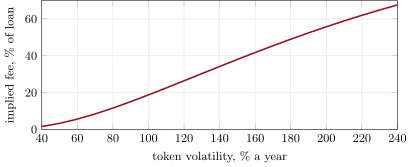
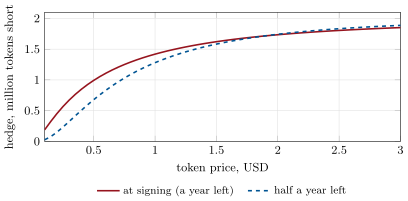
Goal. Value a token loan with three call strikes by simulation, derive the fee it implies, and compute the hedge the market maker must hold at launch and through the year. End state: Figures 24.2 and 24.3 and the numbers of the weekend problem.
The package. Monte Carlo with antithetic pairs and the terminal price as a control variate, checked against Black.
def package_value_mc(deal: Deal, paths: int = 200_000, seed: int = 24) -> float:
    """Monte Carlo value of the call package: antithetic pairs and the terminal price as a control
    variate (its expectation is the price at signing)."""
    rng = random.Random(seed)
    sd = deal.vol * math.sqrt(deal.years)
    pays, ends = [], []
    for _ in range(paths // 2):
        z = rng.gauss(0, 1)
        for zz in (z, -z):
            st = deal.price * math.exp(-0.5 * sd * sd + sd * zz)
            pays.append(sum(n * max(st - k, 0.0) for n, k in deal.tranches))
            ends.append(st)
    n = len(pays)
    mp, me = sum(pays) / n, sum(ends) / n
    cov = sum((p - mp) * (e - me) for p, e in zip(pays, ends, strict=True)) / n
    var = sum((e - me) ** 2 for e in ends) / n
    return mp - cov / var * (me - deal.price)
Listing 24.1. Monte Carlo value of the call package with a control variate. code/firm/tokenloan/firm_tokenloan.py Fee and hedge.
implied_fee,day_one_hedgeanddelta_schedule.def implied_fee(deal: Deal) -> float: """Call value as a share of the loaned tokens' value.""" return package_value(deal) / (deal.tokens_loaned * deal.price) def day_one_hedge(deal: Deal) -> float: """Tokens to sell at signing so that the calls are delta-hedged.""" return sum(n * call_bs(deal.price, k, deal.years, deal.vol)[1] for n, k in deal.tranches) def delta_schedule(deal: Deal, prices: list[float], t_left: float) -> list[tuple[float, float]]: """Tokens the hedge should be short at each price with t_left years to expiry.""" return [(s, sum(n * call_bs(s, k, t_left, deal.vol)[1] for n, k in deal.tranches)) for s in prices]Listing 24.2. The implied fee, the day-one hedge and the hedge through the year. code/firm/tokenloan/firm_tokenloan.py - Run
summary()andfig_business.py.
What to change next. Add a token unlock of 10% of supply at month six as a jump in supply that moves the price; charge the hedge the spread it pays on a thin market; value the deal from the issuer’s side, including the tokens it gets back.
24.7 Build: token market-making agreements
Purpose. The miniature firm signs, values and hedges token market-making agreements, monitors its quoting obligations, and books the value it earns.
Interface. Deal(tokens_loaned, price, years, vol, tranches); call_bs; package_value_mc, package_value; implied_fee; day_one_hedge; delta_schedule(deal, prices, t_left); obligations_met(spread_bp, depth_usd, uptime); post_fee(ledger, deal, ts) posting to firm.ledger.
Rules. Tokens received and owed netted; volatility from the token’s own history and comparable listings, never assumed low; obligations checked per venue and per day; the calls booked at signing as fee revenue in the ledger.
Acceptance tests. code/firm/tokenloan/tests/: Monte Carlo within 1% of the closed form; call limits; fee between 0 and 1; a hedge that rises with the price; obligations; a ledger posting.
Stretch. Unlock schedules; hedging costs on thin books; accounting for the loan liability; the deal’s value to the issuer.
Sources and further reading
- SEC, press release 2024-166, 9 October 2024.
- ESMA, Markets in Crypto-Assets Regulation (MiCA) page; Regulation (EU) 2023/1114. Accessed September 2026.
- GENIUS Act, Public Law 119-27, 18 July 2025 (GovInfo).
- Ontario Securities Commission, QuadrigaCX: A Review by Staff of the Ontario Securities Commission, 2020.
- FATF, International Standards on Combating Money Laundering and the Financing of Terrorism and Proliferation (the FATF Recommendations), updated June 2025: Recommendations 15 and 16 and the Interpretive Note to Recommendation 15 (Internet Archive copy).
- Regulation (EU) 2023/1113 of 31 May 2023 on information accompanying transfers of funds and certain crypto-assets (Internet Archive copy of EUR-Lex).
- US Attorney’s Office, District of Massachusetts, press release of 9 October 2024 (Internet Archive copy).
24.8 Exercises
Exercise 24.1 ★
Why does a token loan by itself leave the market maker with no net exposure to the token?
Solution
Solution of Exercise 24.1.
It holds the lent tokens and owes the same number back: a long spot position and a short forward of equal size, whose price moves cancel.
Exercise 24.2 ★
Distinguish a hot wallet from a cold wallet, and say what MPC adds.
Solution
Solution of Exercise 24.2.
A hot wallet’s keys sit on connected systems and can sign at once; a cold wallet’s keys are offline and signing needs a deliberate offline process. MPC splits the key into shares held by several parties who sign jointly, so that no single person or machine ever holds the whole key.
Exercise 24.3 ★
From when did MiCA apply to stablecoin issuers, and from when to crypto-asset service providers?
Solution
Solution of Exercise 24.3.
Stablecoin (asset-referenced and e-money token) titles from 30 June 2024; the rest, including CASPs, from 30 December 2024, with existing providers allowed to continue until 1 July 2026 at the latest.
Exercise 24.4 ★★
Value one call on a token at USD 0.50, strike 0.75, one year, volatility 120%, without drift or discounting.
Solution
Solution of Exercise 24.4.
About USD 0.171, with a delta of 0.60.
Exercise 24.5 ★★
How does the implied fee of the listing deal change between volatilities of 80% and 160%? Why so much?
Solution
Solution of Exercise 24.5.
From 11.7% to 41.8% of the loan: the calls are out of the money, and the value of out-of-the-money options rises steeply with volatility, so the fee depends mostly on a number no one can know for a token that has not traded.
Exercise 24.6 ★★
An OTC client asks for a price on 500 bitcoin. List what goes into the desk’s quote.
Solution
Solution of Exercise 24.6.
The mid across venues; the depth it would consume across them and their fees; the stablecoin and fiat conversion; the risk of the price moving during the hedge (volatility times the square root of the hedging time, times size); the settlement and credit risk of the client and the window; and a margin for the desk.
Exercise 24.7 ★★★
Coding. With delta_schedule, how many tokens must the market maker buy back if the price falls from 0.50 to 0.25 with half a year left?
Exercise 24.8 ★★★
Find the flaw. “Our agreement pays us only if volume on the token reaches USD 5 million a day; we will make sure it does.”
Solution
Solution of Exercise 24.8.
A volume obligation is met most cheaply by trading with oneself, which is wash trading: the SEC’s 2024 cases charged firms that sold exactly that service. Obligations should be on spread, depth and presence, which serve users.
24.9 Problem: The Listing Deal
Problem 24.1
Weekend problem — what the calls are worth and what to sell
A project with 100 million tokens lists at USD 0.50. It lends a market maker 2% of the supply for a year and grants calls on a third of that amount each at USD 0.75, 1.00 and 1.50. The token’s volatility is estimated at 120% a year; ignore interest and drift.
Part I — The value.
- What is the loan worth in dollars?
- What are the three call tranches worth, and the package?
- What fee does the package imply, as a share of the loan?
- How close does the Monte Carlo value come to the closed form?
- At 80% volatility, what is the fee?
Part II — The hedge.
- How many tokens does the market maker sell on day one?
- What share of the loan is that?
- What happens to the hedge if the token doubles in the first month?
- And if it halves?
- Why does the day-one sale matter to the new market?
Part III — The obligations.
- What obligations should the agreement set, and which should it avoid?
- How would the market maker meet a maximum spread of 1% with depth of USD 50 000 on each side?
- What does a token unlock at month six do to the hedge and the quotes?
- How should the firm book the deal?
- What would make this deal unlawful?
Part IV — Judgement.
- Who has the better side of the deal?
- Why do issuers pay in calls rather than cash?
- How would you check that a market maker is honest?
- State the named result: the value of the call package as a share of the loaned tokens’ value, and the tokens sold on day one.
- In one sentence: what does a listing market maker sell to the issuer?
Solution
Solution of Problem 24.1.
1. 2 million tokens at USD 0.50: USD 1 million. 2. About USD 114 052 (0.75), 89 993 (1.00) and 60 574 (1.50); USD 264 619 in all. 3. 26.5%. 4. Within 0.33% (USD 263 744) with 200 000 paths. 5. 11.7%. 6. About 992 331 tokens. 7. 49.6%. 8. At 1.00 with eleven months left the hedge is about 1 400 000 tokens short: the market maker sells another 408 000 into the rally. 9. At 0.25 it is about 518 000: it buys back 474 000 into the fall. 10. Half the loan is sold into a market that has just opened, as the issuer’s own supply: the market maker’s hedging is a large seller at listing. 11. Maximum spread, minimum depth on each side, presence (share of time quoting), venues and reporting; avoid volume targets and anything that rewards a price level. 12. Quote at most 0.5% either side of its fair value with USD 50 000 on each side, drawing on the lent tokens for the offers and on its own stablecoins for the bids, and widen only within the obligation. 13. More supply at a known date: the price and volatility assumptions change, and the hedge and quotes must be re-sized ahead of it. 14. The calls’ value as fee revenue at signing (and remeasured), the lent tokens as an asset with an equal liability to return them, and the hedge’s P&L as position P&L. 15. Manipulating the price or volume (wash trades, pushing the price towards the strikes), or misleading investors about the market’s activity. 16. It depends on volatility: at 120% the calls pay the market maker USD 265 000 for a year’s quoting; if the issuer estimated 50%, it thought it paid much less. 17. A new project has tokens but little cash, and calls pay most when the listing succeeds. 18. Measure its quotes’ spread and depth on the venues yourself, look for its trades against itself, and ask for its hedge and inventory reports. 19. Named result: the calls are worth 26.5% of the loaned tokens’ value, and the market maker sells about 992 000 tokens (49.6% of the loan) on day one. 20. Liquidity for a new market, paid for with an option on its success.
24.10 Interview questions
Interview question 24.1 ★ trader
How is a market maker paid in a loan-plus-call deal, and how does it hedge?
Solution
Solution of Interview question 24.1.
With call options on the token, while the lent tokens supply its inventory; it sells the calls’ delta at signing and rebalances, selling in rallies and buying in falls, to earn the calls’ value rather than bet on the token.
What the interviewer is looking for: the loan nets out; the calls are the pay; delta hedging.
Interview question 24.2 ★ risk
Describe a sound custody set-up for a crypto trading firm.
Solution
Solution of Interview question 24.2.
Most assets in cold storage; hot wallets sized to daily needs; MPC or multi-signature approvals with separation of duties; address allow-lists; daily reconciliation of on-chain balances to books; limits and sweeps for balances on venues; tested recovery procedures; independent audit.
What the interviewer is looking for: defence in depth and reconciliation.
Interview question 24.3 ★★ researcher
How would you estimate the volatility of a token that has not traded yet?
Solution
Solution of Interview question 24.3.
From comparable tokens at their listings (sector, float, unlock schedule), the realised and implied volatilities of peers, pre-market or perpetual prices if any trade, and a wide range for stress; update fast from the first days’ trading.
What the interviewer is looking for: comparables and humility.
Interview question 24.4 ★★ trader
How do you price an OTC block of 500 bitcoin at 3 a.m. on a Sunday?
Solution
Solution of Interview question 24.4.
From the available depth across venues at that hour (thin), perpetual prices, the time to hedge and its price risk, the stablecoin leg (fiat is closed), and the client’s settlement: wider than on a weekday, or partly on a risk basis with a hedge in perpetuals.
What the interviewer is looking for: weekend liquidity and settlement.
Interview question 24.5 ★★ risk
What changes for a trading firm when MiCA and the travel rule apply to it?
Solution
Solution of Interview question 24.5.
Authorisation for the services it provides in the EU (custody, dealing), conduct and disclosure rules, reporting, and originator and beneficiary information on transfers with other regulated providers, with procedures for transfers to unhosted wallets; venues it may use may change.
What the interviewer is looking for: authorisation, conduct, and data with transfers.
Interview question 24.6 ★★★ developer, risk
Design the controls for moving USD 50 million of coins from cold storage to three venues within an hour.
Solution
Solution of Interview question 24.6.
Pre-approved destination addresses per venue; a request with amounts and purpose; approval by several people through MPC quorums; test transfers for new routes; amounts split by venue and chain; monitoring until credited; reconciliation; and alerts on anything outside the plan.
What the interviewer is looking for: quorums, allow-lists, test transfers and reconciliation.