Markets III: Commodities, Energy and Crypto · Markets
27Prediction and Betting Markets
In September 2024 a US court ruled that the derivatives regulator had exceeded its authority in forbidding a regulated exchange to list contracts on which party would control Congress. Two years earlier the same regulator had fined a blockchain venue that offered, without registration, contracts such as “Will Trump win the 2020 presidential election?”. A contract that pays one dollar if an event happens trades at a price that reads as a probability. Bookmakers have quoted such prices for centuries, with a margin; exchanges now let bettors trade them with each other, and derivatives regulators have had to decide which of them are gambling. This chapter explains how odds encode probabilities and margins, how betting exchanges and event contracts work, how trading firms make these markets, and the best-documented bias in them.
27.1 Bookmakers, overround and implied probabilities
Definition 27.1 (Bookmaker, implied probability, overround)
A bookmaker is a firm that quotes odds on the outcomes of an event and takes bets against them as the counterparty. The implied probability of decimal odds is . The overround of a book is the amount by which its implied probabilities over all outcomes exceed one: the bookmaker’s margin.
Decimal odds pay per unit staked, the stake included; they are the odds of One Quant Book 2, chapter 29, written as a payout. A three-way market at 1.50, 4.00 and 7.00 has implied probabilities 66.7%, 25.0% and 14.3%, summing to 105.95%: an overround of 5.95%. A bettor who backs every outcome in proportion to its implied probability loses 5.6% of the stake whatever happens. To read the market’s probabilities, the margin must be taken out, and how to take it out is a model of where the bookmaker put it.
Proposition 27.2 (Four ways to remove the margin)
Let with . The multiplicative method sets ; the additive method ; the power method with such that ; Shin’s method solves for the share of bettors who are insiders, with and . The multiplicative method puts the margin in proportion to the probability; the others put relatively more of it on the longshots.
Proof. Each formula sums to one by construction (the power and Shin parameters by a one-dimensional root search, unique since the sums are monotone in the parameter). For the power method, is smallest for the smallest , so longshots lose the most probability relative to their implied value; Shin’s formula does the same because the insider term penalises small proportionally more. ∎
| Method | favourite (1.50) | middle (4.00) | longshot (7.00) |
|---|---|---|---|
| Implied, with margin | 66.67 | 25.00 | 14.29 |
| Multiplicative | 62.92 | 23.60 | 13.48 |
| Additive | 64.68 | 23.02 | 12.30 |
| Power | 64.82 | 22.71 | 12.48 |
| Shin () | 64.23 | 23.15 | 12.62 |
27.2 Betting exchanges
Definition 27.3 (Betting exchange, back bet, lay bet, in-play betting)
A betting exchange is a venue on which bettors trade bets with each other through an order book and the operator charges a commission rather than taking positions. A back bet is a bet that an outcome happens; a lay bet is a bet that it does not, the layer taking the role of the bookmaker for that bet. In-play betting is betting while the event is under way, at prices that move with it.
A betting exchange is a limit order book (One Quant Book 1, chapter 19) in which the instrument is an outcome and the price is decimal odds. Backers want high odds, layers low ones, and the spread between the best back and lay odds is the market’s spread. Commission is charged on each market’s net winnings, so a bettor pays only on what it wins: Betfair computes it as net winnings times the market’s base rate times one minus the bettor’s discount, with base rates in its Australian help pages of 6% for sport, 10% for one rugby league competition and 8 or 10% for local racing. Lay and back positions offset: a bettor who backed at 3.0 and lays at 2.5 after the odds shorten locks in a profit whatever happens, just as a trader closes a long at a higher price. In-play markets move with every event on the field and reward speed of information, which puts slow layers at the mercy of fast backers.
27.3 Event contracts on and off chain
Definition 27.4 (Event contract, resolution source)
An event contract is a derivative that pays a fixed amount, usually one dollar, if a specified event occurs and nothing otherwise; its price, as a share of the payout, reads as the market’s probability of the event. Its resolution source is the source and procedure named in the contract by which the occurrence of the event is determined.
In the United States event contracts are derivatives under the Commodity Exchange Act and must be listed on a designated contract market (Chapter 13). The statute’s special rule lets the regulator prohibit event contracts involving certain activities, among them unlawful activity and gaming, if contrary to the public interest.
As of September 2026 — Event contracts before US courts and regulators
On 12 September 2024 the US District Court for the District of Columbia, in KalshiEX LLC v. CFTC, found that Kalshi’s congressional control contracts (“will this chamber of Congress be controlled by this party for this term?”) involve neither unlawful activity nor gaming, that the CFTC’s order prohibiting them exceeded its statutory authority, and granted Kalshi summary judgment. The CFTC appealed; on 7 May 2025 the Court of Appeals granted its unopposed motion to dismiss the appeal. In January 2022 the CFTC had settled charges against Blockratize, Inc., doing business as Polymarket, for offering off-exchange event-based binary options without being a designated contract market or a registered swap execution facility; the order imposed a USD 1.4 million penalty and required it to wind down its non-compliant markets. On 2 September 2025 CFTC staff granted a no-action position on swap reporting to QCX, a designated contract market and clearing house that Polymarket had acquired for its return to the United States.
On a blockchain venue the event contract is a pair of tokens, YES and NO, minted together against one dollar of stablecoin and redeemable for it, traded on an order book or a market maker, and settled by an oracle (Chapter 14). The resolution source is the contract’s most important and least visible term: “who won the election” must be decided by someone, at some time, from some source, and the rules for disputed or ambiguous outcomes decide what the tokens pay. Minting also inflates volume: from the full on-chain ledger of Polymarket’s 2024 presidential markets, Tsang and Yang measure October’s turnover in the Trump market at USD 391 million against 958 million of naive volume, which counts the creation and destruction of pairs as trades.
As of September 2026 — An optimistic oracle
UMA’s documentation describes its optimistic oracle: third-party proposers post a resolution with a bond, refundable if the proposal is correct; the proposal is pending for a challenge period during which anyone may dispute it by posting a dispute bond; disputes go to a vote of UMA token stakers, with a 24-hour commit period and a 24-hour reveal period, and the incorrect side’s bond compensates the correct side.

27.4 How trading firms make these markets
A market maker in event contracts quotes a probability with a spread, like any other market maker, and its risks are the same in new clothes: adverse selection by bettors who know more (One Quant Book 1, chapter 19), inventory that it cannot hedge except in the same event on other venues, and prices that jump to zero or one at resolution. Three features are peculiar. The same event trades on several venues, a bookmaker, an exchange, a regulated event-contract exchange and a blockchain venue, with different fees, participants and resolution sources, so a firm’s first edge is cross-venue: buying the event where it is cheap and selling it where it is dear. Capital is locked until resolution, often for months, so a price gap must beat the return on that capital. And the resolution sources differ: the same headline event can resolve differently on two venues if their sources or rules for edge cases differ, which turns an arbitrage into a bet on the rules.
Proposition 27.5 (When a cross-venue gap pays)
Let venue A sell YES at and venue B sell NO at with , with fees and per contract and capital cost a year for years until resolution. Buying one of each pays exactly one dollar whatever happens, if both venues resolve the same way, and earns . It pays when the gap exceeds approximately .
Proof. One YES and one NO on the same event pay one dollar together; the cost is the two prices, the fees and the financing until the payment. ∎
27.5 The favourite–longshot bias
Definition 27.6 (Favourite–longshot bias)
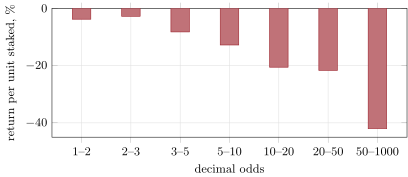
The favourite–longshot bias is the tendency, documented across betting markets, for bets on longshots to return less per unit staked than bets on favourites, so that longshots’ prices overstate their probabilities.
Snowberg and Wolfers, studying horse racing, asked whether the bias comes from bettors who love risk or from bettors who misperceive probabilities, and found that misperceptions, as prospect theory predicts, explain it better. Shin’s model, in which the bookmaker protects itself against insiders by shading longshots most, is another explanation, and the reason the Shin method of Proposition 27.2 exists. For a trader the bias is a structural edge on one side: selling longshots and buying favourites, at scale and with discipline, and a warning that a market’s longshot prices are poor probability estimates.
27.6 Tutorial: odds, margins and the bias
Goal. Convert bookmaker odds to probabilities with the multiplicative, additive, power and Shin methods, compare them, and measure a favourite–longshot bias on a synthetic book of results. End state: Table 27.1, Figure 27.2 and the numbers of the weekend problem.
Shin’s method. A one-dimensional root search for the insider share.
def shin(odds: list[float]) -> tuple[list[float], float]:
    """Shin (1993): p_i = (sqrt(z^2 + 4 (1 - z) pi_i^2 / S) - z) / (2 (1 - z)), z the insider share, chosen so
    that the p_i sum to one. Returns (probabilities, z)."""
    pi = implied(odds)
    s = sum(pi)

    def probs(z: float) -> list[float]:
        return [(math.sqrt(z * z + 4 * (1 - z) * x * x / s) - z) / (2 * (1 - z)) for x in pi]
    z = _bisect(lambda z: sum(probs(z)) - 1, 0.0, 0.99)
    return probs(z), z
Listing 27.1. Shin’s margin removal. code/firm/odds/firm_odds.py The bias. Price races with a biased bookmaker, draw the winners, and average the returns by odds.
def flb_book(n_events: int = 20_000, runners: int = 8, seed: int = 27) -> list[tuple[float, float]]:
    """Synthetic races: true win probabilities from a Dirichlet-like draw; one unit staked on every runner.
    Returns (decimal odds, realised return per unit) for every bet."""
    rng = random.Random(seed)
    out = []
    for _ in range(n_events):
        w = [rng.expovariate(1.0) ** 1.5 for _ in range(runners)]
        s = sum(w)
        p = [x / s for x in w]
        odds = biased_odds(p)
        u, acc, winner = rng.random(), 0.0, runners - 1
        for i, x in enumerate(p):
            acc += x
            if u < acc:
                winner = i
                break
        out += [(o, (o - 1) if i == winner else -1.0) for i, o in enumerate(odds)]
    return out
Listing 27.2. A synthetic book of races and its bets’ realised returns. code/markets-3/27-prediction-and-betting-markets/python/m3_betting.py - Run
methods(),returns_by_odds(flb_book()),election_gap()andfig_betting.py.
What to change next. Recover the bias parameter from the synthetic results by maximum likelihood; hedge a back bet to an equal outcome with hedge_equal; add an in-play price path and compute a market maker’s inventory risk.
27.7 Build: odds and hedging
Purpose. The miniature firm prices events across bookmakers, exchanges and event-contract venues: it needs their prices as probabilities without margins, their fees on the same basis, and hedges that equalise its outcomes.
Interface. implied, overround; multiplicative, additive, power, shin; kelly(p, odds); exchange_payout(stake, odds, commission); hedge_equal(back_stake, back_odds, lay_odds, commission).
Rules. Decimal odds internally, conversions at the edges; probabilities that sum to one; commission applied on net winnings as exchanges do.
Acceptance tests. code/firm/odds/tests/: the overround; all methods summing to one; power and Shin shading the longshot more than the multiplicative method; Kelly at zero edge and at a stated edge; a hedge to equal outcomes.
Stretch. Multi-venue arbitrage scanner for one event; the resolution-risk discount between venues with different sources.
Sources and further reading
- KalshiEX LLC v. CFTC, No. 23-3257 (D.D.C.), memorandum opinion of 12 September 2024 (Doc 51); D.C. Circuit No. 24-5205, order of 7 May 2025 granting the CFTC’s unopposed motion to dismiss.
- CFTC, press release 8478-22 (Polymarket), January 2022; CFTC Letter No. 25-28, 2 September 2025; CoinDesk, 3 September 2025.
- Betfair, help pages on commission (“Exchange: What is Commission and how is it calculated?”; Australian “Commissions and Charges”), Internet Archive copies.
- K. P. Tsang and Z. Yang, “The Anatomy of a Blockchain Prediction Market: Polymarket in the 2024 U.S. Presidential Election”, arXiv:2603.03136, version of 14 September 2026.
- UMA documentation, “How does UMA’s oracle work”. Accessed September 2026.
- H. S. Shin, “Measuring the incidence of insider trading in a market for state-contingent claims”, Economic Journal 103, 1993; E. Snowberg and J. Wolfers, “Explaining the Favorite-Longshot Bias: Is it Risk-Love or Misperceptions?”, NBER Working Paper 15923, 2010.
27.8 Exercises
Exercise 27.1 ★
A two-way market is priced at 1.80 and 2.10. What is its overround, and what are the multiplicative probabilities?
Solution
Solution of Exercise 27.1.
: an overround of 3.17%; multiplicative probabilities 53.85% and 46.15%.
Exercise 27.2 ★
A bettor backed at 3.0 for 100 and the odds have shortened to 2.5. How much should it lay to lock in an equal profit, and what is that profit?
Solution
Solution of Exercise 27.2.
Lay at 2.5: if the selection wins, ; if it loses, . A profit of 20 either way, before commission.
Exercise 27.3 ★
Why must a US exchange listing event contracts be a designated contract market?
Solution
Solution of Exercise 27.3.
Event contracts are derivatives under the Commodity Exchange Act, and the statute requires an entity listing them for public trading to be designated as a contract market by the CFTC.
Exercise 27.4 ★★
Compute the power-method probabilities of the book 1.50, 4.00, 7.00, and explain why the longshot’s is below the multiplicative one.
Solution
Solution of Exercise 27.4.
64.82%, 22.71% and 12.48%. Raising each implied probability to a common power above one shrinks small probabilities proportionally more, so the longshot loses more than under proportional scaling (13.48%).
Exercise 27.5 ★★
An event contract trades at 0.58 and you believe the probability is 0.65. What Kelly fraction should you stake, ignoring fees?
Solution
Solution of Exercise 27.5.
Decimal odds : of wealth.
Exercise 27.6 ★★
Why does an arbitrage between two venues’ contracts on “the same” event carry resolution risk?
Solution
Solution of Exercise 27.6.
Each venue resolves by its own rules and source; a disputed, delayed or ambiguous outcome can resolve YES on one and NO on the other, or be voided on one, so the two positions no longer offset.
Exercise 27.7 ★★★
Coding. With returns_by_odds, what is the return of backing every runner priced between 1 and 3, and of backing every runner priced between 50 and 1 000?
Solution
Solution of Exercise 27.7.
About between 1 and 3, and between 50 and 1 000.
Exercise 27.8 ★★★
Find the flaw. “The market prices the longshot at 50 to 1, so its probability is 2%.”
Solution
Solution of Exercise 27.8.
50 to 1 is decimal odds of 51, an implied probability of about 2% before the margin, and the margin and the favourite–longshot bias sit disproportionately on longshots: the true probability is likely lower, perhaps much lower.
27.9 Problem: Election Night
Problem 27.1
Weekend problem — one event, two venues
A month before an election, venue A (a regulated event-contract exchange) sells YES on a candidate at 0.58 with a fee of 1 cent a contract; venue B (a blockchain venue) sells YES at 0.62, so NO at 0.38, with a fee of half a cent. Capital earns 4.5% a year elsewhere. Your model gives the candidate 65%.
Part I — The arbitrage.
- What does one YES on A and one NO on B cost, with fees?
- What does the pair pay, and when?
- What is the profit per pair after the cost of capital?
- What is the smallest gap that survives fees and capital?
- What does 10 000 pairs earn, and what capital does it lock?
Part II — The risks.
- What happens if the two venues resolve differently?
- What does venue B’s settlement in stablecoins add?
- What limits the size of the trade on each venue?
- Can a US-resident firm trade on both venues?
- What does the gap tell you about the two venues’ participants?
Part III — The view.
- With a belief of 65%, what Kelly fraction would you stake on YES at venue A?
- What is the expected return per contract at 0.58?
- Why would a professional stake a fraction of Kelly?
- How would you check whether 65% is better than the market’s 58–62%?
- How does the favourite–longshot bias bear on the view?
Part IV — Judgement.
- Are election contracts gambling or hedging instruments?
- What did the 2024 court decision decide, and what did it leave open?
- Which venue’s price is the better forecast, and how would you know?
- State the named result: the price gap that survives fees and capital, and the Kelly stake on the cheaper contract for a belief of 65%.
- In one sentence: what is a price of 0.58?
Solution
Solution of Problem 27.1.
1. . 2. Exactly one dollar, at resolution, if both venues resolve the same way. 3. a pair. 4. About 1.86 cents: the two fees plus a month of capital. 5. About USD 214, locking USD 9 750 for a month (and margin or collateral on each venue). 6. The pair can pay nothing or two dollars, or one leg can be voided: the arbitrage becomes a bet on the rules. 7. Stablecoin risk (Chapter 14) and the cost of moving dollars on and off chain. 8. Each venue’s depth at those prices, position limits, and on the blockchain venue the depth of its book or pool. 9. Not on a venue that excludes US persons; the firm’s access and legal advice decide. 10. That capital does not move freely between them: different users, access rules and fees keep separate prices, as in the kimchi premium (Chapter 16). 11. 16.7%. 12. . 13. Beliefs are uncertain, and a full Kelly stake on an overestimated edge loses heavily; fractions of Kelly trade growth for safety. 14. Backtest the model on past elections against market prices, and compare its calibration and scoring with the market’s. 15. A 58% favourite is on the side where prices tend to be closer to the truth; a longshot view would deserve more suspicion. 16. Both: most traders speculate, some hedge exposures to policy outcomes; the statute’s gaming test is a legal line, not an economic one. 17. That the CFTC’s order prohibiting Kalshi’s congressional control contracts exceeded its authority, because they involve neither unlawful activity nor gaming; it did not decide whether they serve the public interest. 18. The one whose prices are better calibrated over many events; with one election, no one can know from the outcome alone. 19. Named result: a gap above about 1.86 cents survives the fees and a month of capital (the 4-cent gap earns 2.14 cents a pair); the Kelly stake on YES at 0.58 for a belief of 65% is 16.7% of wealth. 20. The market’s price of a dollar paid if the event happens: a probability, net of margins, biases and the cost of capital.
27.10 Interview questions
Interview question 27.1 ★ trader
How do you turn a bookmaker’s odds into probabilities?
Solution
Solution of Interview question 27.1.
Take reciprocals of decimal odds, which sum to more than one by the overround, and remove the margin: proportionally, additively, by a power, or by Shin’s insider model, which put more of the margin on longshots.
What the interviewer is looking for: the overround and a model of where the margin sits.
Interview question 27.2 ★ researcher
What is the favourite–longshot bias and what explains it?
Solution
Solution of Interview question 27.2.
Longshots return less per unit staked than favourites. Explanations: bettors misperceive small probabilities (prospect theory), risk-loving bettors, and bookmakers shading longshots against insiders (Shin).
What the interviewer is looking for: the fact and at least two explanations.
Interview question 27.3 ★★ trader
How would you make a market in an event contract a month before the event?
Solution
Solution of Interview question 27.3.
Start from a fair probability from models and other venues; quote around it with a spread covering adverse selection and the cost of locked capital; skew with inventory; hedge on other venues; widen before news and in illiquid hours; cap exposure given the jump to 0 or 1 at resolution.
What the interviewer is looking for: fair value, adverse selection, inventory and the terminal jump.
Interview question 27.4 ★★ risk
What are the risks of holding offsetting positions in the same event on two venues?
Solution
Solution of Interview question 27.4.
Different resolution sources and rules, voiding, delayed resolution, venue credit and stablecoin risk, access restrictions, and capital locked until resolution.
What the interviewer is looking for: resolution risk first.
Interview question 27.5 ★★ researcher
Derive the Kelly stake for a bet at decimal odds with win probability .
Solution
Solution of Interview question 27.5.
Staking a fraction , wealth becomes with probability and otherwise; maximising gives .
What the interviewer is looking for: the log-utility derivation.
Interview question 27.6 ★★★ developer, risk
Design an oracle for resolving event contracts that is hard to manipulate.
Solution
Solution of Interview question 27.6.
Name primary sources in advance, require resolution after a delay, use bonded proposals with a challenge period and escalation to a broad, economically bonded vote, publish rules for ambiguous cases, and make the cost of corrupting the vote exceed the value at stake.
What the interviewer is looking for: bonds, delays and escalation, and the cost of attack.