Markets III: Commodities, Energy and Crypto · Markets
29A Map of All Markets
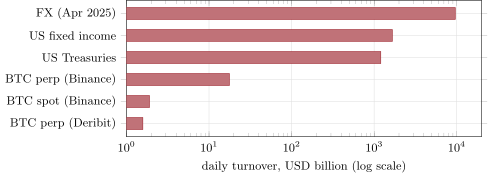
The foreign exchange market trades close to ten trillion dollars a day; the most active bitcoin perpetual on the largest crypto venue, under twenty billion; the weather contracts of Chapter 11, far less. The first three books of this series have described dozens of markets one at a time, each with its own instruments, institutions, hours and habits. This last chapter puts them on one page: how big they are, how they are organised, when they trade, who trades them, and what kinds of strategies they reward. It is a map for a trading firm deciding where to go next, and for a reader deciding which of the later books to open.
29.1 Size
Definition 29.1 (Turnover velocity)
The turnover velocity of a market is its daily turnover divided by the amount of the asset outstanding (or, for derivatives, the open interest): the share of the stock that changes hands each day.
Size alone misleads: a market can be huge and sleepy or small and frantic. The US Treasury market trades about USD 1.2 trillion a day against USD 31.8 trillion outstanding, a velocity of 3.8% a day. The largest bitcoin perpetual on one venue traded about USD 17.6 billion in the 24 hours to the afternoon of 24 September 2026 against open interest of about 96 000 bitcoin, some USD 8 billion: a velocity above two, so that its open interest turned over twice a day. Velocity says what kind of trading a market rewards: low velocity, the patient provision of balance sheet (One Quant Book 2); high velocity, speed and inventory turnover.
As of September 2026 — Market sizes on one scale
The BIS Triennial Survey put average daily FX turnover at USD 9.6 trillion in April 2025. SIFMA reported US fixed-income trading of USD 1 659.2 billion a day, of which US Treasuries USD 1 203.6 billion, for 2026 to August, with USD 31.8 trillion of Treasuries outstanding. The FIA counted 119.29 billion exchange-traded futures and options contracts worldwide in 2025. On 24 September 2026 Binance’s public endpoints reported 24-hour quote volume of USD 17.65 billion in its BTCUSDT perpetual and USD 1.90 billion in BTCUSDT spot, and open interest of 96 463 bitcoin in the perpetual; Deribit’s bitcoin perpetual reported USD 1.58 billion of 24-hour volume. In 2025 the LME’s futures and options averaged 717 334 lots a day, and EPEX SPOT’s power markets traded 917.5 TWh over the year.
29.2 Structure
Every market in these books sits somewhere between two poles. At one, a central limit order book on an exchange, open to many, with a central counterparty behind every trade: equity and futures markets (One Quant Book 1), power day-ahead auctions and crypto venues in this book. At the other, dealers quoting to clients by request for quote, bilateral credit and settlement: most bonds, swaps, FX forwards and physical commodities (One Quant Book 2 and the first part of this book). Between them sit the hybrids: all-to-all bond platforms, cleared swaps traded on electronic platforms, brokered commodity markets, and the automated market makers and on-chain order books of the crypto chapters, which remove the dealer and the clearing house at once and put a protocol in their place.
The position of a market between the poles decides who can trade it and how. A firm with technology and little balance sheet goes to the order books; a firm with balance sheet and client relationships goes to the dealer markets; a firm that can read a protocol goes to the chains. The trend of the last twenty years has been towards the order-book pole, electronic and cleared, but the dealer markets remain among the largest by value, FX first.
29.3 Hours
Definition 29.2 (Follow-the-sun trading)
Follow-the-sun trading is the organisation of a book so that it is managed around the clock by desks in successive time zones, each handing its positions, orders and open issues to the next as its day ends.
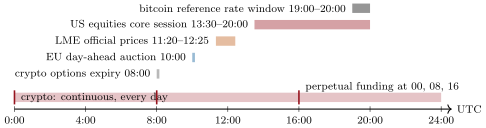
Markets have hours, and the hours have fixed moments at which prices are set and positions are marked. Figure 29.2 places some of the fixed moments met in this book on one UTC day in the northern summer: the eight-hourly funding of perpetuals (Chapter 17), the 08:00 UTC expiry of crypto options (Chapter 19), the European day-ahead auction at 12:00 Central European Time (Chapter 5), the publication of the LME’s official prices from the second Ring session (Chapter 8), the US equity core session from 9:30 to 16:00 New York time, and the hour from 15:00 to 16:00 New York time from which the bitcoin reference rate for US funds is computed. Around these moments, electronic futures and FX run almost around the clock on weekdays: CME Group’s FX market on Globex, for instance, trades from Sunday 17:00 to Friday 16:00 Chicago time with a one-hour break each day from 16:00.
Proposition 29.3 (Shifts to cover a round-the-clock book)
To staff a book that trades around the clock with shifts of hours that overlap by hours for handover, a desk needs shifts a day; the number of traders on each shift is the largest number of markets open at the same time during it.
Proof. Successive shifts start hours apart, so shifts cover hours of the cycle, and must reach 24. A trader per open market is needed at the busiest minute of each shift. ∎
29.4 Participants
The same few kinds of firm appear in every market of these books, in different proportions: dealers (banks and their successors), who provide balance sheet and take the other side of clients; proprietary trading firms, which trade their own capital, mostly in the order books and increasingly in the dealer markets (One Quant Book 1); asset managers and hedge funds, who take views and pay for liquidity; physical players, the producers, consumers and trading houses of the commodity chapters, whose trading follows their assets; and, in crypto, retail traders in large numbers, token issuers and protocols. Who is on the other side decides a strategy’s edge: in markets where hedgers and retail trade for reasons other than price, a market maker earns the spread; in markets of professionals only, edge comes from information, speed or balance sheet.
29.5 Dominant strategy types
Across the markets of these books the strategies that pay fall into a few families, which the later books take up one by one. Market making and liquidity provision: equities, futures, options, FX, crypto venues and pools (One Quant Books 10 and 11 on microstructure and high-frequency trading). Relative value and arbitrage (One Quant Book 9): basis trades, cross-venue arbitrage, spreads between related contracts, from Treasury futures to the kimchi premium. Carry and risk premia (One Quant Books 8 and 9): funding trades, roll yield, selling volatility, the favourite–longshot bias. Directional and systematic strategies (One Quant Book 8): trend and momentum in futures, value and factor strategies in equities. And physical optimisation: storage, transport and generation in commodities, where the trade is an asset’s operation. A firm’s map is the intersection of these families with the markets whose structure, hours and participants it can serve.
29.6 Tutorial: the map and the desk
Goal. Put market sizes on one logarithmic scale, compute turnover velocities, and plan the shifts that cover a firm’s chosen markets around the clock. End state: Figure 29.1 and the numbers of the weekend problem.
The planner. Fewest overlapping shifts covering every staffed minute, and traders per shift.
def plan_shifts(markets: list[Market], weekday: int, length_h: float, overlap_h: float,
                start_min: int = 0) -> list[tuple]:
    """Fewest shifts of `length_h` hours, each starting `length_h - overlap_h` after the previous, that cover every
    minute at which some market is open; returns (start, end, traders) with traders = the most markets open at once
    during the shift (one trader per open market)."""
    need = staffed_minutes(markets, weekday)
    covered = [t for t in range(DAY) if need[t] > 0]
    if not covered:
        return []
    step, length = int((length_h - overlap_h) * 60), int(length_h * 60)
    if len(covered) == DAY:                                   # round the clock: cover the cycle
        first, n = start_min, math.ceil(DAY / step)
    else:
        first, span = covered[0], covered[-1] - covered[0] + 1
        n = 1 if span <= length else 1 + math.ceil((span - length) / step)
    out = []
    for k in range(n):
        s = first + k * step
        e = s + length
        traders = max(need[t % DAY] for t in range(s, e))
        out.append((s % DAY, e % DAY, traders))
    return out
Listing 29.1. Shift planning over a day of market hours. code/firm/marketmap/firm_marketmap.py - The desk.
desks()sets the firm’s coverage choices;shifts(9, 1)plans a weekday and a weekend day. - Run
turnover_velocityfor Treasuries and a perpetual, andfig_map.py.
What to change next. Add an Asian desk and see whether it saves a shift; plan around daylight-saving changes; count trader-hours a week and compare with the cost of an automated overnight shift with a human on call.
29.7 Build: the market registry
Purpose. The miniature firm must know, for every market it trades, when it is open, how it is structured and cleared, and how large it is; its operations must plan staff and systems around those hours.
Interface. Market(name, daily_usd_bn, structure, cleared, hours); every_day(start, end, days); is_open, open_markets(markets, weekday, minute); staffed_minutes; plan_shifts(markets, weekday, length_h, overlap_h).
Rules. Hours in UTC minutes per weekday, converted from local rules with daylight-saving time and holidays (from firm.calendar in a full implementation); sizes stored with their source’s measure; a round-the-clock market planned as a cycle.
Acceptance tests. code/firm/marketmap/tests/: open queries on weekdays and weekends; three nine-hour shifts cover the cycle; one shift covers the US session; no shift on a day with nothing open.
Stretch. Daylight-saving transitions; holiday calendars per market; hand-over checklists generated from open positions.
Sources and further reading
- BIS, Triennial Central Bank Survey 2025 (One Quant Book 2’s ledger); SIFMA, US Treasury and US fixed income securities statistics, September 2026; FIA, ETD volume, December 2025 (One Quant Book 1’s ledger).
- Binance and Deribit public API endpoints, 24 September 2026.
- NYSE, hours and calendars; this book’s chapters 5, 8, 17 and 19 for the other fixed moments.
- CME Group, trading hours page (FX Spot+ on Globex, 2025; Internet Archive copy); LME, data highlights 2025 (January 2026); EPEX SPOT, annual trading results 2025 (19 January 2026).
29.8 Exercises
Exercise 29.1 ★
What is the turnover velocity of the US Treasury market from Box 29.1?
Solution
Solution of Exercise 29.1.
of the outstanding stock a day.
Exercise 29.2 ★
Convert to UTC in the northern summer: the US equity core session and the window of the New York bitcoin reference rate.
Solution
Solution of Exercise 29.2.
New York is four hours behind UTC in the northern summer: the core session runs 13:30–20:00 UTC and the reference-rate window 19:00–20:00 UTC.
Exercise 29.3 ★
Place three markets of your choice between the order-book pole and the dealer pole, and say why.
Solution
Solution of Exercise 29.3.
For example: E-mini futures at the order-book pole (central limit order book, central counterparty); US corporate bonds towards the dealer pole (request for quote, bilateral settlement, with growing all-to-all platforms); an automated market maker as a third kind, a protocol with neither a dealer nor a clearing house.
Exercise 29.4 ★★
How many shifts of eight hours, overlapping by one, does a round-the-clock desk need? Of twelve hours?
Solution
Solution of Exercise 29.4.
shifts of eight hours; of twelve.
Exercise 29.5 ★★
Why is a comparison of FX turnover with one crypto venue’s volume only indicative?
Solution
Solution of Exercise 29.5.
The measures differ: the BIS counts all FX instruments, net of double counting, in one month; the crypto figure is one day on one venue, in one instrument, reported by the venue itself; and turnover in derivatives is notional, not value exchanged.
Exercise 29.6 ★★
What does a velocity above two for a perpetual future say about who trades it?
Solution
Solution of Exercise 29.6.
Its positions are held briefly: most volume comes from market makers and short-horizon traders turning over inventory, not from holders of views for weeks.
Exercise 29.7 ★★★
Coding. With shifts, plan the tutorial’s desks with nine-hour shifts on a weekday and on a Sunday. How many trader-shifts does each need?
Solution
Solution of Exercise 29.7.
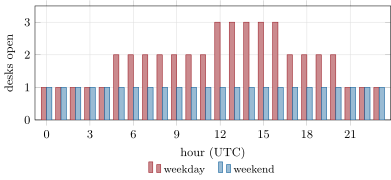
Weekday: shifts 00–09, 08–17 and 16–01 UTC with 2, 3 and 3 traders, 8 trader-shifts; Sunday: the same shifts with one trader each, 3.
Exercise 29.8 ★★★
Find the flaw. “The biggest markets are the best opportunities.”
Solution
Solution of Exercise 29.8.
Size is not profit: the largest markets are the most competitive and served by the largest balance sheets; opportunity lies where a firm’s skills meet participants who trade for reasons other than price, at a scale it can serve.
29.9 Problem: The Round-the-Clock Desk
Problem 29.1
Weekend problem — staffing crypto, European power and US markets
A firm trades crypto around the clock, European power from 05:00 to 17:00 UTC and US rates and equities from 12:00 to 21:00 UTC on weekdays. Shifts last nine hours and overlap by one hour for handover; each market open needs one trader.
Part I — The shifts.
- How many shifts a day does the crypto book alone require?
- When do the shifts start and end if the first starts at midnight UTC?
- How many traders does each weekday shift need?
- And at weekends?
- How many trader-shifts a week is that?
Part II — The moments.
- Which fixed moments of Figure 29.2 fall in each shift?
- Which shift handles the European day-ahead auction?
- Which the US equity close and the bitcoin reference rate?
- What should each handover cover?
- How does daylight-saving time change the plan in winter?
Part III — The alternatives.
- What would twelve-hour shifts save and cost?
- Could an office in Asia replace the night shift?
- What can be automated at night, and what must a human watch?
- How would you cover the weekend?
- What does the plan cost in salaries if a trader costs a stated amount a year?
Part IV — Judgement.
- Which of the three markets should the firm drop if it had to, and why?
- What does the map say about where to expand next?
- How does turnover velocity inform the choice?
- State the named result: the number of shifts and the traders per shift that cover the chosen markets with a one-hour overlap.
- In one sentence: what is the map for?
Solution
Solution of Problem 29.1.
1. Three shifts of nine hours overlapping by one. 2. 00:00–09:00, 08:00–17:00 and 16:00–01:00 UTC. 3. 2, 3 and 3 (crypto plus power at night from 05:00; crypto, power and US in the day; crypto and US in the evening). 4. One per shift. 5. . 6. First shift: funding at 00:00 and at 08:00 with the options expiry (in the overlap); second: 08:00, the day-ahead auction at 10:00, the LME’s official prices and the US open, funding at 16:00 (in the overlap); third: 16:00, the reference-rate window and the US close at 20:00, and funding at midnight (in the overlap). 7. The second. 8. The third. 9. Open positions and orders, limits used, pending transfers and margin calls, incidents, and the fixed moments of the next shift. 10. In winter the US session and the reference-rate window move an hour later in UTC and the European auction an hour later, so the second and third shifts’ contents shift and the desk windows should be restated in local time. 11. Two shifts would leave two hours uncovered with a one-hour overlap (): twelve-hour shifts still need three, at the cost of fatigue. 12. Yes, for the night shift’s crypto and early power coverage, at the cost of a second office and cross-time-zone handovers. 13. Automated quoting within limits, hedging and monitoring; humans must watch risk limits, incidents, venue problems and large moves. 14. A reduced crypto rota with automation and a human on call. 15. 46 trader-shifts a week, about nine and a half full-time traders at five shifts each, times the stated cost, plus the overlap and cover for leave. 16. The one whose profit per trader-hour is lowest, measured, not guessed; crypto costs most to staff, the US desk least. 17. Towards markets that reuse the same technology and hours (for instance crypto derivatives on regulated venues) or fill the idle hours. 18. High-velocity markets reward the firm’s speed and inventory turnover; low-velocity ones need balance sheet it may not have. 19. Named result: three nine-hour shifts a day (00–09, 08–17, 16–01 UTC) with 2, 3 and 3 traders on weekdays and one at weekends. 20. To choose where to trade, and to see what each market demands before going there.
29.10 Interview questions
Interview question 29.1 ★ trader
Rank FX, US Treasuries, equities and crypto by daily turnover, and say what the ranking hides.
Solution
Solution of Interview question 29.1.
FX first, then Treasuries, then equities and crypto; the ranking hides different measures (notional or value, net or gross, one venue or all), velocity, the share of that turnover a firm can access, and the margins earned.
What the interviewer is looking for: measures, velocity and accessibility.
Interview question 29.2 ★ risk
What are the risks of a book handed between time zones?
Solution
Solution of Interview question 29.2.
Positions or orders not understood by the next desk, limits inconsistent across time zones, events in the gap between shifts, differences in local practice, and fatigue; handover checklists, one book of record and overlap reduce them.
What the interviewer is looking for: information loss at handover.
Interview question 29.3 ★★ researcher
How would you estimate the addressable profit pool of a new market for a market-making firm?
Solution
Solution of Interview question 29.3.
Volume the firm could trade times the spread it could capture net of adverse selection and fees, from the market’s depth, participants and competition, checked against the profits of firms already there, and discounted for the cost of access.
What the interviewer is looking for: volume times net capture, and competition.
Interview question 29.4 ★★ trader
Which market in these books would you enter with a small team and little capital, and why?
Solution
Solution of Interview question 29.4.
One where participants trade for reasons other than price, technology matters more than balance sheet, and access is cheap: for example market making in a young derivatives market, with the caveats of venue risk.
What the interviewer is looking for: a reasoned match of edge and constraints.
Interview question 29.5 ★★ developer
Design a service that tells every system in a firm which markets are open, with holidays and daylight-saving time.
Solution
Solution of Interview question 29.5.
A calendar service holding each market’s session rules in local time, holidays and early closes, converting to UTC for any date with time-zone data, exposing “open now” and “next event” queries, versioned and tested against the markets’ published calendars.
What the interviewer is looking for: local rules, time-zone conversion and versioning.
Interview question 29.6 ★★★ researcher, trader
Choose three markets from these books whose combination gives a firm the best use of the same technology, people and capital.
Solution
Solution of Interview question 29.6.
Choose markets that share infrastructure (order-book market making), fill complementary hours, and have low correlation of profit: for example equity index futures, crypto perpetuals and European power intraday; justify by edge, hours and capital.
What the interviewer is looking for: shared technology, complementary hours, diversified profits.