Markets III: Commodities, Energy and Crypto · Markets
17Perpetual Futures
At midnight, eight in the morning and four in the afternoon, UTC, the holders of crypto perpetual futures pay each other money. If the contract has traded above the spot price over the previous eight hours, the longs pay the shorts; if below, the shorts pay the longs. The contract never expires, never delivers and never needs to be rolled, and yet it stays within a fraction of a percent of spot, because this periodic payment makes it expensive to hold the side that is pushing it away. The perpetual future is the crypto market’s principal instrument of leverage: of all listed bitcoin futures traded in the first half of 2023, perpetuals made up 75% of the USD 27 billion average daily volume and 94% of the USD 8 billion average open interest, by the count Ackerer, Hugonnier and Jermann report. This chapter takes it apart: the index it tracks and the mark price at which it is valued, the premium and the formula that turns it into a funding payment, the three ways of denominating the contract, and the trade that collects the funding.
17.1 A future that never expires
A dated future (One Quant Book 1, chapter 18) converges to spot because at expiry it becomes spot: the long receives the underlying, or its cash value, at the final settlement price. Between now and expiry the future can trade at a basis to spot, which the cash-and-carry trade keeps near the cost of carry. Take away the expiry and nothing forces convergence. The perpetual replaces delivery with a stream of payments.
Definition 17.1 (Perpetual future, funding rate, funding interval)
A perpetual future is a futures contract with no expiry, marked to market continuously, whose holders exchange periodic payments that push its price towards an index of the underlying’s spot price. The payment per unit of position value is the funding rate, positive when longs pay shorts; the period between payments is the funding interval, commonly eight hours.
In this chapter denotes the funding rate per interval, and a position of units of the underlying held at a funding time pays , where is the mark price defined below: a long pays when and receives when . If the perpetual trades rich to spot, the longs pay, which invites arbitrageurs to sell the perpetual and buy spot, collecting the funding while hedged; their selling pushes the perpetual back down. Funding plays the part that convergence plays for a dated future.
Proposition 17.2 (The perpetual as a continuously rolled future)
Hold a long perpetual and a short spot position of the same size, and let the perpetual’s price equal the index at the start and the end. The position’s total P&L is minus the sum of the funding payments. A long dated future bought at a basis to spot and held to expiry earns relative to spot. Funding is therefore the perpetual’s basis paid in instalments: a perpetual whose funding averages per interval behaves like a future rolled at a basis of per interval.
Proof. With equal prices at the two ends the price legs cancel and only the funding flows remain. For the dated future, convergence moves it from to while spot moves from to , a difference of . ∎
As of September 2026 — A perpetual’s history and its default funding
BitMEX’s instrument data give 13 May 2016 as the listing date of its XBTUSD perpetual swap, an inverse contract settled in bitcoin with an eight-hour funding interval; on 24 September 2026 its funding rate was 0.01% per interval. Binance pays funding at 00:00, 08:00 and 16:00 UTC by default, with an interest component of 0.01% per interval (0.03% a day) for most contracts.
17.2 Index price and mark price
A perpetual needs two reference prices besides its own last trade.
Definition 17.3 (Index price, mark price)
The index price of a perpetual is a weighted average of the underlying’s spot price on several constituent venues, with rules that limit the influence of any one of them. The mark price is the price at which the venue values open positions for unrealised P&L, margin and liquidation; it is built from the index and a smoothed basis rather than from the last trade.
The index is what funding pushes the contract towards; the mark decides who is liquidated. Both are designed against manipulation. A trader who could move one spot venue’s price, or the perpetual’s own last trade, for a few seconds could otherwise trigger liquidations and profit from them (Chapter 18). An index that caps each constituent near the median of all of them, and drops those that stop updating, costs more to move; a mark that uses a median of several estimates ignores a single outlying trade.
As of September 2026 — Index and mark rules at a large venue
Binance’s USD-margined futures compute the index as a weighted sum of spot prices on constituent exchanges, which it lists as including Binance, OKX, Coinbase, Kraken, Bybit and others, as well as decentralised venues. A constituent whose latest price deviates by more than 3% from the median of all sources is capped at 1.03 or 0.97 times the median (1% for some pairs such as BTCUSDT); a constituent that cannot be reached or has not updated for five minutes gets zero weight. The mark price is the median of three prices: the index times with the last funding rate ; the index plus a 30-second moving average of the basis; and the contract’s last price.
17.3 The premium index and the funding formula
The premium is zero while the index lies between the impact bid and ask; positive when even the bids are above it, negative when even the asks are below. Using impact prices rather than the best quotes makes it costly to move with small orders. The venue samples it through the interval and averages the samples with weights that grow over time, so that the premium near the funding time counts most: with samples , .
Proposition 17.5 (The funding rule and its dead zone)
Let be the interest component per interval and the clamp. The funding rate
equals whenever , equals when and when . With and , funding is exactly for every average premium between and .
Proof. If the clamp returns and . If it returns ; if it returns . ∎
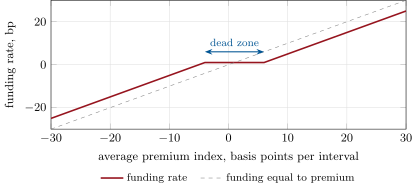
The dead zone has a consequence that surprises newcomers: in quiet markets the funding rate is not the premium but the interest component, 0.01% every eight hours, which is a year paid by longs to shorts. The interest component is meant to reflect the difference between the interest rates of the quote currency and the underlying, as in the forward points of One Quant Book 2; in practice it is a fixed parameter, and for most of a calm year a short perpetual hedged with spot collects it.
As of September 2026 — The funding formula at a large venue
Binance’s funding rate is for an -hour interval, with per interval for most contracts. The premium index uses impact bid and ask prices for an impact margin notional of 200 USDT divided by the initial margin rate at maximum leverage, sampled every 5 seconds and averaged with linearly increasing weights (5 760 samples in eight hours). Funding is capped and floored at times the maintenance margin ratio for major contracts such as BTCUSDT and at for others.
17.4 Linear, inverse and quanto contracts
A perpetual on bitcoin can be denominated in three ways, and the choice changes what the holder is exposed to.
Definition 17.6 (Linear, inverse and quanto contracts)
A linear contract is quoted and settled in the quote currency (a dollar or a stablecoin), its P&L linear in the price: for units bought at . An inverse contract has a fixed notional in the quote currency but is margined and settled in the underlying coin, so that contracts of one dollar each bought at earn coins. A quanto contract is quoted on one asset but margined and settled in another at a fixed rate per unit of price move, so that its P&L in the settlement asset is for a multiplier , whatever the settlement asset’s price.
As of September 2026 — Contract terms at BitMEX
BitMEX’s instrument data on 24 September 2026 describe XBTUSD as an inverse perpetual, one US dollar of bitcoin per contract, settled in bitcoin; ETHUSD, listed on 1 August 2018, as a quanto perpetual quoted in dollars and settled in bitcoin with a multiplier of 100 satoshis (0.000001 bitcoin) per contract per dollar of the ether price; and XBTUSDT, listed in November 2021, as a linear perpetual settled in USDT. All three had an eight-hour funding interval.
Proposition 17.7 (The inverse contract’s P&L in coin)
The P&L in coin of a long inverse position of one-dollar contracts, , is concave in : its derivative falls as the price rises. A long gains at most coins however high the price goes and loses without bound as ; the short’s P&L is the mirror image. In dollars, is linear.
Proof. Differentiate twice: and . The limits follow from and . ∎
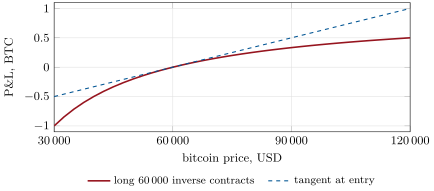
The inverse contract suits a holder who thinks in coin: a miner or a fund whose books are in bitcoin can hedge its dollar value by selling inverse contracts, since a short inverse position plus the coins posted as margin has a constant dollar value. A trader who thinks in dollars and goes long with coin margin is doubly long: the position and the collateral both fall together. The quanto contract gives exposure to ether settled in bitcoin at a fixed number of satoshis per dollar; its dollar P&L is the coin P&L times the bitcoin price, so the holder is also exposed to bitcoin and to the correlation between the two, which the funding and the price of the contract must compensate. Linear contracts margined in stablecoins avoid both effects, and carry instead the stablecoin’s own risk (Chapter 14).
17.5 Cash-and-carry and funding arbitrage
Definition 17.8 (Funding arbitrage)
Funding arbitrage is holding a perpetual against an offsetting position in the underlying (spot, or another venue’s perpetual) so that price moves cancel and the position earns the funding difference; most often long spot and short perpetual to collect positive funding.
It is the cash-and-carry trade of One Quant Book 1, chapter 21, with the carry paid every eight hours instead of at expiry. Its return depends on how much funding there is to collect. Schmeling, Schrimpf and Todorov of the BIS find that crypto carry, the difference between futures and spot prices, averages above 10% a year, far more than carry in equities, bonds, currencies or commodities, is extremely volatile, reaching 60% a year, and is highest when small investors chase leveraged upside and arbitrage capital is scarce; high carry predicts subsequent crashes.
As of September 2026 — Funding on a major perpetual, by year
From Binance’s public funding history for the BTCUSDT perpetual (computed by the author on 24 September 2026), the mean funding rate annualised was 17.2% in 2020, 30.6% in 2021, 4.2% in 2022, 7.9% in 2023, 11.9% in 2024, 5.1% in 2025 and 2.9% in 2026 to date; the share of negative funding events was highest in 2022 (22%) and 2026 (26%). The largest single rate was 0.3% per interval in 2020; since 2025 funding has not exceeded the default 0.01%.
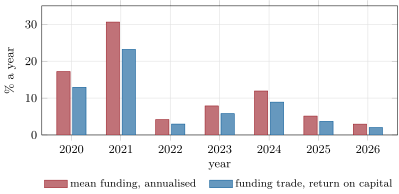
The trade has three weaknesses. Funding can turn negative, as it did one interval in five in 2022, and the hedged position then pays. The short perpetual is margined separately from the spot, so a rally that the spot gains on drains the short’s margin, and if the margin is not topped up in time the short is liquidated and the position is left unhedged at the worst moment.
Proposition 17.9 (Margin to survive a rally)
A short perpetual of notional entered at price , with a maintenance margin rate , survives a rally of (the price rising to ) without liquidation only if its margin is at least : for a 30% rally and , 30.65% of the initial notional.
Proof. At the short has lost and must still hold maintenance margin of times its notional, now . ∎
The third weakness is the venue: the spot and the margin sit on exchanges, and the trade’s return is a credit spread over what a failed exchange would repay (Chapter 15). Venues that let spot holdings count as collateral for the short (portfolio or cross margin, Chapter 18) remove most of the margin drag, at the cost of concentrating both legs on one venue.
17.6 Tutorial: funding, and the inverse contract
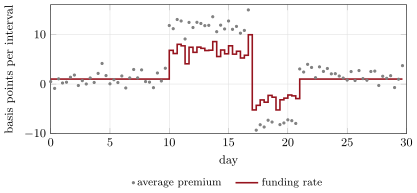
Goal. Implement the premium index and the funding rule, apply them to a simulated month of premium samples, and plot the inverse contract’s P&L in coin. End state: Figures 17.1, 17.2 and 17.3 and the numbers of the weekend problem.
The formula. Premium, time-weighted average and funding, as the venue publishes them.
def premium_index(impact_bid: float, impact_ask: float, index: float) -> float:
    return (max(0.0, impact_bid - index) - max(0.0, index - impact_ask)) / index


def average_premium(samples: list[float]) -> float:
    """Time-weighted: the k-th sample of the interval has weight k."""
    n = len(samples)
    return sum((k + 1) * p for k, p in enumerate(samples)) / (n * (n + 1) / 2)


def funding_rate(avg_premium: float, interest: float = 0.0001, clamp: float = 0.0005,
                 cap: float = 0.02) -> float:
    """F = P + clamp(I - P, -clamp, +clamp), then bounded by +-cap."""
    f = avg_premium + min(max(interest - avg_premium, -clamp), clamp)
    return min(max(f, -cap), cap)
Listing 17.1. The premium index, its time-weighted average and the funding rate. code/firm/perp/firm_perp.py - The month.
month_of_funding(regimes())simulates 5 760 premium samples an interval. The trade. The margin a short needs and the return of the funding trade.
def margin_to_survive(rally: float = 0.30, maintenance: float = 0.005) -> float:
    """Margin, as a share of the initial notional, a short perpetual needs to survive a rally."""
    return rally + maintenance * (1 + rally)


def funding_trade(funding_annual: float, spot_fee: float = 0.001, perp_fee: float = 0.0005,
                  margin: float | None = None) -> float:
    """Annual return on capital of long spot + short perpetual held a year at a constant price: funding
    received less entry and exit fees, over the spot outlay plus the short's margin."""
    m = margin_to_survive() if margin is None else margin
    return (funding_annual - 2 * (spot_fee + perp_fee)) / (1 + m)
Listing 17.2. Margin to survive a rally and the funding trade’s return on capital. code/markets-3/17-perpetual-futures/python/m3_perp.py - Run
fig_perp.pyfor the chart data.
What to change next. Let funding be paid every hour instead of every eight and see how the dead zone scales; charge the trade the funding of 2022 with its negative intervals; value the quanto contract’s correlation exposure by simulating bitcoin and ether together.
17.7 Build: the perpetual contract engine
Purpose. Everything the miniature firm does with perpetuals (quoting, hedging, the funding trade, the liquidation engine of Chapter 18) needs the venue’s index, mark and funding reproduced exactly, and P&L in the right currency for each contract type.
Interface. index_price(sources, cap, stale_s); impact_price(levels, notional); premium_index(impact_bid, impact_ask, index); average_premium(samples); funding_rate(avg_premium, interest, clamp, cap); mark_price(index, last_funding, frac_to_funding, basis_ma, last_trade); funding_payment; pnl_linear, pnl_inverse, pnl_quanto.
Rules. Parameters per venue and contract, read from its documentation and versioned; no source, no index (an error, never a stale value); rates per interval.
Acceptance tests. code/firm/perp/tests/: capping of an outlier and exclusion of a stale source; impact price through two levels; premium zero inside the impact spread; funding inside and outside the dead zone and at the cap; the median mark; P&L of the three contract types.
Stretch. Hourly and dynamic funding intervals; reproduction of a venue’s published funding history from its order-book data; the quanto correlation adjustment.
Sources and further reading
- Binance, “Introduction to Binance Futures Funding Rates” and “How to Calculate the Mark Price and the Price Index in USDS-M Futures”, support pages; public funding-rate endpoint. Accessed September 2026.
- BitMEX, instrument endpoint of the public API (XBTUSD, ETHUSD, XBTUSDT), 24 September 2026.
- M. Schmeling, A. Schrimpf and K. Todorov, “Crypto carry”, BIS Working Papers 1087, April 2023.
- D. Ackerer, J. Hugonnier and U. Jermann, “Perpetual Futures Pricing”, working paper, 27 February 2025.
17.8 Exercises
Exercise 17.1 ★
A long position of 2 bitcoin in a linear perpetual is held through a funding time with the mark at 60 000 and a funding rate of 0.03%. Who pays whom, and how much?
Solution
Solution of Exercise 17.1.
The rate is positive, so the long pays the shorts .
Exercise 17.2 ★
With an interest component of 0.01% and a clamp of 0.05%, what is the funding rate for average premiums of 0.02%, 0.10% and ?
Solution
Solution of Exercise 17.2.
0.02% is inside the dead zone ( to ): funding 0.01%. 0.10%: . : .
Exercise 17.3 ★
Why does the venue use a median of several prices for the mark rather than the last trade?
Solution
Solution of Exercise 17.3.
A single trade, possibly small or manipulated, could move the last price and trigger liquidations; the median of an index-based funding estimate, an index-plus-average-basis estimate and the last trade ignores one outlier.
Exercise 17.4 ★★
A trader is long 60 000 inverse contracts at 60 000. What is the P&L in bitcoin if the price goes to 50 000? To 75 000? In dollars?
Solution
Solution of Exercise 17.4.
At 50 000: bitcoin, . At 75 000: bitcoin, . In dollars the P&L is linear, ; in bitcoin it is not.
Exercise 17.5 ★★
The ETHUSD quanto pays 0.000001 bitcoin per contract per dollar of the ether price. A trader is long 10 000 contracts from 3 000 to 3 300; bitcoin is at 60 000. What is the P&L in bitcoin and in dollars?
Solution
Solution of Exercise 17.5.
bitcoin, $180 000 at 60 000; the dollar value would differ at another bitcoin price although the ether move is the same.
Exercise 17.6 ★★
Funding stays at 0.01% per eight hours for a year. What does a short collect on USD 10 million?
Solution
Solution of Exercise 17.6.
: about USD 1.095 million.
Exercise 17.7 ★★★
Coding. With funding_trade and yearly_funding, compute the funding trade’s return on capital each year. In which years is it below a 5% money-market yield?
Solution
Solution of Exercise 17.7.
12.93% (2020), 23.20% (2021), 2.95% (2022), 5.79% (2023), 8.89% (2024), 3.70% (2025) and 2.02% (2026, at the mean rate to September). Below 5% in 2022, 2025 and 2026.
Exercise 17.8 ★★★
Find the flaw. “Long spot, short perpetual is market-neutral, so it cannot lose money.”
Solution
Solution of Exercise 17.8.
Price moves cancel but funding can turn negative, the short leg’s margin can run out in a rally and be liquidated, the venues holding both legs can fail, the stablecoin margin can depeg, and the basis at exit can differ from entry.
17.9 Problem: The Funding Trade
Problem 17.1
Weekend problem — collecting a year of funding
A fund buys USD 100 million of bitcoin spot and sells the same notional of a linear perpetual, paying taker fees of 0.10% on spot and 0.05% on the perpetual at entry and at exit. It holds for a year at the funding of 2024 (Box 17.5); the maintenance margin rate is 0.5%.
Part I — The income.
- What funding does the short collect over the year, assuming a constant price?
- What are the fees for entering and exiting?
- What does the default funding of 0.01% per interval come to over a year?
- Why was 2024’s mean funding close to that default?
- What would the income have been at 2022’s funding?
Part II — The margin.
- What margin must the short leg hold to survive a 30% rally?
- What is the capital of the trade, and its return on capital?
- What is the return on capital if the venue counts the spot as collateral for the short and no extra margin is needed?
- What happens if the price rises 40% and the margin is not topped up?
- Why does the spot’s gain in the rally not help, unless the venue cross-margins the two?
Part III — The risks.
- What happens to the trade when funding turns negative?
- What is the trade’s exposure to the venue?
- What is its exposure to the stablecoin in which the perpetual is margined?
- How does the basis at exit affect the result?
- What does the BIS finding that high carry predicts crashes mean for this trade?
Part IV — Judgement.
- Is the funding trade an arbitrage?
- Why does funding exist at all, from the point of view of those who pay it?
- How would you size the trade across several venues?
- State the named result: the funding trade’s return on capital over 2024 with 30.65% of margin, and the margin needed to survive a 30% rally.
- In one sentence: what does a funding payment buy the long?
Solution
Solution of Problem 17.1.
1. USD 11.92 million. 2. million: USD 0.30 million. 3. 10.95% a year. 4. The average premium spent most intervals inside the dead zone, where funding equals the interest component. 5. USD 4.16 million. 6. of notional: USD 30.65 million. 7. USD 130.65 million; . 8. 11.62%. 9. The short is liquidated when its loss leaves only maintenance margin, at a rise of ; the fund is left long spot and unhedged, having sold nothing high. 10. The spot sits in a separate account; its gain is unrealised and not available as margin unless the venue counts it. 11. The short pays funding while hedged; the income becomes a cost. 12. Both legs and the margin sit on venues: their failure is a loss of up to the whole capital. 13. The short’s margin and P&L are in USDT; a depeg changes their dollar value. 14. If the perpetual trades cheap to spot at exit, closing the short costs more than the spot sale returns relative to entry; the premium at entry and exit adds to the result. 15. The trade’s income is highest just before crashes, when margins spike, liquidations cascade and funding can reverse: its returns and its risks arrive together. 16. Not strictly: it earns an uncertain stream and bears margin, venue and stablecoin risk; it is a carry trade with a hedge. 17. Longs pay for leveraged exposure without borrowing or holding spot; funding is the price of that leverage. 18. By venue credit limits, by each venue’s depth and funding, and so that a rally’s margin calls can be met on every venue at once. 19. Named result: 8.89% on capital over 2024, with 30.65% of the notional as margin to survive a 30% rally. 20. The right to hold a leveraged long position without an expiry, for another eight hours.
17.10 Interview questions
Interview question 17.1 ★ trader
What is a perpetual future and what keeps it close to spot?
Solution
Solution of Interview question 17.1.
A future with no expiry; holders exchange funding payments every interval, longs paying shorts when the contract is rich to the index and the reverse when it is cheap, which rewards arbitrageurs for pushing it back.
What the interviewer is looking for: funding as the convergence mechanism.
Interview question 17.2 ★ developer
Why do venues liquidate on the mark price rather than the last trade, and how is the mark built?
Solution
Solution of Interview question 17.2.
The last trade is easy to move for a moment; liquidating on it would reward manipulation. The mark is built from the index (capped, multi-venue) and a smoothed basis, for example the median of an index-plus-funding-basis price, an index-plus-moving-average-basis price and the last trade.
What the interviewer is looking for: manipulation resistance and the median.
Interview question 17.3 ★★ researcher, trader
Explain the difference between linear, inverse and quanto perpetuals, and who would use each.
Solution
Solution of Interview question 17.3.
Linear: P&L in the quote currency, the default for dollar-based traders. Inverse: dollar notional, coin margin and settlement; P&L in coin is concave, and a short plus coin margin is a dollar-stable position, useful to coin-based holders such as miners. Quanto: exposure to one asset settled in another at a fixed rate, adding the settlement asset and the correlation to the risk.
What the interviewer is looking for: currency of P&L and who naturally holds each.
Interview question 17.4 ★★ trader
Funding has been 0.01% for weeks while the perpetual trades a few basis points above the index. Why?
Solution
Solution of Interview question 17.4.
Because the average premium sits inside the dead zone, where the clamp pins funding at the interest component of 0.01% whatever the premium, as long as it stays within 0.05% of it.
What the interviewer is looking for: the clamp.
Interview question 17.5 ★★ risk
What can go wrong with a long-spot, short-perpetual book of USD 500 million?
Solution
Solution of Interview question 17.5.
Negative funding; margin calls on the short legs in a rally, possibly on several venues at once, and liquidation if unmet; venue failure; stablecoin depeg; basis moves at unwind; operational risk in moving collateral. Limits per venue, margin buffers, cross-margin where possible, and a plan to unwind.
What the interviewer is looking for: liquidity of margin as the main risk.
Interview question 17.6 ★★★ developer, researcher
You must predict the next funding rate two hours before the funding time. How?
Solution
Solution of Interview question 17.6.
Two hours before, three quarters of the samples are in and, with linear weights, they already carry about 56% of the weight. Reproduce the venue’s premium from its book (impact notional, 5-second sampling), compute the weighted average so far, forecast the remaining samples (their current level, mean reversion) and apply the clamp and caps; the dead zone makes the answer exact whenever the forecast stays inside it.
What the interviewer is looking for: reproduce the index and the weights, then forecast what remains.