Markets III: Commodities, Energy and Crypto · Markets
8Metals
In the early hours of Tuesday 8 March 2022 the three-month nickel contract on the London Metal Exchange rose from slightly below 50 000 dollars a tonne to 101 365 dollars at 06:08, more than doubling in about five hours; the day before it had opened just under 30 000. At 08:15 the exchange suspended trading. At 12:05 it cancelled every nickel trade done since midnight. Its clearing house had calculated that, had the trades stood, members would have had to post some 19.75 billion dollars of margin at short notice, with a risk of multiple defaults. Base metals trade on an exchange whose contracts, warehouses and rules differ from every other futures market, and the week of the nickel squeeze tested all of them. This chapter covers the London metal market’s prompt dates and prices, its warehouse system, the nickel episode, gold’s two markets in London and New York, and iron ore.
8.1 The London metal market: prompt dates and prices
The London Metal Exchange trades aluminium, copper, zinc, nickel, lead, tin and other metals. Its contracts are not monthly futures: they are forwards for delivery on any of a dense set of dates, a structure inherited from the time it took ships to bring metal to London.
Definition 8.1 (Prompt date, three-month price)
A prompt date is a date on which an LME contract can be settled by delivery of warrants against payment. There is one for every business day from tomorrow (tom) to three months ahead, one every Wednesday from there to six months, and one on the third Wednesday of each month beyond, up to a limit that depends on the metal. The three-month price (3M) is the price for the prompt date about three months from the trade date; it is the most liquid LME contract and the reference for most hedging.
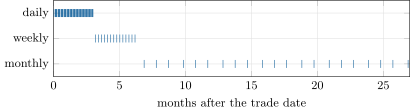
A dense date structure lets a consumer match its hedge to the day it needs metal, but it spreads liquidity. Traders move positions between dates with carries, the metal market’s name for a calendar spread (One Quant Book 1, chapter 19), and the shortest of them is the tom-next of One Quant Book 2, chapter 16: selling for tomorrow and buying back for the next day lends metal for a day.
Example 8.2 (A carry as an interest rate)
Copper cash is at 9 800 dollars a tonne and three months at 9 880: an 80-dollar contango, 0.82% of the cash price for about 91 days, or 3.3% a year. A holder of metal who sells cash and buys three months (lends metal) gives up 80 dollars a tonne and saves the cost of financing and storing the metal for three months; if money and storage cost more than 3.3% a year, lending is the better use of the metal. A backwardation of the same size would pay the lender 80 dollars instead: the market pays for metal now.
Definition 8.3 (LME official price)
The LME official price of a metal is the price set each business day from the final bids and offers of the second session of the exchange’s open-outcry trading floor (the Ring), for the cash, three-month and some later dates; physical contracts across the industry price against it, much as oil cargoes price against an agency’s assessment.
8.2 Warehouses, warrants and queues
LME contracts are delivered by transferring ownership of metal stored in warehouses the exchange has approved, in documents that circulate like title.
Definition 8.4 (Warehouse warrant, cancelled warrant, load-out queue)
A warehouse warrant is a document of title to a specific lot of metal of a specified brand and quality in an LME-approved warehouse, and the means of delivery against LME contracts. A cancelled warrant is one whose owner has told the warehouse that it will withdraw the metal: the lot leaves the LME system and waits to be loaded out. The load-out queue is the backlog of cancelled metal waiting to leave a warehouse when cancellations exceed its daily load-out capacity.

Stocks on warrant are what shorts can deliver; cancelled stocks are metal already claimed. A fall in stocks on warrant, or a jump in cancellations, tightens the near dates and can turn the curve into backwardation. Long queues have also been used to raise rent income and the premiums consumers pay for prompt metal; the exchange’s rules now cap the rent warehouses may charge on metal in long queues.
Definition 8.5 (LME lending rule)
An LME lending rule requires a holder of a dominant long position (of warrants and near-dated contracts) to lend (sell for the nearer date and buy back for the later one) at no more than a set backwardation, so that holding most of the deliverable metal cannot be used to squeeze shorts at will.
8.3 Nickel, March 2022
![LME three-month nickel, 4 to 8 March 2022: the prices stated in the Court of Appeal’s judgment, in trading order (the weekend omitted; the levels after 07:00 shown at the judgment’s “consistently above 80 000”). All trades after midnight on 8 March were cancelled. Source: R (Elliott Associates) v London Metal Exchange [2024] EWCA Civ 1168.](/images/onecourse/chapters/quant-3/m3-metals/fig-79d925149a17.svg)
The prices rose in three steps (Figure 8.3). On Friday 4 March three-month nickel rose 6.8%, from 27 080 to 28 919 dollars, after Russia’s invasion of Ukraine a week earlier; the clearing house called about 2.6 billion dollars of intraday margin, 40% above its previous record. On Monday 7 March it rose 66% close to close, to 48 078, a daily move nearly five times larger than any in the previous twenty years, and margin calls totalled about 7.05 billion dollars; three clearing members failed to pay on time. In the first hours of Tuesday it rose to 101 365. At 04:49, with the price near 60 000, the exchange’s staff suspended the price bands because trades were being done above them; the price stayed above 80 000 from 07:00 until the suspension.
The court’s account of the cause was a short squeeze (One Quant Book 1, chapter 16): large short positions had been built up by several participants, among them a Chinese nickel producer, Tsingshan, on the over-the-counter market; as the price rose, shorts had to buy to meet margin, and others bought in front of them. The market reopened on 16 March, after the producer’s banks had put support in place. The cancellation was challenged in court by trading firms that had bought during the night; the High Court and then the Court of Appeal (2024) held that the exchange had acted lawfully.
As of September 2026 — The regulator’s finding
On 19 March 2025 the Financial Conduct Authority fined the London Metal Exchange £9 245 900, its first enforcement action against a recognised investment exchange, for failing to maintain orderly trading in March 2022. It found that only junior staff, not trained to recognise all causes of disorder, were on duty in the Asian hours, and that they worked to accommodate the rises, including by disabling price bands. The exchange settled and received a 30% discount.
Proposition 8.6 (Margin on a squeezed short)
A short of tonnes marked from price to owes variation margin in cash the same day. A short of 10 000 tonnes owed 191.59 million dollars on the Monday and would have owed a further 532.87 million at the Tuesday peak: 724.46 million on a position whose value had been 289 million dollars at Friday’s close.
Proof. and ; the position was worth at Friday’s close. ∎
A producer that has sold its future output forward is economically hedged: the metal it will produce rises in value with its short. Its margin, though, is paid in cash now, and the metal’s gain arrives only when it is sold. The nickel squeeze is the sharpest example of a hedge that was sound in value and fatal in liquidity, a theme of Chapter 28.
8.4 Gold: London against New York
Gold trades in two places with different conventions. In London it trades over the counter, for settlement in unallocated metal.
Definition 8.7 (Loco London, unallocated gold)
Loco London is the convention that a price is for gold (or silver) delivered in London, settled through the London clearing system of unallocated accounts. Unallocated gold is a balance of gold in an account with a clearing bank: the holder owns no specific bars, only a claim on the bank for that weight of metal, and is an unsecured creditor of the bank.
Definition 8.8 (LBMA Gold Price)
The LBMA Gold Price is the benchmark price of spot, unallocated, loco London gold, set twice each London business day in electronic auctions run by an independent administrator.
As of September 2026 — The London auctions
The LBMA Gold Price auctions run at 10:30 and 15:00 London time, administered by ICE Benchmark Administration, which has run them since March 2015.
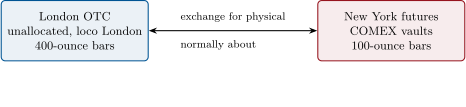
In New York gold trades as futures on COMEX, delivered in 100-ounce bars in approved vaults. The two markets are linked by the exchange for physical (One Quant Book 1, chapter 21): a trader long futures and short London gold swaps one for the other, and normally the futures trade at a premium over London equal to carry and a small fee, about $1.50 an ounce. In March 2020 the link broke. Swiss refineries that recast London’s 400-ounce bars into the smaller bars New York delivers closed, and the passenger flights that carry gold were grounded; on 25–26 March April futures traded more than $70 above London and then at $50. The exchange and the London association responded with a futures contract deliverable in 100-ounce, 400-ounce or one-kilogram bars.
8.5 Iron ore
Iron ore trades on two very different kinds of contract. In Singapore it trades as cash-settled futures and swaps on the monthly average of a price-reporting agency’s assessment of 62% iron-content fines delivered to China; in Dalian it trades as physically delivered futures in lots of 100 tonnes, open to foreign investors since May 2018. The spread between them is a market in its own right, with basis risk of the kind met in Chapter 1.
8.6 Tutorial: the prompt calendar and a squeezed short
Goal. Build the prompt-date calendar and compute the margin of a short through the nickel squeeze. End state: Figure 8.1 and the margins of Proposition 8.6.
Prompt dates. Daily to three months, weekly Wednesdays to six months, third Wednesdays beyond.
def prompt_dates(trade: dt.date, months: int = 27, holidays: Holidays = frozenset()) -> dict[str, list[dt.date]]:
    """Daily, weekly and monthly prompt dates for a trade date."""
    tom = next_business(trade, holidays)
    three_m = three_month_date(trade, holidays)
    daily, d = [], tom
    while d <= three_m:
        daily.append(d)
        d = next_business(d, holidays)
    end_weekly = add_months(dt.date(trade.year, trade.month, 1), 7) - dt.timedelta(days=1)
    weekly, d = [], three_m + dt.timedelta(days=1)
    while d <= end_weekly:
        if d.weekday() == 2 and is_business(d, holidays):
            weekly.append(d)
        d += dt.timedelta(days=1)
    monthly = []
    for k in range(7, months + 1):
        f = add_months(dt.date(trade.year, trade.month, 1), k)
        w = third_wednesday(f.year, f.month)
        if w > end_weekly:
            monthly.append(lme_roll(w, holidays))
    return {"daily": daily, "weekly": weekly, "monthly": monthly, "cash": [daily[1]], "three_month": [three_m]}
Listing 8.1. The prompt dates of a trade date. code/firm/prompts/firm_prompts.py The squeeze. Variation margin day by day on the judgment’s prices.
def short_squeeze(tonnes: float = 10_000) -> dict[str, float]:
    """Variation margin on a short of `tonnes` from Friday's close to Monday's close, and from
    Monday's close to Tuesday's peak (the part the cancellation removed)."""
    p = {k: v for k, _, v in NICKEL}
    mon = variation_margin(-tonnes, p["4 Mar close"], p["7 Mar close"])
    tue = variation_margin(-tonnes, p["7 Mar close"], p["8 Mar 06:08, peak"])
    return {"monday": mon, "tuesday_peak": tue, "total": mon + tue}
Listing 8.2. Variation margin of a short through 7 and 8 March 2022. code/markets-3/08-metals/python/m3_metals.py - Run
m3_metals.calendar(),short_squeeze()andfig_metals.py.
What to change next. Add the exchange’s holiday calendar; price a carry from cash to three months from two quotes and convert it to an annualised implied interest rate.
8.7 Build: the prompt calendar and margin estimator
Purpose. The miniature firm hedges metal on the LME: it must know which dates exist today, what a carry costs, and how much cash its positions will need if prices move.
Interface. prompt_dates(trade, months, holidays) returning daily, weekly, monthly, cash and three-month dates; carry(near, far); variation_margin(position, old, new); the calendar helpers add_months, lme_roll, three_month_date, third_wednesday.
Rules. Business days exclude weekends and the given holidays; a prompt date on a non-business day moves to the next business day, but a Saturday moves back to the Friday, and a three-month date pushed into the fourth month falls on the last business day of the third (the LME’s Trading Regulations 8.4.1 and 8.4.2); monthly prompts start after the last weekly one.
Acceptance tests. code/firm/prompts/tests/: month arithmetic at month ends; the Saturday, Sunday and month-end rolls; the daily, weekly and monthly structure; the sign of a short’s margin.
Stretch. Load the exchange’s published trading calendar; margin under a scenario of several days’ moves with intraday calls; lending-rule limits on a dominant long.
Sources and further reading
- Court of Appeal, R (Elliott Associates) v London Metal Exchange [2024] EWCA Civ 1168.
- Financial Conduct Authority, press release of 20 March 2025 and Final Notice to the London Metal Exchange.
- London Metal Exchange, prompt date structure; position management and lending rules; warehouse policy; Rules and Regulations (1 June 2026), Part 3, Trading Regulation 8, prompt dates (Internet Archive copy).
- LBMA, the LBMA Gold Price and loco London; ICE Benchmark Administration.
- J. East, “The day the EFP broke”, Singapore Bullion Market Association, 26 March 2020.
- SGX iron ore contract rules; Dalian Commodity Exchange, opening of iron ore futures to foreign investors (2018).
8.8 Exercises
Exercise 8.1 ★
On a Thursday, which date is tom and which is cash, if no holidays intervene?
Solution
Solution of Exercise 8.1.
Tom is Friday (the next business day) and cash is the following Monday (two business days).
Exercise 8.2 ★
A consumer lends 500 tonnes of copper tom-next. What does it do on each date?
Solution
Solution of Exercise 8.2.
It sells 500 tonnes for tom (delivering warrants tomorrow against cash) and buys 500 tonnes for the next prompt, the day after (receiving them back): it lends metal for one day and earns the backwardation, or pays the contango, between the two dates.
Exercise 8.3 ★
Why does a surge in cancelled warrants tend to tighten the nearby dates?
Solution
Solution of Exercise 8.3.
Cancelled metal leaves the deliverable pool: fewer warrants remain for shorts to deliver on the near dates, so shorts must buy back or borrow, pushing near prices above later ones (backwardation).
Exercise 8.4 ★★
A short of 2 000 tonnes of nickel was marked at Friday’s close. What variation margin did it owe on Monday, and what would it have owed at Tuesday’s peak?
Solution
Solution of Exercise 8.4.
Monday: USD 38.32 million; at Tuesday’s peak a further USD 106.57 million.
Exercise 8.5 ★★
By how much did nickel rise from Friday’s open to Tuesday’s peak? Give each day’s move.
Solution
Solution of Exercise 8.5.
Friday +6.8%, Monday +66.3% (close to close), Tuesday to the peak +110.8%: the peak was 3.74 times Friday’s opening price, a rise of 274%.
Exercise 8.6 ★★
In March 2020, why could a trader not simply buy London gold at $1 600 and deliver it into COMEX futures at $1 670?
Solution
Solution of Exercise 8.6.
The London gold was in 400-ounce bars that COMEX does not accept; recasting them needed Swiss refineries that had closed, and moving them needed flights that were grounded. Without a way to deliver, the spread was not an arbitrage but a bet on how long the disruption would last, with margin calls on the short futures in the meantime.
Exercise 8.7 ★★★
Coding. With prompt_dates, count the daily, weekly and monthly prompts available on 24 September 2026 out to 27 months.
Solution
Solution of Exercise 8.7.
65 daily, 14 weekly and 21 monthly prompt dates (weekends only, no holidays).
Exercise 8.8 ★★★
Find the flaw. “The producer was fully hedged, so the price spike could not hurt it.”
Solution
Solution of Exercise 8.8.
Hedged in value, not in cash. Its short futures demanded variation margin at once, while the rise in the value of its future output would be collected only when the metal was sold. Without committed credit lines to fund the margin, a hedged producer can be forced to close its hedge, or default, at the worst price.
8.9 Problem: Tuesday 8 March 2022
Problem 8.1
Weekend problem — a short in the nickel squeeze
A metals trader is short 10 000 tonnes of three-month nickel against expected output. Use the prices of Figure 8.3.
Part I — The position.
- What was the position worth at Friday’s close?
- What margin did Friday’s rise cost?
- What did Monday’s rise cost?
- What would the Tuesday peak have cost, had the trades stood?
- Give the total cash drain from Friday’s open to the peak.
Part II — The market.
- How large were the clearing house’s margin calls on 4 and 7 March?
- What would members have had to post on 8 March had the trades stood?
- Why were the price bands suspended at 04:49?
- Why did the exchange cancel rather than only suspend?
- Who lost from the cancellation, and what did the courts decide?
Part III — The mechanism.
- Why does a known large short invite others to buy?
- How does a lending rule limit squeezes on the exchange, and why did it not stop this one?
- Why did the squeeze start on the over-the-counter market?
- What role did thin Asian-hours trading play?
- What made the market reopen on 16 March?
Part IV — Judgement.
- What should the trader have held besides the short to survive the week?
- What would the regulator’s findings change in the exchange’s operations?
- Should an exchange ever cancel trades that were not errors?
- State the named result: the margin a 10 000-tonne short owed from Monday’s close to the peak, and in total from Friday’s close.
- In one sentence: what kills a hedged producer in a squeeze?
Solution
Solution of Problem 8.1.
1. USD 289.19 million. 2. USD 18.39 million from Friday’s open to its close. 3. USD 191.59 million. 4. USD 532.87 million. 5. USD 742.85 million. 6. About USD 2.6 billion on 4 March and USD 7.05 billion on 7 March. 7. About USD 19.75 billion. 8. Trades were being done above the band limits and staff judged them genuine, not errors. 9. Suspension stopped further trades, but margin at the night’s prices would still have been due and could have caused multiple member defaults; cancelling let margin be set on the 7 March close. 10. Buyers who had traded during the night, among them firms that sued; the High Court (2023) and the Court of Appeal (2024) held the decisions lawful. 11. A short that must buy to meet margin or delivery is a forced buyer: others buy ahead of it and sell to it higher. 12. It obliges dominant longs on the exchange to lend at a capped backwardation; the short here was largely over the counter and the squeeze was in the three-month price, not only the nearby spread. 13. Positions there are not visible to the exchange, and the exchange’s position data could not show the full short. 14. Thin liquidity and junior staff let the price run and the bands be disabled. 15. A support package from the producer’s banks. 16. Committed credit lines or cash for margin, or options instead of futures for part of the hedge. 17. Trained senior staff at all hours, automatic price limits that cannot be lifted to accommodate a runaway price, and better surveillance of over-the-counter exposure. 18. Only to prevent a disorderly market from causing defaults, and under rules known in advance: the cancellation is itself a risk every trader must price. 19. Named result: USD 532.87 million from Monday’s close to the peak, and USD 724.46 million from Friday’s close. 20. Cash margin on a hedge that is sound in value.
8.10 Interview questions
Interview question 8.1 ★ trader
How is an LME contract different from a CME monthly future?
Solution
Solution of Interview question 8.1.
It is a forward for a specific prompt date (daily to three months, then weekly, then monthly), settled by delivery of warrants on that date, with profits and losses realised at the prompt rather than daily; a CME future is a standard monthly contract marked to market every day.
What the interviewer is looking for: the date structure and the settlement.
Interview question 8.2 ★ trader, risk
What is a short squeeze, and what did the nickel episode add to your understanding of one?
Solution
Solution of Interview question 8.2.
Holders of shorts forced to buy (margin, delivery) face others who buy ahead of them. Nickel showed that the forced buyers can be hedgers, that the short can sit off-exchange where nobody sees it, and that an exchange may end it by cancelling trades.
What the interviewer is looking for: forced buying, hidden positions, exchange intervention.
Interview question 8.3 ★★ researcher
Stocks on warrant fall by half in a month. What happens to the curve, and how would you trade it?
Solution
Solution of Interview question 8.3.
Nearby spreads move towards backwardation as deliverable metal shrinks. Trade: long the near date against a later one (a borrowing position), sized to the lending rules and to the risk that metal returns to warrant.
What the interviewer is looking for: stocks and spreads; the lending-rule cap.
Interview question 8.4 ★★ risk
Design the liquidity stress test for a producer hedging its output with exchange futures.
Solution
Solution of Interview question 8.4.
Scenarios of large multi-day price rises (several times the worst history), margin per day with intraday calls, available cash and committed lines, the time to raise more, and the point at which the hedge must be cut; report the survival horizon.
What the interviewer is looking for: cash, not value; multi-day paths; funding sources.
Interview question 8.5 ★★ trader
Why did the gold EFP blow out in March 2020, and what closed it?
Solution
Solution of Interview question 8.5.
Delivery into COMEX needed 100-ounce bars, London holds 400-ounce bars, and refining and flights were disrupted, so the arbitrage could not be done. It closed as logistics resumed and a new contract accepted 400-ounce and kilogram bars.
What the interviewer is looking for: the physical link behind a financial spread.
Interview question 8.6 ★★★ developer, risk
You run an exchange’s surveillance. What signals would have warned you on the night of 7–8 March 2022, and what would you have automated?
Solution
Solution of Interview question 8.6.
Price moves far outside historical distributions, band breaches, one-sided order flow, members’ margin shortfalls from the previous day, concentrated short positions reported by members, and trading at thin hours. Automate alerts on these and escalation to senior staff, and keep hard limits that cannot be switched off by night staff.
What the interviewer is looking for: concrete signals, escalation and hard limits.