 Coach
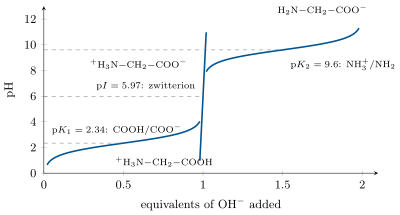
CoachAn amino acid has a central carbon bearing an amino group (), a carboxyl group (), a hydrogen and a side chain that distinguishes the twenty standard amino acids of proteins. At the pH of the cell the amino group is protonated and the carboxyl ionised: the molecule is a zwitterion, , with no net charge. The carbon is chiral in all but glycine, and living things use the L enantiomer only. Side chains group by their chemistry:
| class | amino acids (three- and one-letter codes) | side chain |
|---|---|---|
| non-polar, aliphatic | Gly G, Ala A, Val V, Leu L, Ile I, Met M, Pro P | hydrocarbon; Pro a ring |
| aromatic | Phe F, Tyr Y, Trp W | rings; Tyr and Trp absorb UV |
| polar, uncharged | Ser S, Thr T, Cys C, Asn N, Gln Q | OH, SH, amide |
| positively charged | Lys K, Arg R, His H | bases; His p 6.0 |
| negatively charged | Asp D, Glu E | carboxylates, p 4 |
Nine of them (His, Ile, Leu, Lys, Met, Phe, Thr, Trp, Val) are essential for humans: we cannot make them and must eat them.
Examples
Example 12.10 (Collagen)
A quarter of a mammal’s protein is collagen: three chains, each a left-handed helix of a thousand residues with glycine at every third position (Gly–X–Y, Y often hydroxyproline), wound together into a right-handed triple helix long, then packed side by side into fibrils cross-linked by covalent bonds. Glycine’s absence of a side chain is what lets the three chains pack at the axis; a single substitution of glycine by any other residue kinks the helix and gives brittle bones. Vitamin C is needed to hydroxylate the prolines; without it the helix is unstable and the fibrils fail: scurvy.