
সব বই

পেশাদার

1 Markets I: The Ecosystem and Exchange-Traded Marketsবাজার অনলাইন 2 Markets II: Rates, FX and Creditবাজার অনলাইন 3 Markets III: Commodities, Energy and Cryptoবাজার অনলাইন 4 Quantitative Methodsপদ্ধতি অনলাইন 5 Derivatives and Volatilityডেরিভেটিভস অনলাইন 6 Rates, Credit, XVA and Riskসুদহার, ঋণ ও ঝুঁকি অনলাইন 7 Research Craft: Predictors, Backtests, Measurement, Portfoliosগবেষণা অনলাইন 8 Strategies I: Equities and Futuresকৌশল অনলাইন 9 Strategies II: Volatility, Relative Value, Macro and the Bank Desksকৌশল অনলাইন 10 Microstructure and Executionএক্সিকিউশন অনলাইন 11 Market Making and High-Frequency Tradingমার্কেট মেকিং অনলাইন 12 Machine Learning for Marketsমেশিন লার্নিং অনলাইন 13 Low-Latency Softwareপ্রযুক্তি অনলাইন 14 Networks, Hardware and Trading Infrastructureপ্রযুক্তি অনলাইন 15 Research, Data and Risk Platformsপ্রযুক্তি অনলাইন 16 The Desk and the Firmপ্রতিষ্ঠান অনলাইন 17 The Industry: Firms, Roles and Careersক্যারিয়ার অনলাইন 18 Interviews I: Maths, Probability and Speedক্যারিয়ার অনলাইন 19 Interviews II: Markets, Trading Games and the Final Roundক্যারিয়ার অনলাইন 20 Interviews III: Codeক্যারিয়ার অনলাইন
অ্যাপ পরিচিতি Coach সাইন ইন পড়া শুরু করো

বইগুলো এখনো বাংলা ভাষায় পাওয়া যায় না — ইংরেজি সংস্করণ দেখানো হচ্ছে।

Biology · পরিভাষা

Antibiotic কী?

Definition 18.3 High School Biology · অধ্যায় 18 — Bacteria and Antibiotic Resistance

An antibiotic is a molecule that kills bacteria or stops their growth, at concentrations harmless to the patient’s cells, by acting on a structure or a process that bacteria have and human cells lack: penicillin and its relatives block the building of the bacterial wall; streptomycin and tetracycline jam the bacterial ribosome, which differs from ours; others block the bacterial enzymes of DNA replication. Most were first found in moulds and soil bacteria, which make them against their competitors. Antibiotics have no effect on viruses, which have none of these targets.
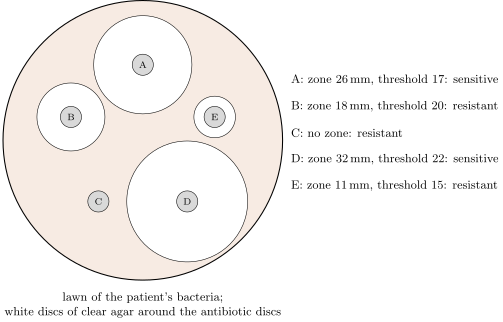
An antibiogram read. Each disc holds one antibiotic; the clear zone is where the bacteria could not grow. Compared with each drug’s threshold, the diameters classify the strain as sensitive to A and D, resistant to B, C and E.
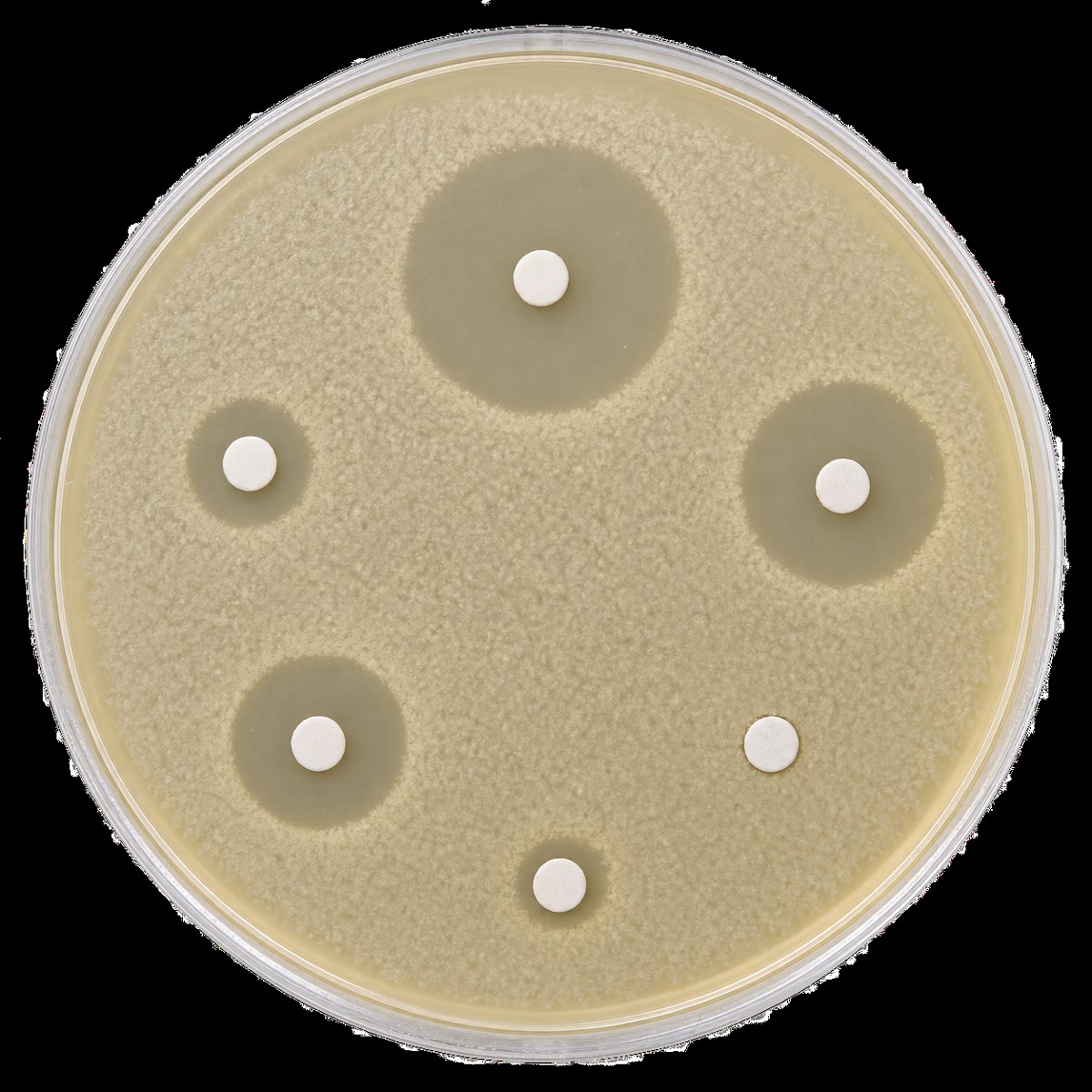
An antibiogram plate after a night’s incubation: a lawn of bacteria, and around each antibiotic disc a clear zone whose size measures the strain’s sensitivity. One disc has no zone.

উদাহরণ

Example 18.2 (The arithmetic of a population)

A resistance mutation arises about once in 10810^8 divisions. A flask of 10910^9 bacteria has therefore had, in the divisions that produced it, some ten such mutations; an infected wound or a gut, with 101210^{12} bacteria, some ten thousand. Every large population of bacteria contains, before any antibiotic is used, cells resistant to it — the replica plates of Chapter 13 proved it.

Example 18.7 (From one cell to a ward)

A patient treated with penicillin carries, among 101010^{10} bacteria, a hundred resistant ones. In three days the sensitive ones are gone and the resistant clone has taken the place: 101010^{10} resistant cells. On a nurse’s hands, on a bed rail, in the next patient, the clone continues — and if its resistance gene is on a plasmid, it hands it to other species along the way. Nothing in this sequence required the antibiotic to act on the DNA; it only removed the competition.

প্রসঙ্গসহ পড়ো →