High School Biology · Grades 10–12
18Bacteria and Antibiotic Resistance
In 1941 a policeman dying of blood poisoning from a scratch was given the first doses of penicillin ever used on a patient. He recovered within days — and relapsed and died when the supply, painstakingly extracted from mould, ran out. Within a decade penicillin was manufactured by the tonne and infections that had killed for millennia became curable in a week. Within two decades, bacteria that penicillin no longer touched were common in every hospital. This chapter is about why: how bacteria vary, how an antibiotic sorts them, and how the arithmetic of a population of billions turns a rare mutation into a ward-wide problem.
18.1 How bacteria vary
Proposition 18.1 (Bacterial reproduction and variation)
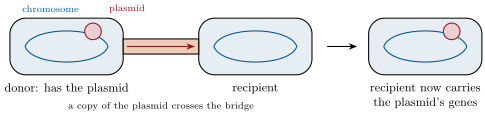
A bacterium reproduces by dividing in two after copying its single chromosome: the daughters are, apart from copying errors, genetically identical to the mother — a clone. In a rich medium a division every 20 minutes turns one cell into a billion in ten hours. Genetic variation in the clone comes from two sources:
- mutations (Chapter 13), rare per division but frequent in a population of billions;
- horizontal gene transfer: DNA received from another bacterium, of the same species or another, most often as a plasmid — a small circle of DNA, separate from the chromosome, carrying a few genes and able to pass from cell to cell through a bridge of membrane.
Proof. Admitted at this level. ∎
Example 18.2 (The arithmetic of a population)
A resistance mutation arises about once in divisions. A flask of bacteria has therefore had, in the divisions that produced it, some ten such mutations; an infected wound or a gut, with bacteria, some ten thousand. Every large population of bacteria contains, before any antibiotic is used, cells resistant to it — the replica plates of Chapter 13 proved it.
18.2 Antibiotics
Definition 18.3 (Antibiotic)
An antibiotic is a molecule that kills bacteria or stops their growth, at concentrations harmless to the patient’s cells, by acting on a structure or a process that bacteria have and human cells lack: penicillin and its relatives block the building of the bacterial wall; streptomycin and tetracycline jam the bacterial ribosome, which differs from ours; others block the bacterial enzymes of DNA replication. Most were first found in moulds and soil bacteria, which make them against their competitors. Antibiotics have no effect on viruses, which have none of these targets.
Proposition 18.4 (Mechanisms of resistance)
A bacterium is resistant to an antibiotic when it grows at concentrations that stop its sensitive relatives. Resistance has a genetic basis of one of a few kinds: a gene for an enzyme that destroys the antibiotic (penicillinases cut penicillin in two); a mutation altering the antibiotic’s target so that the drug no longer binds (a changed ribosomal protein); a pump that expels the drug; a wall that does not let it in. Each is an allele or a gene, and each is inherited — vertically by the clone and, when on a plasmid, horizontally by neighbours.
Proof. Admitted at this level. ∎
Method 18.5 (Reading an antibiogram)
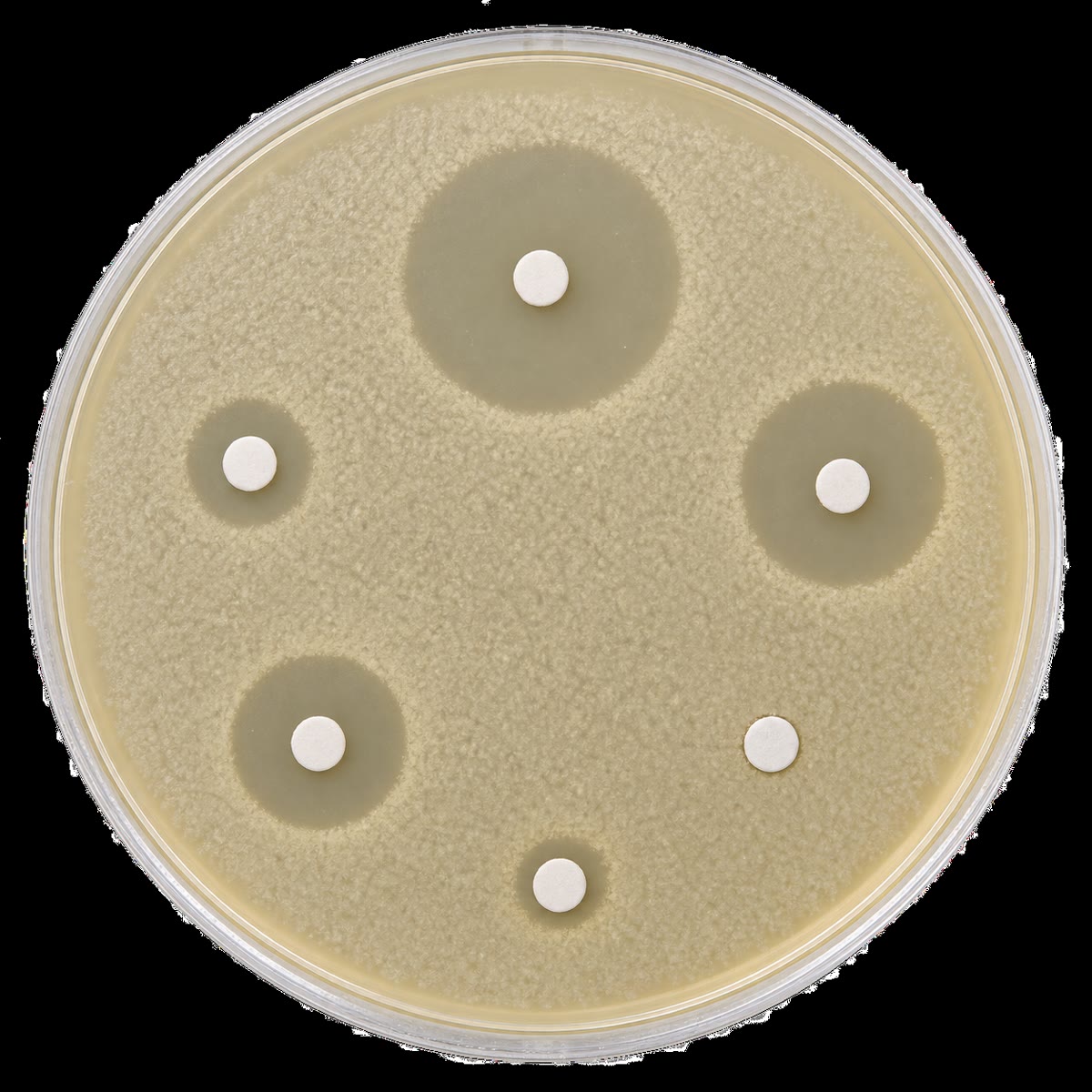
An antibiogram tests a patient’s bacteria against several antibiotics at once.
- Spread the bacteria evenly on a plate; lay paper discs each soaked with one antibiotic; incubate overnight.
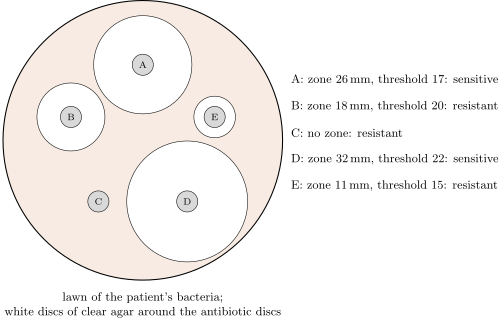
- The antibiotic diffuses out of the disc, its concentration falling with distance; the bacteria grow into a lawn except where the concentration stops them: a clear zone of inhibition around each disc.
- Measure each zone’s diameter and compare with the threshold established for that antibiotic: a diameter above the threshold means sensitive, below it resistant.
- The largest zones among the sensitive results guide the prescription; a disc with no zone at all is an antibiotic the strain ignores.
18.3 How resistance spreads
Proposition 18.6 (Selection by the antibiotic)
An antibiotic does not create resistant bacteria; it selects them. In a population where a few cells carry a resistance allele, the drug kills or stops the sensitive majority and leaves the resistant few to multiply without competition: within days the population is resistant. The more an antibiotic is used — in patients, in animals, in the environment — the more often this sorting happens, and the more resistant the bacteria of a hospital, a farm or a country become. An incomplete course, which kills the most sensitive cells and spares the least, selects most efficiently of all.
Evidence. Lederberg’s replica plates showed the resistant cells present before exposure. Cultures grown for a week in rising concentrations of an antibiotic end up resistant to a hundred times the initial dose, and their resistance is inherited and mapped to specific mutations. Countries that use the most antibiotics per person have the highest proportions of resistant strains; hospital wards that reduce their use see resistance fall over months. A strain of the skin bacterium Staphylococcus aureus resistant to penicillin appeared within four years of the drug’s introduction and now accounts for most hospital strains; the strain resistant to the replacement drug followed the replacement by two years. ∎
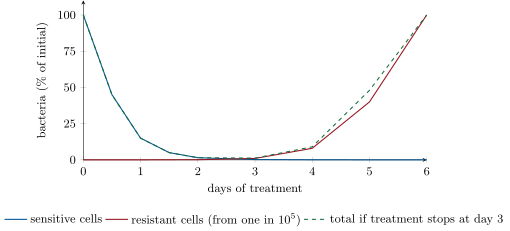
Example 18.7 (From one cell to a ward)
A patient treated with penicillin carries, among bacteria, a hundred resistant ones. In three days the sensitive ones are gone and the resistant clone has taken the place: resistant cells. On a nurse’s hands, on a bed rail, in the next patient, the clone continues — and if its resistance gene is on a plasmid, it hands it to other species along the way. Nothing in this sequence required the antibiotic to act on the DNA; it only removed the competition.
18.4 Keeping antibiotics working
Proposition 18.8 (Consequences and responses)
Resistant infections are longer, costlier and more often fatal; some strains now resist every available drug. Since resistance is driven by use, the response is to use antibiotics less and better: only for bacterial infections (never for viral colds and flu), chosen after an antibiogram where possible, at the full dose for the full course, with the narrowest drug that works; to limit their use in farming; to prevent infection (hygiene, vaccination) so that fewer courses are needed; and to isolate carriers of resistant strains in hospitals. New antibiotics buy time; the arithmetic of selection guarantees that resistance to each will appear.
Proof. Admitted at this level. ∎
Remark 18.9 (Evolution in a week)
Mutation supplying variation at random, the environment sorting it, the descendants of the survivors inheriting the difference: the bacteria of this chapter run through, in a week, the process that the final year will describe over millions of years for whales and oaks. Antibiotic resistance is evolution by natural selection observed in real time, with humans as the selecting agent — and the clearest demonstration that the process is not a theory about the past but a fact about any population that varies and reproduces.
18.5 Exercises
Exercise 18.1 ★
Name the two sources of genetic variation in a bacterial population.
Solution
Solution of Exercise 18.1.
Mutations arising during the clone’s divisions, and horizontal gene transfer — DNA, usually a plasmid, received from another bacterium.
Exercise 18.2 ★
What is an antibiotic, and why does it harm bacteria but not the patient’s cells? Why is it useless against a cold?
Exercise 18.3 ★
Give three mechanisms by which a bacterium can resist an antibiotic.
Solution
Solution of Exercise 18.3.
An enzyme that destroys the antibiotic; a mutated target the drug no longer binds; a pump expelling the drug (or a wall that excludes it).
Exercise 18.4 ★
In the antibiogram figure, a new disc F gives a zone of with a threshold of . Sensitive or resistant? Which antibiotic would you prescribe among A to F?
Solution
Solution of Exercise 18.4.
Sensitive (20 above 18), but only just. D, with the widest margin above its threshold, then A.
Exercise 18.5 ★
Does an antibiotic cause resistance mutations? Justify with the experiment of Chapter 13.
Solution
Solution of Exercise 18.5.
No. On replica plates, resistant colonies appear at the same positions on every antibiotic plate, so the resistant cells existed in the original colonies, which never met the drug. The antibiotic reveals and selects; it does not induce.
Exercise 18.6 ★★
Starting from one bacterium dividing every 20 minutes, how many are there after 10 hours? If resistance arises once per divisions, how many resistant cells does the culture probably contain?
Exercise 18.7 ★★
From the selection figure, at which day do resistant cells become the majority of the total? What is the total population at day 6 in the dashed case, and what is it made of?
Exercise 18.8 ★★
Explain why a resistance gene on a plasmid spreads faster than one on the chromosome.
Exercise 18.9 ★★
A patient feels better after three days of a seven-day course and stops. Explain, with the figure, what happens in the following days and why the relapse is harder to treat.
Solution
Solution of Exercise 18.9.
At day 3 the sensitive cells are down to a fraction of a per cent while the resistant ones are rising; without the drug all survivors regrow, and the population that returns is far richer in resistant cells than the original. The relapse no longer responds to the same drug.
Exercise 18.10 ★★
Why is the proportion of resistant strains higher in hospitals than in the general population?
Solution
Solution of Exercise 18.10.
Hospitals use antibiotics intensively on many patients close together: selection is constant and the selected strains are passed from patient to patient by hands and surfaces.
Exercise 18.11 ★★
Explain why a mutation altering a ribosomal protein can make a bacterium resistant to streptomycin, and why such a bacterium often grows a little more slowly than its sensitive relatives.
Exercise 18.12 ★★★
Two antibiotics with different targets are given together. Estimate the probability that a cell is resistant to both by independent mutations (one in each), and explain why combined therapy is used against slow, long infections such as tuberculosis.
Solution
Solution of Exercise 18.12.
per division: with bacteria, no cell is likely to carry both. In tuberculosis, treatment lasts months and the bacteria number billions, so single-drug resistance is certain to be selected; two drugs at once leave no survivor to select.
Exercise 18.13 ★★★
A farm adds low doses of an antibiotic to animal feed to speed growth. Predict the consequences for the animals’ bacteria, for the farm workers, and for human medicine, using selection and horizontal transfer.
Solution
Solution of Exercise 18.13.
Low doses select resistant strains in the animals’ gut without killing the population; the workers acquire them by contact; plasmids carry the genes into human pathogens and into the environment through manure. Resistance to the drug, and to related human drugs, rises in medicine.
Exercise 18.14 ★★★
A ward halves its antibiotic prescriptions; within a year the proportion of resistant strains falls. Explain why resistance can recede, using the cost of resistance to the bacterium and competition.
Solution
Solution of Exercise 18.14.
Resistance often costs the bacterium (a slower ribosome, an enzyme to make): without the drug, sensitive cells grow slightly faster and outcompete the resistant ones over many generations. The proportion falls — but the resistant genes remain in the population at low frequency, ready to be selected again.
Exercise 18.15 ★★★
"Bacteria become resistant because they get used to the antibiotic." Rewrite this sentence correctly, in a short paragraph, using mutation, selection and inheritance.
Solution
Solution of Exercise 18.15.
Bacteria do not adapt individually. In any large population a few cells carry, by random mutation or by a plasmid received from another cell, an allele that makes them resistant. The antibiotic kills the others; the resistant cells multiply and pass the allele to their descendants. The population becomes resistant because it has been sorted, not because its members learnt anything.
18.6 Problem: The Ward
Problem 18.1
Weekend problem — an outbreak on a hospital ward followed from a single mutant cell: the arithmetic of a colony, an antibiogram read, a course interrupted, and the policy that stops the spread
A patient’s wound is infected with bacteria of one species. The bacteria divide every 30 minutes; a mutation giving resistance to the antibiotic amoxicillin occurs once per divisions. The antibiotic kills 90% of sensitive cells every 6 hours and does not affect resistant cells, which keep dividing.
Part I — Before treatment.
- How many divisions produced the bacteria from the first cell? (Count the number of cells.)
- Estimate the number of resistant cells present before any antibiotic is given.
- Explain why the patient’s infection is nevertheless described as "sensitive" on the antibiogram.
- The antibiogram shows zones of for amoxicillin (threshold 17), for erythromycin (threshold 20) and none for penicillin. Interpret the three results.
- The doctor prescribes amoxicillin for 7 days. Why not penicillin, and why not the drug with the largest zone if one had been larger?
Part II — During treatment.
- How many sensitive cells remain after 1 day? After 3 days?
- Starting from your answer to question 2, how many resistant cells are there after 1 day if they double every 30 minutes without limit? (Use .) Why is this figure unrealistic, and what limits it?
- Suppose the resistant clone is limited to the space the sensitive cells vacate, so that it cannot exceed . Roughly when does it fill that space?
- Sketch, or describe, the curves of sensitive, resistant and total cells over the 7 days.
- In fact the patient’s immune system clears the last few million cells of any kind within days. Explain why the outcome depends on whether the resistant clone grows faster than the immune system clears it.
Part III — The course interrupted.
- The patient stops after 2 days, feeling well. How many sensitive cells remain, and what fraction of the surviving population is resistant?
- The bacteria regrow to over the following days. What proportion is now resistant, if resistant and sensitive cells grow at the same rate?
- The patient relapses and is given amoxicillin again. Predict the result.
- An antibiogram of the relapse shows no zone for amoxicillin. Explain the change from the first antibiogram.
- The resistance gene is on a plasmid. What further risk does that add for the ward?
Part IV — The ward’s policy. The ward treats 400 patients a year with amoxicillin; 30% of infections isolated on the ward are now resistant, against 5% in the town.
- Explain the difference between the ward and the town in terms of selection pressure.
- The ward decides: antibiograms before every prescription, full courses, hand hygiene, and isolation of carriers of resistant strains. Say which mechanism of this chapter each measure acts on.
- After two years resistance on the ward is 12%. Explain why it fell, and why it did not return to 5%.
- Why would a new antibiotic, introduced on the ward, not solve the problem for more than a few years?
- State the result: the number of resistant cells the wound held before any drug, the day on which they inherited it, and the single habit of the patient that turned a curable infection into an outbreak.
Solution
Solution of Problem 18.1.
1. About divisions (one per cell produced).
2. resistant cells, on average.
3. A hundred cells in ten billion are invisible on a plate: the lawn behaves as sensitive because 99.999999% of it is.
4. Amoxicillin: sensitive (24 above 17). Erythromycin: resistant (12 below 20). Penicillin: fully resistant, no inhibition.
5. Penicillin is useless against this strain. The choice among sensitive drugs also weighs side effects and spectrum; the narrowest effective drug is preferred to spare the patient’s other bacteria.
6. Four periods of 6 hours per day: after 1 day; after 3 days — essentially none.
7. : absurd, more than the wound could hold. Growth is limited by space, nutrients and the immune system.
8. From 100 cells to needs doublings, about 13 hours; in practice the space frees over the first day, so by day 1 to 2 the resistant clone has replaced the sensitive population.
9. Sensitive: falling by a factor of 10 every 6 hours to nothing by day 3. Resistant: rising from 100 to fill the space within a day or two, then flat at . Total: a dip during day 1, then back to , now all resistant.
10. If the immune system clears cells faster than the resistant hundred can multiply, the infection ends despite them; if the clone outgrows the clearance, the infection becomes resistant. Antibiotics work with the immune system, not instead of it.
11. Sensitive after 2 days: . Resistant: about if the clone has filled the space, or at least many thousands: the survivors are almost all resistant.
12. Growing at the same rate preserves the proportion: essentially 100% resistant.
13. No effect: the resistant clone ignores amoxicillin.
14. The first plate held the original population, 99.999999% sensitive; the relapse plate holds the selected clone, all resistant, so the lawn grows up to the disc.
15. The gene can pass to other species carried by other patients or staff, so the ward’s other pathogens can become resistant without waiting for their own mutation.
16. On the ward, 400 courses a year in a small closed population sort the bacteria continually, and the selected strains pass between patients; in the town selection is diluted among many people and species.
17. Antibiograms: choose a drug the strain cannot resist, so no clone is selected. Full courses: no interrupted course leaves the resistant survivors to regrow. Hygiene: no transmission of the selected clone between patients. Isolation: no horizontal or vertical spread from carriers.
18. Less selection let sensitive strains, which grow slightly faster, regain ground, and transmission of resistant ones was cut. It did not return to 5% because the resistant strains and their plasmids persist at low frequency and are re-selected by each remaining course.
19. Any large bacterial population contains cells resistant to the new drug by chance mutation; using it selects them, and in a few years the resistant strain is common, as with every antibiotic introduced so far.
20. About a hundred resistant cells among ten billion before any drug; on the second day of treatment they inherited the wound; stopping the course early turned the curable infection into a resistant one that spread.