High School Biology · Grades 10–12
13Mutations and Genetic Variation
A child is born with no pigment at all — white hair, pale skin, eyes that cannot bear bright light — to two ordinary parents from a family with no history of the condition. A colony of bacteria that has never met an antibiotic contains, out of a hundred million cells, a few that already resist it. A gardener finds a single branch of a rose bush bearing flowers of a different colour. In each case a DNA sequence has changed, once, in one cell; and in each case the change is copied faithfully thereafter. This chapter is about those changes: what they are, where they come from, how the cell limits them, and why life depends on their never quite stopping.
13.1 What a mutation is
Definition 13.1 (Mutation)
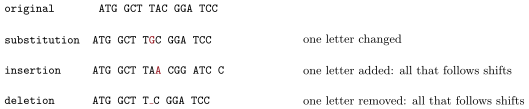
A mutation is a change in the sequence of nucleotides of a DNA molecule, transmitted to the descendants of the cell in which it occurs. The commonest are point mutations, affecting one or a few nucleotides:
- a substitution: one nucleotide replaced by another;
- an insertion: one or more nucleotides added;
- a deletion: one or more nucleotides removed.
Larger changes — a segment duplicated, inverted, moved, or a whole chromosome gained or lost — are mutations too.
Proposition 13.2 (Where mutations happen, and to whom)
A mutation occurring in a body cell (somatic mutation) is passed to the descendants of that cell only: a patch of tissue, at most, in one individual. A mutation in a germ cell — a gamete or one of its precursors — is passed to the offspring conceived from it and to every one of their cells: a germline mutation is the only kind that enters the heredity of the species. The rose bush’s odd branch is somatic; the pigmentless child’s condition came from a germline mutation in some ancestor, carried silently for generations.
Proof. Admitted at this level. ∎
Example 13.3 (The frequency of mutation)
Replication leaves about one error per nucleotides (Chapter 11). A gene of base pairs is therefore miscopied about once in every replications; a human, whose genome is copied some times in a lifetime, accumulates mutations in every gene in many cells. Each child is born with some 60 new mutations that neither parent carried — almost all in the 98% of the genome that is not genes.
13.2 Causes: spontaneous and induced
Proposition 13.4 (Spontaneous mutations)
Mutations arise in every cell, in the absence of any external agent: from the rare mispairings that escape the polymerase’s checking, and from the chemical instability of DNA itself, whose bases are damaged thousands of times a day per cell by the water and the reactive molecules of ordinary metabolism. Such spontaneous mutations are random: they occur at any position, at a rate that does not depend on whether the change would be useful to the cell.
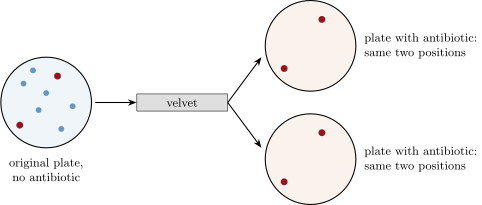
Evidence. Lederberg (1952) spread bacteria never exposed to an antibiotic on a plate, let them grow into colonies, then pressed a velvet pad onto the plate and stamped its imprint — the same colonies in the same positions — onto several plates containing the antibiotic. The few resistant colonies appeared at the same positions on every antibiotic plate. Since they came from the same colonies of the original plate, which had never seen the antibiotic, the resistance mutation existed before the exposure: the antibiotic revealed it and did not cause it. The mutations had occurred at random during the growth of the colonies, without regard to their future usefulness. ∎
Definition 13.5 (Mutagen)
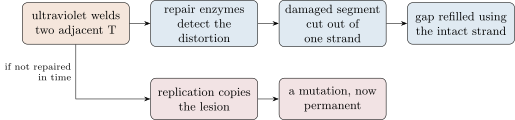
A mutagen is a physical or chemical agent that raises the rate of mutation by damaging DNA. Ultraviolet light welds neighbouring thymines together on a strand; X-rays and radioactivity break the strands; chemicals such as the benzopyrene of tobacco smoke or the aflatoxin of mouldy grain attach to bases and distort the helix. A cell exposed to a mutagen carries induced mutations in addition to its spontaneous ones — still at random positions, only more of them.
Example 13.6 (Ultraviolet on yeast)
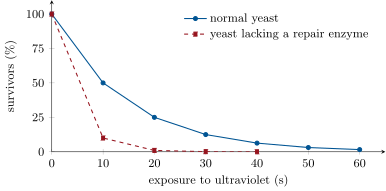
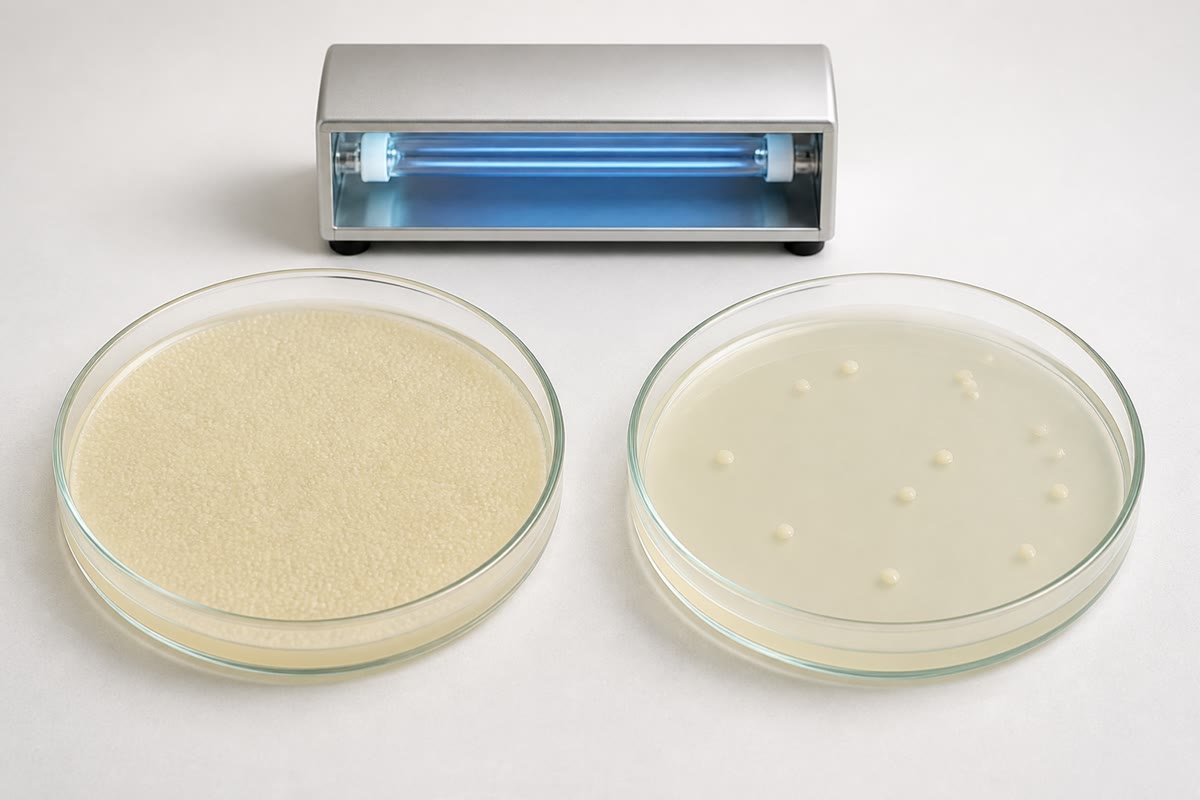
Yeast cells spread on plates and exposed to ultraviolet light for increasing times: after half the cells fail to form a colony, after a quarter, after an eighth — each dose halves the survivors. Among the survivors, the proportion of colonies with a visibly changed trait (colour, shape, inability to grow on a certain sugar) rises from one in a million to one in a thousand. The lamp kills by damaging DNA beyond repair, and mutates by damaging it just short of that.
13.3 The cell fights back: repair
Proposition 13.7 (DNA repair)
A cell suffers tens of thousands of DNA lesions a day and keeps almost none of them: dedicated enzyme systems patrol the double helix, recognise a damaged or mispaired base, cut out the faulty segment of one strand and rebuild it using the other strand as template — the complementarity of Chapter 3 once again. A lesion becomes a mutation only if it escapes repair before the next replication copies it. Repair is why the mutation rate is and not .
Evidence. People with the hereditary condition xeroderma pigmentosum lack one of the enzymes that excise ultraviolet damage. Their skin, exposed to ordinary daylight, develops cancers a thousand times more often than normal skin and from early childhood; protected from the sun, it is normal. The same ultraviolet, the same lesions — but without the repair the lesions stay, and the mutations accumulate in the genes that control cell division (Chapter 17). Yeast and bacterial strains lacking repair enzymes show the same hypersensitivity in the laboratory. ∎
13.4 Consequences of a mutation
Proposition 13.8 (From sequence to phenotype)
A mutation changes an allele into a new allele. Its effect depends on where it falls and what it does to the protein the gene encodes (Chapter 14 gives the rules):
- outside any gene, or at a position that does not change the protein: no effect — the great majority;
- within a gene, changing one amino acid: a protein that works slightly differently, or not at all, or occasionally better;
- within a gene, shifting or truncating the message: usually a protein that does not work.
Whether a changed protein is harmful, neutral or useful depends on the environment: the same allele of a haemoglobin gene is a burden in a region without malaria and a protection where malaria is present.
Proof. Admitted at this level. ∎
Example 13.9 (Pigment lost, pigment kept)
The pigment melanin is made by an enzyme. Dozens of different mutations of its gene are known, each producing a non-working enzyme and, in a person carrying two such alleles, the pigmentless condition of the chapter’s opening. Every one of them arose at random, once, in a germ cell; the visible condition appears only when two carriers pass their silent alleles to the same child. The same gene, in another allele, makes a slightly less active enzyme — and lighter skin, common in populations that lived for millennia at high latitudes, where a little less pigment lets the skin make more vitamin D from a weak sun.
Proposition 13.10 (Mutation, the source of diversity)
Every allele of every gene began as a mutation of an earlier allele. Mutation is the only process that creates new genetic information; the sexual shuffling of the final year only recombines what mutation has made. Rare, random and mostly neutral or harmful in the individual, mutation is nevertheless what supplies, over the generations, the variation on which the evolution of Chapter 5 depends.
Proof. Admitted at this level. ∎
Method 13.11 (Analysing a mutation)
- Compare the mutant sequence with the original, letter by letter, and name the change (substitution, insertion, deletion; how many nucleotides).
- Locate it: in a gene or outside; if in a gene, whether the reading of the message is shifted.
- Identify the cell it occurred in: somatic (one individual, one tissue) or germline (transmitted).
- Look for a cause if the rate is unusual (mutagen exposure, defective repair); otherwise attribute it to chance.
- Judge the consequence at the level of the protein, the cell, the organism and the population — in that order, and in a stated environment.
Remark 13.12 (Randomness, precisely)
"Random" does not mean that all positions mutate equally — some sequences are more fragile — nor that mutations are causeless. It means that a mutation’s occurrence is independent of whether it would help the cell: the antibiotic-resistant bacteria of the replica plates were not made resistant by the antibiotic, and no organism can "decide" to mutate in a useful direction. Selection does the directing, afterwards; mutation only supplies.
13.5 Exercises
Exercise 13.1 ★
Define mutation and name the three kinds of point mutation.
Solution
Solution of Exercise 13.1.
A change in the nucleotide sequence of DNA, transmitted to the descendants of the cell. Substitution, insertion, deletion.
Exercise 13.2 ★
Compare ATGCCTGAAT with the mutants ATGCCAGAAT, ATGCCTGAT and ATGCCTTGAAT. Name each mutation.
Solution
Solution of Exercise 13.2.
ATGCCAGAAT: substitution (T to A at position 6). ATGCCTGAT: deletion of one A. ATGCCTTGAAT: insertion of one T.
Exercise 13.3 ★
What is the difference between a somatic and a germline mutation? Which one matters for heredity?
Exercise 13.4 ★
Name three mutagens and, for one of them, the damage it does to DNA.
Solution
Solution of Exercise 13.4.
Ultraviolet light, X-rays, benzopyrene of tobacco smoke (also radioactivity, aflatoxin). Ultraviolet welds two neighbouring thymines of one strand together, distorting the helix.
Exercise 13.5 ★
What does a repair system use as a template to rebuild a damaged segment? Why is that possible?
Solution
Solution of Exercise 13.5.
The intact complementary strand: because each strand determines the other, the correct sequence of the damaged segment can be rebuilt from its partner.
Exercise 13.6 ★★
From the survival figure, what fraction of normal yeast survives of ultraviolet? And of the repair-deficient strain? By what factor does repair improve survival at that dose?
Solution
Solution of Exercise 13.6.
Normal: about 6%; repair-deficient: 0.01%. Repair improves survival about 600-fold at that dose.
Exercise 13.7 ★★
A culture of bacteria is spread on an antibiotic plate and 20 colonies grow. Estimate the frequency of resistant cells. Does this tell you the mutation was caused by the antibiotic?
Exercise 13.8 ★★
Explain in your own words why the identical positions of resistant colonies on the replica plates prove that the mutations occurred before exposure.
Solution
Solution of Exercise 13.8.
Each replica receives cells from the same original colonies. If the antibiotic caused resistance at contact, the affected cells would be a random few on each replica, at unrelated positions. Finding resistance always at the same positions means those original colonies, grown without the drug, already contained resistant cells.
Exercise 13.9 ★★
A gene of base pairs is copied with one error per nucleotides. In a tissue of cells, all descended from one cell by 40 divisions, roughly how many cells carry a new mutation in that gene? (Count only errors made in the last division.)
Exercise 13.10 ★★
A rose bush bears one branch with flowers of a different colour. Cuttings from that branch give bushes with the new colour; seeds from its flowers give ordinary roses. Explain both results.
Solution
Solution of Exercise 13.10.
A somatic mutation in a bud cell gave the branch its colour; cuttings are that tissue, so they keep it. The flowers’ germ cells derive from the same branch, but a change in one allele is passed to only half the gametes, and the ovules were fertilised by pollen carrying the ordinary allele; the new allele, if recessive, is hidden in the seedlings.
Exercise 13.11 ★★
Why does a person with xeroderma pigmentosum develop skin cancers but not, for instance, cancers of the gut?
Solution
Solution of Exercise 13.11.
The missing enzyme repairs ultraviolet damage; ultraviolet penetrates only the skin. The gut receives no ultraviolet, suffers no such lesions, and does not need that repair.
Exercise 13.12 ★★★
Sunscreen absorbs ultraviolet. Using the survival figure, explain what a sunscreen that lets through a tenth of the ultraviolet does to the number of lesions per skin cell in an hour of sun, and why "no sunburn" does not mean "no mutations".
Solution
Solution of Exercise 13.12.
Lesions are proportional to the dose: a tenth of the ultraviolet means a tenth of the lesions per cell per hour — still thousands. Sunburn is the death of many cells; below that dose cells survive, but the lesions that escape repair become mutations. No burn means the damage was survivable, not absent.
Exercise 13.13 ★★★
An allele of the haemoglobin gene protects against malaria in carriers of one copy but causes a severe disease in carriers of two. Discuss whether this mutation is "harmful" or "useful", and what decides.
Solution
Solution of Exercise 13.13.
Neither in itself. In a region with malaria the single copy raises survival, and the allele is kept common despite the disease of double carriers; where malaria is absent it only causes disease and is rare. The environment, and the number of copies, decide the value of a mutation.
Exercise 13.14 ★★★
Bacteria in a broth without antibiotic are found, after 30 generations, to contain one resistant cell per million. If the antibiotic is then added, what happens to the culture within a day? Explain why doctors insist that an antibiotic course be taken in full.
Solution
Solution of Exercise 13.14.
The sensitive cells die; the resistant ones, already present, divide freely and within a day the culture is entirely resistant. A course stopped early leaves the last survivors — the most resistant — alive to regrow, in a body now enriched in resistance; taking the full course kills them before they multiply.
Exercise 13.15 ★★★
"If mutations are almost always harmful, evolution cannot be built on them." Discuss in a paragraph, using the notions of randomness, the proportion of neutral mutations, the environment, and the time scale.
Solution
Solution of Exercise 13.15.
Most mutations are neutral (outside genes or without effect on the protein), a minority harmful, a very few useful; being random, they occur regardless of use, but selection keeps the useful ones and removes the harmful. Usefulness depends on the environment, so a mutation harmful today can be the one that matters when conditions change. Over thousands of generations, with billions of individuals, even rare useful mutations arise repeatedly: evolution is built on the sorted remainder, not on the average mutation.
13.6 Problem: The Velvet Stamp
Problem 13.1
Weekend problem — Lederberg’s replica plating reconstructed: colonies counted, resistances mapped, the origin of the mutations decided, and their rate measured
A student spreads about 200 bacteria, from a culture that has never met the antibiotic streptomycin, on a plate without antibiotic. After a night, 200 colonies have grown, each from one cell and each containing about cells. A velvet pad is pressed on the plate and stamped onto three plates containing streptomycin. The next day, plate A shows two resistant colonies, plate B two, plate C two — at the same two positions on all three.
Part I — The experiment.
- Why must the colonies on the original plate come from single cells, and why is the number of bacteria spread kept small?
- Explain what the velvet transfers, and why the position of a colony is preserved.
- Two positions out of 200 give resistant colonies on every replica. What does the agreement between the three replicas show?
- Suppose instead that the antibiotic induced resistance in a small fraction of cells on contact. Describe the pattern the three replicas would then show.
- Which of the two hypotheses — mutation before contact, or induction by contact — does the observed pattern support? State the argument in one sentence.
Part II — Back to the original plate.
- The student takes cells from the two resistant positions on the original plate (which has never touched the antibiotic) and from two other positions, and tests each sample on streptomycin. Predict the results.
- The two colonies at the resistant positions contain about cells each. Are all of their cells resistant, or only some? What would you need to know to decide?
- A colony grows from one cell through about 23 divisions. If the mutation happened at the 20th division, what fraction of the colony’s cells carry it? And if at the 3rd division?
- Explain why testing a whole colony can reveal a mutation that occurred in only a fraction of its cells.
- Why does the experiment work only if the colonies on the replica plates grow exactly where the original ones were?
Part III — Measuring the rate.
- The student repeats the experiment with 50 original plates of 200 colonies each: 10 000 colonies, of which 30 give resistant replicas. What fraction of colonies carries at least one resistant cell?
- Each colony arose from one cell by about cell divisions. Estimate the probability that a given division produces a resistance mutation.
- Streptomycin resistance requires a change at one specific position of one gene. Compare your estimate with the replication error rate of per nucleotide, and comment.
- A culture of cells is grown from a single cell in antibiotic-free broth. Using your rate, estimate how many resistant cells it is likely to contain when the antibiotic is finally added.
- If the resistance mutation occurred early in that culture’s growth, how does the number of resistant cells change? Why do repeated cultures give very different counts?
Part IV — What it means.
- Explain the difference between "mutations are random" and "mutations are rare", and which one the experiment establishes.
- The antibiotic did not create the resistance. What did it do to the population?
- Translate the experiment into the language of Proposition 13.10: what supplied the variation, and what sorted it?
- A student objects that the two resistant colonies on the original plate "looked exactly like the others". Explain why a mutation can be invisible until the environment changes.
- State the result: what the identical positions on three velvet replicas proved about the origin of mutations, and the rate per division you measured.
Solution
Solution of Problem 13.1.
1. So that each colony is a clone with a known origin, and so that colonies are separate enough to be told apart on the replicas.
2. A few cells from the top of every colony, in the same geometric arrangement as on the plate, because the pad is pressed flat without sliding.
3. That the resistant cells were present in those two original colonies: three independent replicas do not agree by chance.
4. Resistant colonies at random, unrelated positions on the three plates, since which cells were induced would differ from replica to replica.
5. Mutation before contact: the resistance maps to the original colonies, which never met the drug.
6. Cells from the two resistant positions grow on streptomycin; cells from the other positions do not.
7. Only some, probably: the mutation happened at some division during the colony’s growth, and only the descendants of that cell are resistant. To decide, one would plate a known number of the colony’s cells on streptomycin and count survivors.
8. At the 20th of 23 divisions: …more simply, the mutant cell then divides 3 more times: resistant cells out of , about one in a million. At the 3rd division: one of the 8 cells then present, so an eighth of the colony.
9. Even a few resistant cells among the or so the velvet lifts are enough to found a colony on the antibiotic plate; the test detects the presence of resistant cells, not their proportion.
10. The argument rests on position: only if the geometry is preserved can a colony on a replica be identified with a colony on the original plate.
11. .
12. About mutations per divisions: per division.
13. Of the same order as the error rate at one nucleotide: the resistance mutation is essentially one specific substitution escaping repair.
14. divisions at : on average a fraction of one mutation, so most cultures hold none or a few resistant cells (each mutation then multiplied by the divisions that follow it).
15. A mutation at an early division is inherited by a large fraction of the culture, so the count is large; a late one gives only a few resistant cells. Because the timing is random, replicate cultures give widely scattered counts — itself a sign that the mutations arise before, not in response to, the antibiotic.
16. Rare: mutations occur seldom per division. Random: they occur independently of their usefulness. The experiment establishes randomness (the position argument); the counts of Part III measure rarity.
17. It sorted the population: it killed the sensitive cells and let the resistant ones multiply — selection.
18. Mutation supplied the resistant allele, at random, before any need; the antibiotic sorted the population, keeping only its carriers.
19. The mutation changes a molecule involved in the drug’s action, not the colony’s growth or appearance without the drug; a genetic difference has a visible effect only in an environment where it matters.
20. Identical positions on the three replicas proved that resistance mutations arise before, and independently of, exposure to the antibiotic; the measured rate is about per cell division.