 Coach
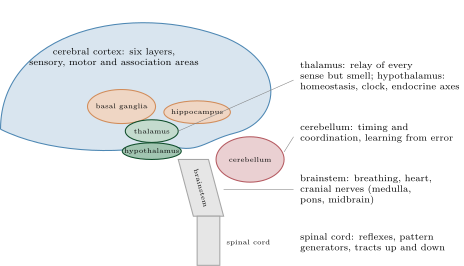
CoachThe central nervous system is the brain and spinal cord; the peripheral is everything else. The spinal cord receives sensory axons through its dorsal roots and sends motor axons through its ventral roots, its grey matter a butterfly of cell bodies, its white matter the myelinated tracts running up and down. The brainstem — medulla, pons, midbrain — holds the nuclei of the cranial nerves and the centres that keep breathing, heart rate and blood pressure going without thought; a brainstem death is death. The cerebellum, with more neurons than the rest of the brain, tunes the timing and coordination of movement and learns from error. The thalamus relays every sense but smell to the cortex and the cortex’s answers back; the hypothalamus beneath it runs homeostasis — temperature, hunger, thirst, the clock, the endocrine axes of Chapter 21. The basal ganglia select among possible actions; the hippocampus makes memories (Chapter 19); and the cerebral cortex, a sheet of six layers of cells two to four millimetres thick and a quarter of a square metre in area, folded to fit, does the rest, in areas mapped for each sense and movement and in association areas between them. The peripheral system’s autonomic division runs the organs: the sympathetic chain, releasing noradrenaline, mobilises (heart up, gut down, pupils wide); the parasympathetic nerves, releasing acetylcholine, conserve and digest; and the enteric nervous system, half a billion neurons in the gut wall, runs digestion on its own.
Examples
Example 17.10 (Counting neurons)
A nematode has neurons, every one named and every synapse mapped; a fruit fly ; a honeybee ; a mouse ; an octopus ; a human ; an elephant , most of them in its cerebellum. Brain mass scales with body mass across mammals roughly as , so a mouse’s brain is a larger fraction of its body than an elephant’s; species above the line for their size — dolphins, primates, humans by a factor of seven — are said to be encephalised. What tracks cognition best is not brain mass but the number of neurons in the cerebral cortex: about in a human, in the elephant with its three-times-larger brain, in a chimpanzee. The human brain is not special in its cells or its plan; it has more cortical neurons than any other, packed more densely, and it is the number, not the weight, that seems to count.