Coach
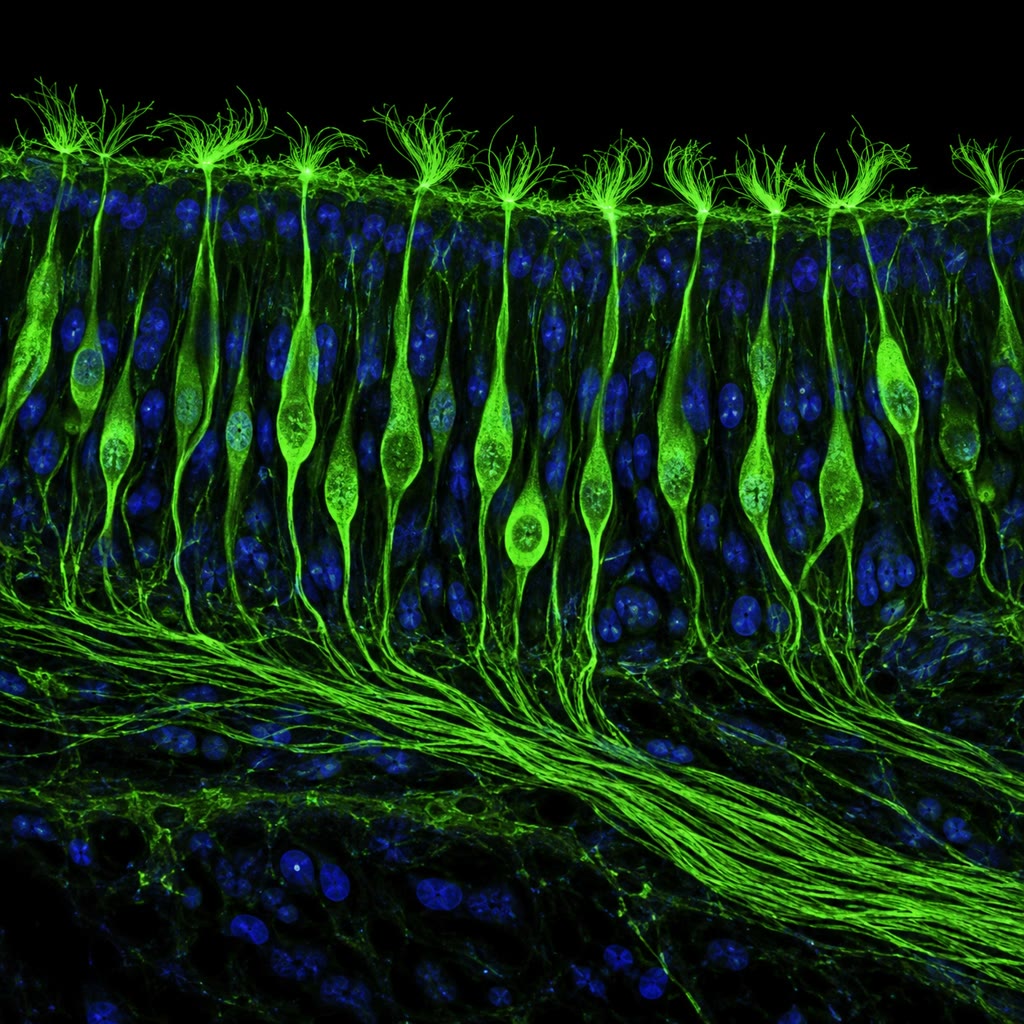
CoachSmell begins in a patch of epithelium at the top of the nose, where some ten million olfactory sensory neurons each express one olfactory receptor gene out of about in humans ( in a mouse, the largest gene family in either genome) — G-protein- coupled receptors that bind odorant molecules in a pocket and, through cyclic AMP, open a channel. Each receptor binds several odorants and each odorant binds several receptors, so an odour is a combinatorial code, a pattern of activity across the receptor types, and a change of one carbon in a molecule changes the pattern and the smell. All the neurons expressing one receptor send their axons to the same one or two glomeruli in the olfactory bulb, so the bulb holds a map in which each odour is a spatial pattern of active glomeruli, read by the cortex without passing through the thalamus. Taste is simpler: five modalities, each a labelled line from its own receptor cells — sweet, umami and bitter through G-protein-coupled receptors (one sweet receptor, one umami, some twenty-five bitter), salt through a sodium channel, sour through a proton channel — and the rest of what we call flavour is smell, reaching the nose through the back of the mouth.