
Biology · Glossary

What is Meristems and the two kinds of growth?

Definition 13.1 University Biology — Year 2 · Chapter 13 — Plant Vegetative Development: Meristems and Growth

A meristem is a population of small, undifferentiated, dividing cells that persists throughout the plant’s life and from which all its tissues derive. The shoot apical meristem (SAM) at the tip of each shoot makes leaves, stem and, in season, flowers; the root apical meristem (RAM) behind each root tip makes the root; together they drive primary growth, the lengthening of the plant. The lateral meristems — the vascular cambium and the cork cambium, thin cylinders inside stems and roots — drive secondary growth, the thickening that makes wood and bark. Plant growth is therefore indeterminate: the meristems can go on indefinitely, and the plant is a modular organism, repeating the unit leaf–node–internode–bud as long as conditions allow. Every axillary bud is a dormant SAM, so a plant carries thousands of reserve growing points.
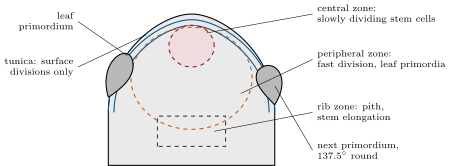
The shoot apical meristem in section: a tunica of one or two surface layers over a corpus, a central zone of stem cells at the summit, a peripheral zone where leaf primordia bulge out, and a rib zone below.
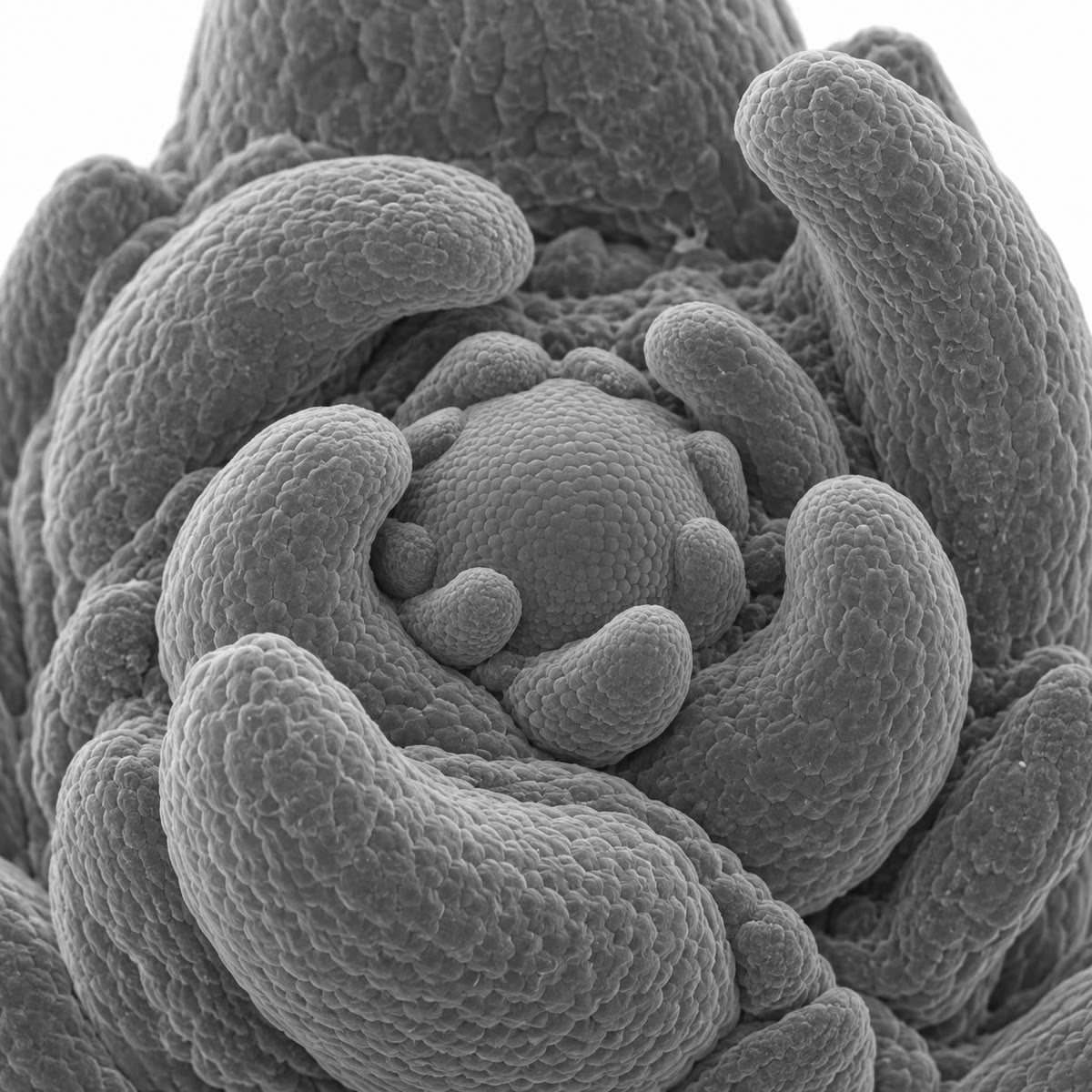
A shoot apex under the scanning electron microscope: the smooth dome of the meristem and the spiral of leaf primordia around it, each new one placed in the widest gap.
Read in context →