Biology · Glossary

What is Nucleosome, chromatin?

Also known as: nucleosome

Definition 17.4 University Biology — Year 1 · Chapter 17 — Genomes of Cells and Viruses

In a eukaryotic nucleus the DNA is wound on proteins: 147147\, base pairs make 1.7 turns around an octamer of eight histones (two each of H2A, H2B, H3, H4, small proteins rich in lysine and arginine that neutralise the phosphates), forming a nucleosome 11nm11\,\mathrm{nm} across; nucleosomes follow one another every 200200\, pairs or so, like beads on a string, with a fifth histone, H1, sealing each bead. This chromatin folds further: into a fibre of 30nm30\,\mathrm{nm}, into loops of tens of thousands of pairs anchored on a protein scaffold, and — at division — into the compact rods of the metaphase chromosome, ten thousand times shorter than the naked DNA. Euchromatin is the looser, gene-rich, transcribed form of interphase; heterochromatin the condensed, gene-poor form that stays compact (around centromeres, at the ends, and on a switched-off X chromosome).
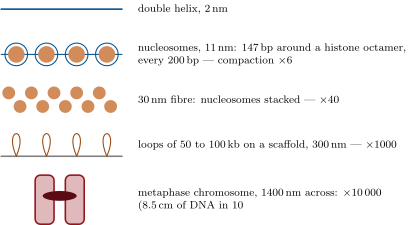
Levels of packing of eukaryotic DNA, from the helix to the metaphase chromosome. Each level multiplies the compaction; the whole reaches ten thousand.
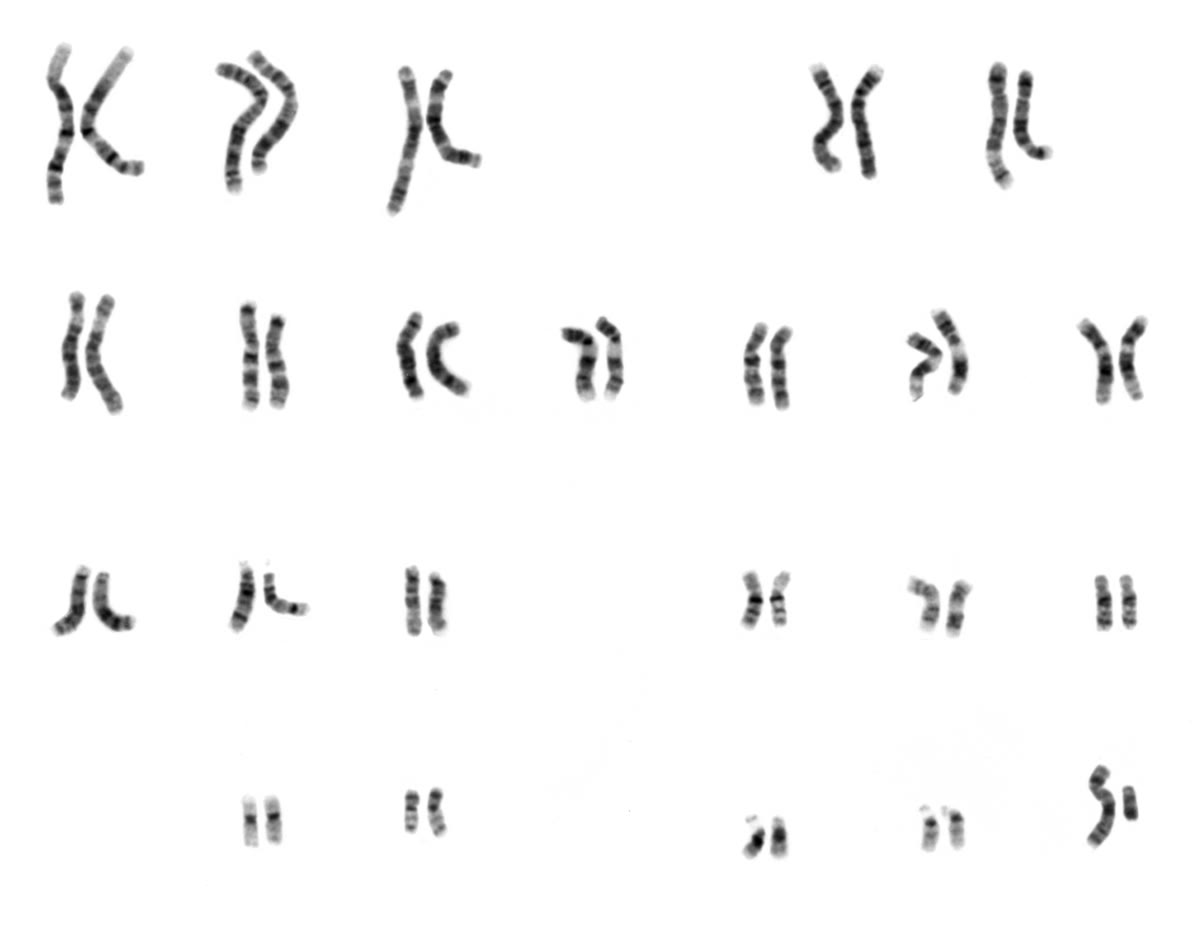
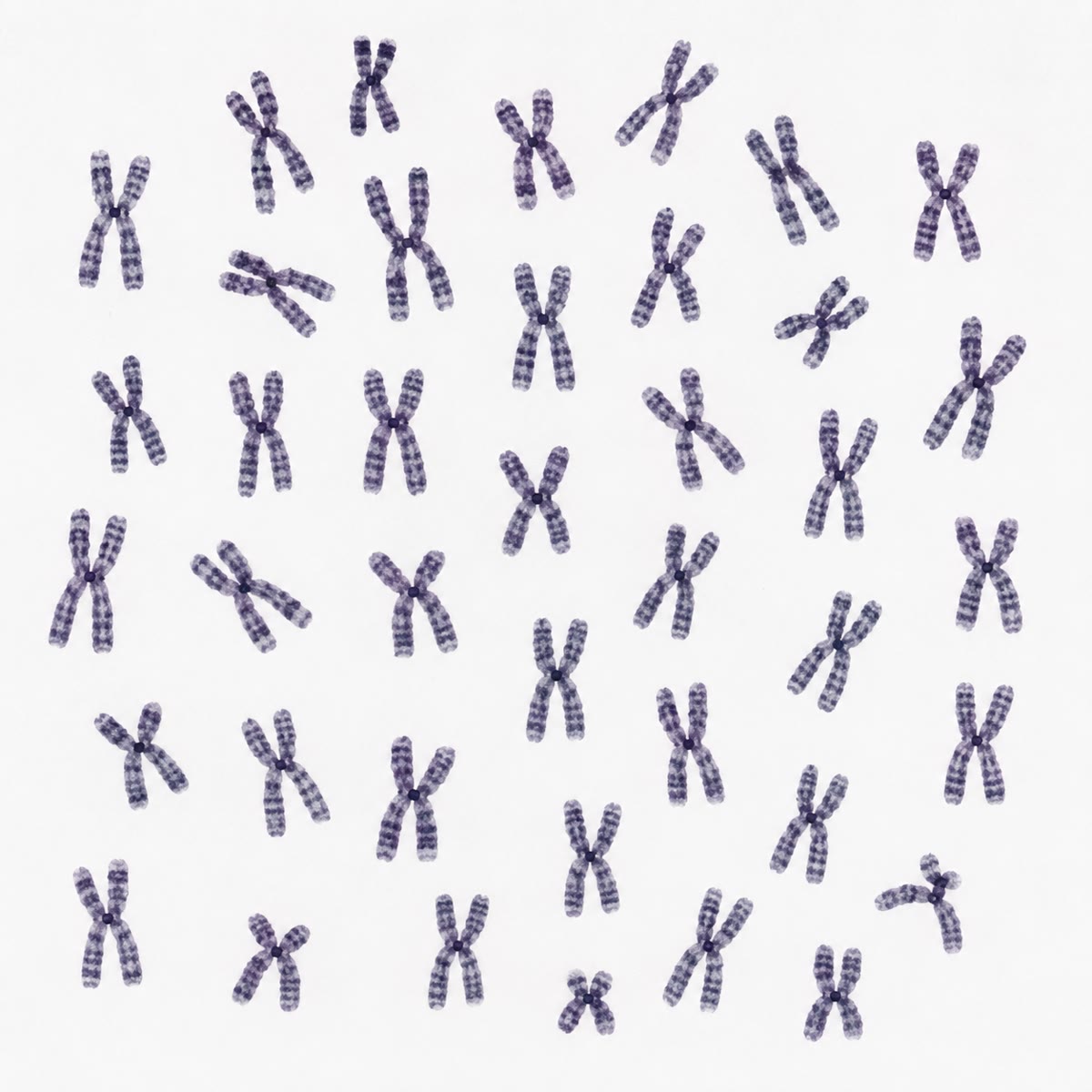
Left: the chromosomes of one human cell, spread from a cell arrested at metaphase. Right: the same chromosomes sorted by size and banding into a karyotype — twenty-two pairs and XY, forty-six in all. Karyotype: National Human Genome Research Institute, public domain.
Read in context →