 Coach
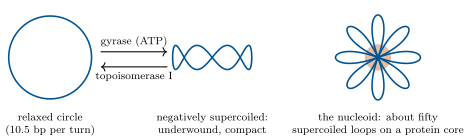
CoachThe genome of a cell is the totality of its DNA: the information for every protein and RNA it can make, and the sequences that control when they are made. A chromosome is one DNA molecule with the proteins that organise it. A bacterium usually has one, circular, of one to ten million base pairs (E. coli: , long), folded into a region of the cytoplasm, the nucleoid, with no membrane around it. Besides the chromosome many bacteria carry plasmids: small circles of a few thousand to a few hundred thousand pairs, in one to hundreds of copies, replicating on their own and carrying optional genes — antibiotic resistance, toxins, the machinery for transferring themselves to another cell.
Examples
Example 17.3 (A dense genome)
Of the E. coli chromosome’s , codes for protein: some genes of about pairs each, packed head to tail with a hundred pairs between them, many grouped into operons transcribed together (Chapter 20). A plasmid of may carry three genes and exist in fifty copies; the resistance gene it carries can spread through a hospital ward’s bacteria in weeks, by conjugation, faster than any mutation could arise.
Example 17.9 (Reading a genome’s size)
A genome of with no introns and few repeats holds genes; one of with long introns and half its length in repeats holds ; one of holds the same twenty thousand. The size measures how much has accumulated in a lineage’s non-coding DNA, and how efficiently it has been removed, not how much the organism does.
Example 17.13 (Viruses with RNA genomes)
Influenza carries eight segments of single-stranded RNA and its own polymerase to copy them, since cells have no enzyme that copies RNA; its polymerase makes one error per bases and the virus changes every season. A retrovirus (HIV) carries RNA and a reverse transcriptase that copies it into DNA, which is inserted into the host chromosome like a prophage — a permanent infection. The mechanisms, and the immune response to them, are the Year 3 volume’s; here they mark the range of what a genome can be.