University Biology — Year 1 · Bachelor Year 1
17Genomes of Cells and Viruses
Two metres of DNA are folded into a nucleus six micrometres across, and folded so that any of twenty thousand genes can be found and read within minutes. A bacterium folds a millimetre and a half into a cell a thousand times shorter, and copies it every twenty minutes. A virus carries a few thousand letters in a protein shell and reads them with a cell it does not own. This chapter describes the genome — the whole of an organism’s DNA — as a physical object: how the DNA of bacteria, of eukaryotic cells, of organelles and of viruses is organised, what it contains besides genes, and why the amount of it says so little about the organism that carries it.
17.1 The bacterial genome
Definition 17.1 (Genome, chromosome, nucleoid)
The genome of a cell is the totality of its DNA: the information for every protein and RNA it can make, and the sequences that control when they are made. A chromosome is one DNA molecule with the proteins that organise it. A bacterium usually has one, circular, of one to ten million base pairs (E. coli: , long), folded into a region of the cytoplasm, the nucleoid, with no membrane around it. Besides the chromosome many bacteria carry plasmids: small circles of a few thousand to a few hundred thousand pairs, in one to hundreds of copies, replicating on their own and carrying optional genes — antibiotic resistance, toxins, the machinery for transferring themselves to another cell.
Proposition 17.2 (How a bacterium folds its chromosome)
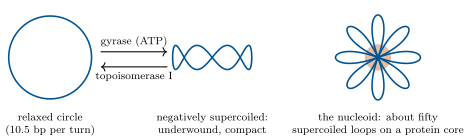
A circular DNA whose ends cannot rotate can be twisted like a rubber band: supercoiling. Enzymes called topoisomerases cut, pass and reseal the strands to add or remove turns; gyrase uses ATP to introduce negative supercoils, which underwind the helix and make it both more compact and easier to open. The chromosome of E. coli is organised into some fifty loops, each supercoiled independently and anchored to a protein core, so that the occupies a nucleoid of about a micrometre — a thousandfold compaction — while any loop can be unwound for reading or copying without disturbing the rest. Small basic proteins (histone-like, though unrelated to histones) bend and bridge the DNA throughout.
Example 17.3 (A dense genome)
Of the E. coli chromosome’s , codes for protein: some genes of about pairs each, packed head to tail with a hundred pairs between them, many grouped into operons transcribed together (Chapter 20). A plasmid of may carry three genes and exist in fifty copies; the resistance gene it carries can spread through a hospital ward’s bacteria in weeks, by conjugation, faster than any mutation could arise.
17.2 The eukaryotic genome: chromatin
Definition 17.4 (Nucleosome, chromatin)
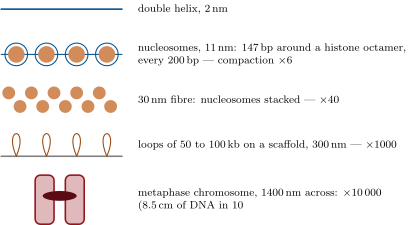
In a eukaryotic nucleus the DNA is wound on proteins: base pairs make 1.7 turns around an octamer of eight histones (two each of H2A, H2B, H3, H4, small proteins rich in lysine and arginine that neutralise the phosphates), forming a nucleosome across; nucleosomes follow one another every pairs or so, like beads on a string, with a fifth histone, H1, sealing each bead. This chromatin folds further: into a fibre of , into loops of tens of thousands of pairs anchored on a protein scaffold, and — at division — into the compact rods of the metaphase chromosome, ten thousand times shorter than the naked DNA. Euchromatin is the looser, gene-rich, transcribed form of interphase; heterochromatin the condensed, gene-poor form that stays compact (around centromeres, at the ends, and on a switched-off X chromosome).
Definition 17.5 (Karyotype, centromere, telomere)
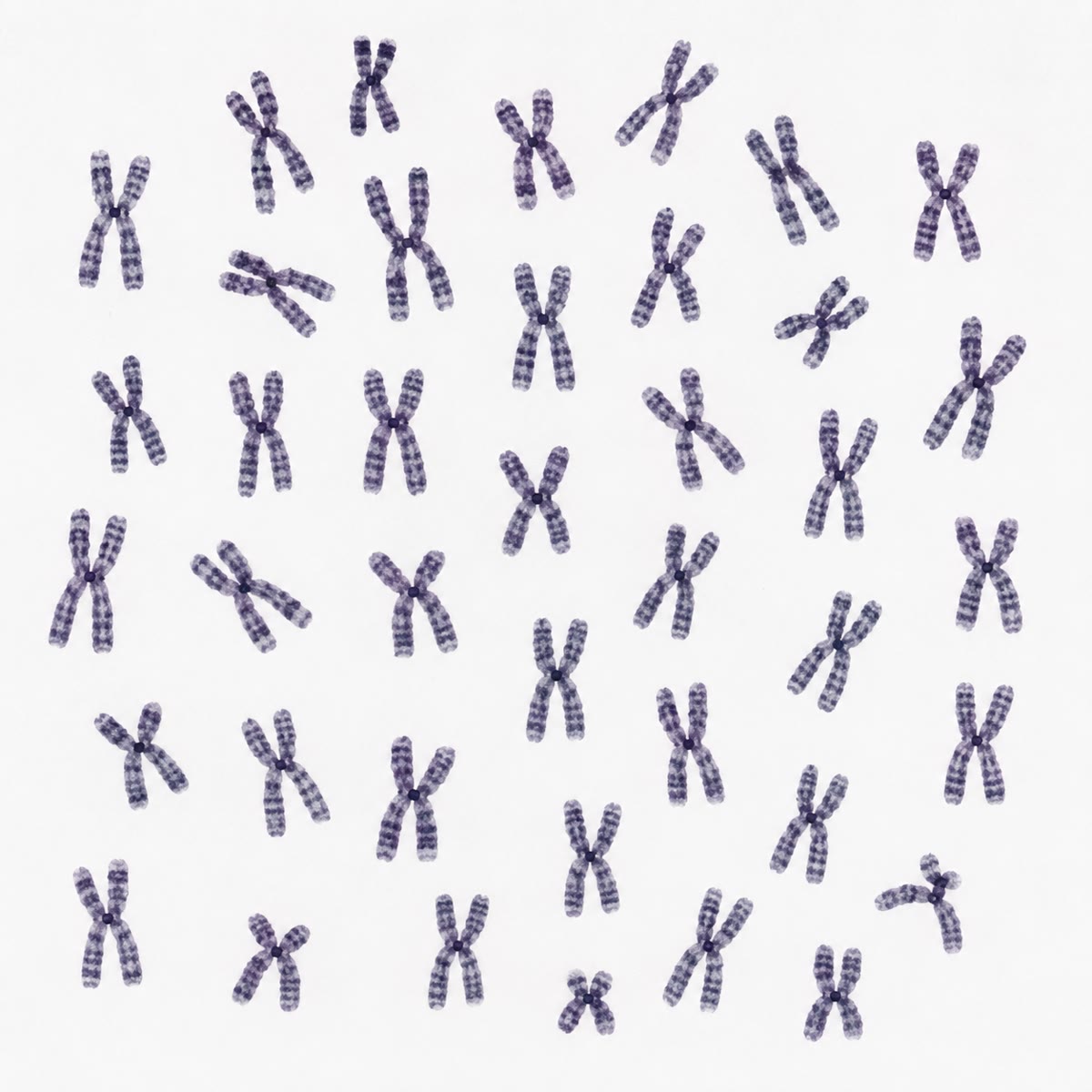
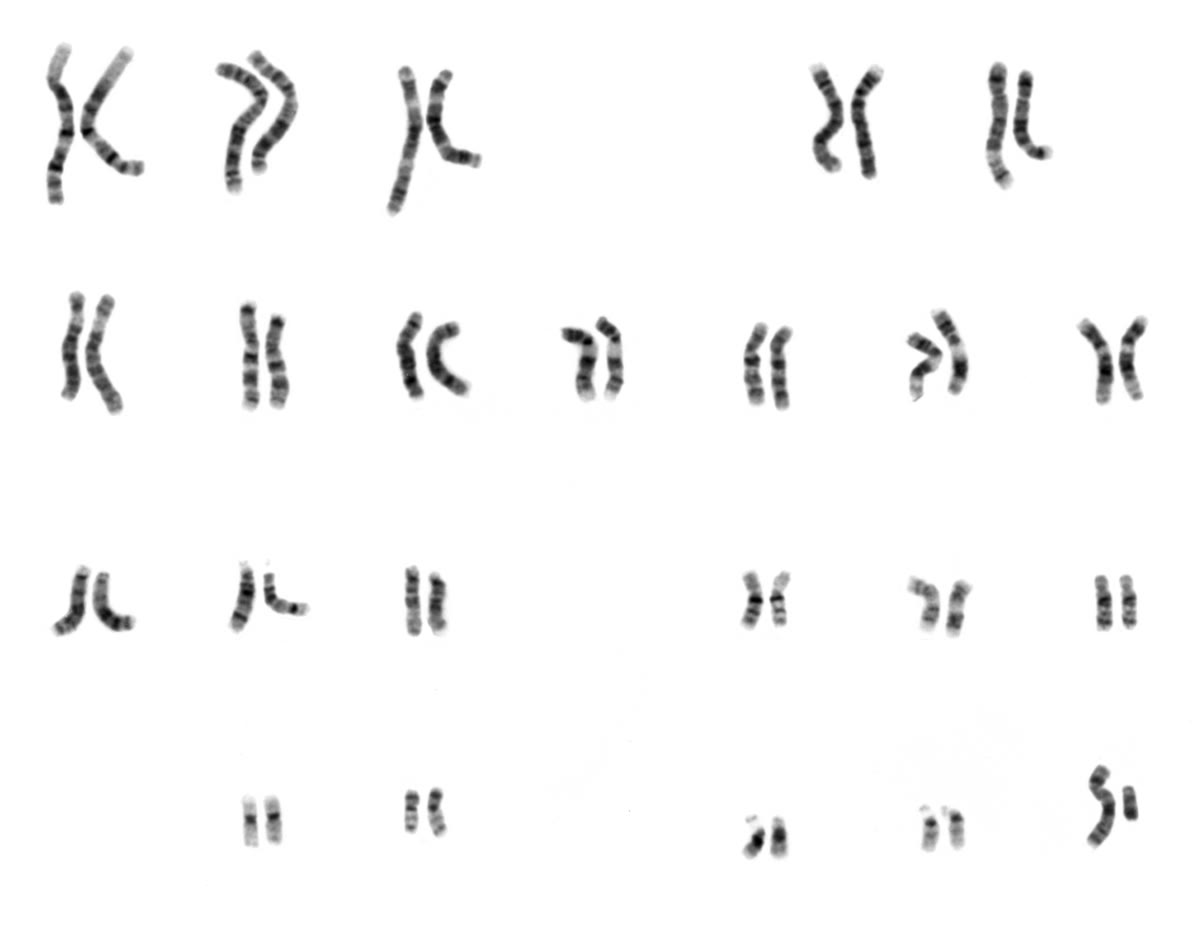
The karyotype is the set of chromosomes of a cell, sorted by size and banding pattern: humans have 23 pairs (22 autosomes and XY or XX), base pairs in all, ; the largest chromosome holds , the smallest . Each linear chromosome carries a centromere, the constricted region where the two copies stay joined after replication and where the spindle attaches (Chapter 18), and two telomeres, repeated sequences at the ends that protect them from being taken for broken DNA and from shortening at each replication.
Proposition 17.6 (Genome size does not measure complexity)
| organism | genome (Mb) | protein-coding genes |
|---|---|---|
| E. coli | 4.6 | |
| yeast | 12 | |
| fruit fly | 140 | |
| human | 3200 | |
| maize | 2300 | |
| lungfish | ||
| Paris japonica (a lily) |
Genome size varies a thousandfold among eukaryotes with no relation to the number of genes or the complexity of the organism (the C-value paradox): a lungfish carries forty times the DNA of a human and no more genes. The difference is not genes but the DNA between them.
17.3 What a genome contains
Definition 17.7 (Anatomy of a gene)
A gene is a stretch of DNA transcribed into a functional RNA — usually a messenger for one protein. A eukaryotic protein-coding gene comprises a promoter, the sequence upstream where transcription begins and is controlled; exons, the parts kept in the mature message; introns, the parts transcribed and then cut out (Chapter 19); the untranslated regions at each end of the message; and a terminator. A human gene averages with eight exons totalling : nineteen twentieths of a typical gene is intron. Bacterial genes have no introns.
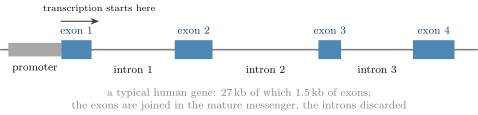
Proposition 17.8 (The census of the human genome)
Of the : about codes for protein; is intron; is the remains of transposable elements — sequences that copy themselves into new places, mostly long dead (the Alu element alone, , is present in a million copies, a tenth of the genome); is short repeats in tandem (satellite DNA, at centromeres and telomeres); the rest is unique non-coding sequence that includes the promoters, enhancers and RNA genes that control expression. Many genes belong to families that arose by duplication (the globins, the olfactory receptors — a thousand of them), and the genome holds thousands of pseudogenes, dead copies that no longer work. A genome is not a design but a record.
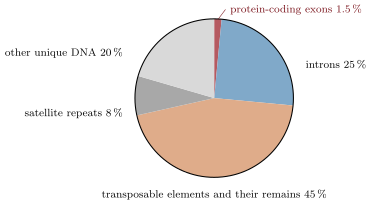
Example 17.9 (Reading a genome’s size)
A genome of with no introns and few repeats holds genes; one of with long introns and half its length in repeats holds ; one of holds the same twenty thousand. The size measures how much has accumulated in a lineage’s non-coding DNA, and how efficiently it has been removed, not how much the organism does.
17.4 Organelle genomes and viruses
Definition 17.10 (Organelle genomes)
Mitochondria and chloroplasts keep a remnant of their bacterial ancestors’ chromosome (Chapter 6): a small circle — and 37 genes in human mitochondria, and about 100 genes in chloroplasts — in many copies per organelle, coding for some of their own proteins and for the RNAs of their ribosomes. The rest of their proteins come from nuclear genes. In most animals the mitochondrial genome is inherited from the mother only, with the egg’s cytoplasm.
Definition 17.11 (Virus)
A virus is a genome in a protein shell, the capsid — sometimes wrapped in a membrane, the envelope, taken from a host cell — that reproduces only inside a cell, using the cell’s ribosomes, energy and precursors. Its genome may be DNA or RNA, double- or single-stranded, linear or circular, one molecule or several: from (a few genes) to (a thousand, in the giant viruses). Outside a cell a virus does nothing: it is not a cell, does not metabolise, and is alive only in the sense that it carries information and evolves. The bacteriophages are the viruses of bacteria.
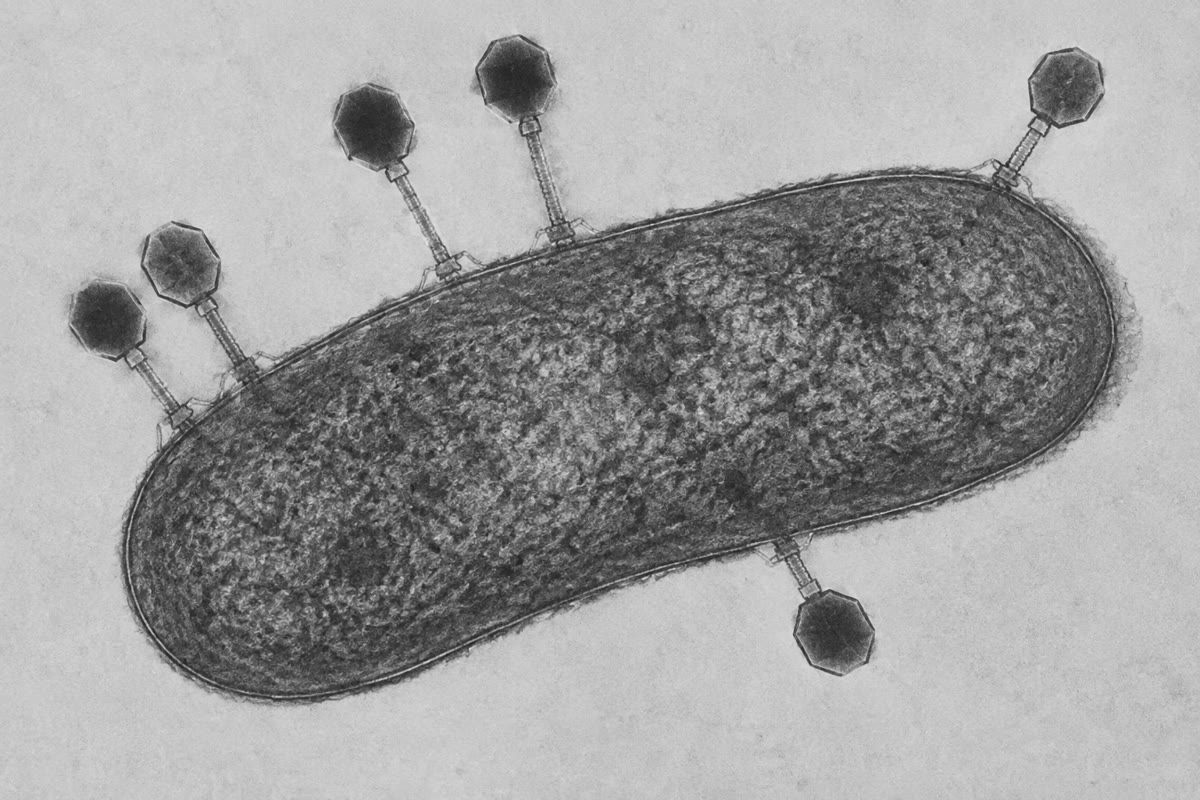
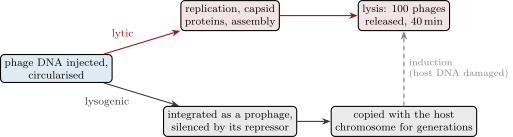
Proposition 17.12 (The two cycles of phage )
Phage injects its of DNA (Chapter 11) into E. coli, where it circularises. Two fates follow. In the lytic cycle the phage’s genes are transcribed by the host’s polymerase, its DNA is replicated a hundredfold, capsid proteins are made and assembled, the DNA is packed into them, and an enzyme dissolves the wall: the cell bursts, releasing a hundred phages, forty minutes after infection. In the lysogenic cycle the phage DNA is inserted into the host chromosome and silenced by a repressor of its own making: the prophage is copied with the chromosome for generations, invisible, until damage to the host’s DNA lifts the repression and the lytic cycle resumes. The choice is a molecular switch, one of the first understood (Chapter 20).
Example 17.13 (Viruses with RNA genomes)
Influenza carries eight segments of single-stranded RNA and its own polymerase to copy them, since cells have no enzyme that copies RNA; its polymerase makes one error per bases and the virus changes every season. A retrovirus (HIV) carries RNA and a reverse transcriptase that copies it into DNA, which is inserted into the host chromosome like a prophage — a permanent infection. The mechanisms, and the immune response to them, are the Year 3 volume’s; here they mark the range of what a genome can be.
17.5 Exercises
Exercise 17.1 ★
Compare the bacterial and the eukaryotic genome: number and shape of the chromosomes, location, proteins that organise them, and gene density.
Solution
Solution of Exercise 17.1.
Bacterium: one circular chromosome (plus plasmids) in a nucleoid without a membrane, compacted by supercoiling and small basic proteins, about coding. Eukaryote: several linear chromosomes in a nucleus, wound on histones into chromatin, a few percent coding.
Exercise 17.2 ★
Describe a nucleosome and give the compaction factor of each level of chromatin folding.
Solution
Solution of Exercise 17.2.
147 base pairs wound 1.7 times around an octamer of histones (two each of H2A, H2B, H3, H4), sealed by H1, one every 200 pairs. Beads on a string ; fibre ; loops ; metaphase chromosome .
Exercise 17.3 ★
From the census figure, what fraction of the human genome codes for protein, and what is the largest category?
Solution
Solution of Exercise 17.3.
; transposable elements and their remains, .
Exercise 17.4 ★
What is a virus, and in what sense is it not alive?
Solution
Solution of Exercise 17.4.
A genome (DNA or RNA) in a protein capsid, sometimes enveloped, that reproduces only inside a cell with the cell’s machinery. Outside a cell it has no metabolism, no growth, no response — an inert particle; it is “alive” only in carrying heritable information that evolves.
Exercise 17.5 ★★
Compute the length of the E. coli chromosome and the number of nucleosome-sized turns it would need if it were eukaryotic; explain how the bacterium compacts it instead.
Solution
Solution of Exercise 17.5.
; nucleosomes. Instead: negative supercoiling by gyrase and folding into some fifty loops on a protein core, with small basic proteins bending the DNA — a thousandfold, into a nucleoid of a micrometre.
Exercise 17.6 ★★
A human gene of has of exons in eight pieces. Compute the mean exon and intron lengths and the fraction of the primary transcript that is discarded.
Exercise 17.7 ★★
Using the table, compute the genes per megabase for E. coli, yeast, the fruit fly, the human and the lungfish. Comment on the trend.
Exercise 17.8 ★★
The Alu element is and present in a million copies. What fraction of the genome is Alu? If each copy arose by retrotransposition (an RNA copied back to DNA and inserted), how many insertions per generation would produce a million copies in million years at years a generation?
Solution
Solution of Exercise 17.8.
: of the genome. generations: one new insertion every three generations, on average, somewhere in the lineage.
Exercise 17.9 ★★
Explain why the mitochondrial genome is inherited maternally, and what this implies for tracing ancestry.
Solution
Solution of Exercise 17.9.
The egg contributes the cytoplasm and its mitochondria; the sperm’s few mitochondria are excluded or destroyed after fertilisation. The mitochondrial DNA therefore passes unmixed from mother to child, and its accumulated mutations trace maternal lineages back through time.
Exercise 17.10 ★★★
Phage in the lysogenic state is copied once per host generation; in the lytic state it makes a hundred copies in . In a well-fed culture doubling every , compare the two strategies over two hours; in a starving culture that does not divide, compare them again. Why does the switch respond to the host’s condition?
Solution
Solution of Exercise 17.10.
Fed culture, two hours: lysogeny gives copies (one per host division); lysis gives 100 phages in , and their progeny in two hours if hosts abound — lysis wins by far. Starving culture: lysogeny gives one copy, safe inside a living cell; lysis gives 100 phages with no cell to infect, which decay. The switch reads the host’s state because the best strategy depends on whether new hosts will be available.
Exercise 17.11 ★★★
A lungfish cell carries : compute the DNA length, the number of nucleosomes and the mass of histones per cell, and the time to replicate it at the human fork speed ( per fork) with one origin per . What does a large genome cost a cell?
Solution
Solution of Exercise 17.11.
(haploid); nucleosomes; histones . Origins: , each replicating on each side at : — the time is not the problem, given enough origins; the cost is the nucleotides ( of DNA per division), the histones, the time to make them, and a nucleus and cell many times larger, which is why such cells divide slowly.
Exercise 17.12 ★★★
“The genome is a record, not a design.” Discuss in a paragraph with pseudogenes, transposable elements, gene families and the C-value paradox.
Solution
Solution of Exercise 17.12.
A design would contain what is needed and no more; a record contains what happened. Pseudogenes are the corpses of duplicated genes that died by mutation; transposable elements are parasites that copied themselves for tens of millions of years and were never removed; gene families show duplication followed by divergence; and the C-value paradox shows that the amount of DNA reflects a lineage’s history of accumulation and loss rather than its needs. Selection keeps the genes working and lets the rest drift: what we read in a genome is mostly history.
17.6 Problem: Two Metres in Six Micrometres
Problem 17.1
Weekend problem — a human nucleus measured from the helix to the chromosome: lengths, volumes, nucleosomes, histones and the packing ratio at every level, ending on the total compaction of metaphase
A human diploid nucleus is a sphere of diameter holding base pairs on 46 chromosomes; the largest chromosome carries , the smallest . Take per pair, for the helix diameter, per pair, pairs per nucleosome, a histone octamer of , and per dalton.
Part I — Lengths and volumes.
- Compute the total length of DNA in the nucleus.
- Compute the number of turns of the double helix it contains.
- Compute the length of the largest and of the smallest chromosome’s DNA.
- Compute the volume of the nucleus.
- Compute the volume of the DNA as a cylinder, and the fraction of the nucleus it occupies.
- Compute the mass of DNA in the nucleus in picograms.
- The nucleus contains about of protein. What fraction of the nuclear mass is DNA, if water is of the nucleus (density )?
Part II — Nucleosomes.
- Compute the number of nucleosomes in the nucleus.
- Compute the mass of histones and compare with the mass of DNA.
- The pairs of one nucleosome span of helix but occupy a bead long. Compute the compaction factor of the “beads on a string”.
- The fibre holds six nucleosomes per of its length. Compute its compaction factor relative to naked DNA.
- Compute the length of the fibre for the whole genome, and compare it with the nucleus’s diameter.
- Each nucleosome must be taken apart and reassembled when the DNA is replicated or transcribed. How many nucleosomes are reassembled in S phase ()? Per second?
Part III — Loops and chromosomes.
- Loops of of the fibre hang from a scaffold. Compute the length of fibre in one loop and the number of loops in the genome.
- A metaphase chromatid of the largest chromosome is long. Compute the compaction factor from naked DNA to metaphase chromosome.
- Compute the volume of that chromatid as a cylinder of diameter, and the fraction of it that is DNA.
- The 46 chromosomes at metaphase, each a rod of the same density: compute their total volume and compare it with the interphase nucleus.
- Explain why interphase chromatin cannot be packed as tightly as metaphase chromatin.
Part IV — Finding a gene.
- A protein must find one site in the genome. If it tested one random site per millisecond, how long would the search take? What does this say about how sites are found?
- The genome’s genes average . What fraction of the genome is inside genes? What fraction is coding, at of exons per gene?
- Each chromosome occupies its own territory of the nucleus. Compute the volume of the territory of the largest chromosome if territories are proportional to DNA content, and the concentration of DNA inside it in base pairs per cubic micrometre.
- A lungfish nucleus of the same DNA density would have what volume for (diploid)? What diameter?
- Compute the number of histone octamers a cell must make in S phase and the amino acids they contain ( residues per octamer). Compare with the residues of protein a cell makes in a day.
- Explain in two sentences why bacteria can do without nucleosomes and eukaryotes cannot.
- State the result: the total compaction factor from the helix to the metaphase chromosome, and the factors at each level.
Solution
Solution of Problem 17.1.
1. . 2. turns. 3. ; . 4. . 5. : of the nucleus. 6. . 7. Nuclear mass ; DNA of it, protein . 8. . 9. : about equal to the DNA. 10. . 11. Six nucleosomes, of helix, in : factor . 12. of fibre — ten thousand times the nuclear diameter, folded within it. 13. All , plus the same number of new ones on the second copy: in , about per second. 14. of fibre per loop; loops. 15. . 16. ; DNA : — the rest is histone and scaffold protein and water. 17. Total DNA pairs at the same density ( pairs in , per chromatid; two chromatids per chromosome): , larger than the interphase nucleus because the chromosomes are now rods with space between them. 18. Interphase chromatin must be read and copied: polymerases and their factors need access to the DNA, so most of it stays as the open fibre and loops; metaphase chromatin is inert and can be packed for transport. 19. sites at per second: seconds, 74 days. Proteins do not search at random: they bind DNA non-specifically and slide along it, and many copies search in parallel, so a site is found in seconds. 20. , of ; coding , (about 1.5% with the shorter genes counted more carefully). 21. (two copies); , the same as the whole nucleus. 22. : diameter , forty times the human nucleus in volume. 23. octamers, residues — a tenth of the cell’s daily protein synthesis, spent on packaging. 24. A bacterium’s chromosome is a thousand times shorter and supercoiling in loops suffices to fit it into a micrometre; a eukaryote must fold a length ten thousand times its nucleus and needs a hierarchy of packing, of which the nucleosome is the first level. 25. About ( into ), built as (nucleosomes), more ( fibre, in all), more (loops, in all), and more (metaphase condensation).