 Coach
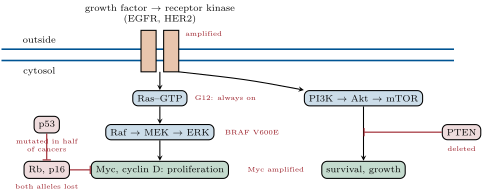
CoachA proto-oncogene is a normal gene that promotes proliferation or survival — a growth factor, its receptor, a signalling protein, a transcription factor, a cyclin — and an oncogene is a mutant form that is active without its normal signal: a point mutation that locks the small GTPase Ras in its GTP state (glycine 12 in a quarter of all cancers), an amplification of the gene for the receptor HER2 or for the transcription factor Myc, a translocation that fuses BCR to the kinase ABL in chronic myeloid leukaemia or puts MYC next to an antibody enhancer in Burkitt lymphoma. One mutant allele suffices: oncogenes act dominantly. A tumour suppressor gene restrains proliferation or enforces death or repair — Rb and p16 at the restriction point, p53, the guardian that arrests or kills a damaged cell, APC in the Wnt pathway of the colon, PTEN, BRCA1 and BRCA2, the mismatch-repair genes — and it must lose both alleles to contribute: two hits, the first often inherited in the familial cancer syndromes, the second somatic. p53 is mutated in half of all human cancers and its pathway disabled in most of the rest.
Examples
Example 11.4 (Reading the exponent)
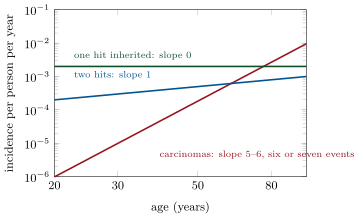
The incidence of most carcinomas in adults rises as about the fifth to sixth power of age — from about in per year at thirty to in at eighty, a factor of for a factor in age, and — which suggests six or seven rate-limiting events. The estimate is crude: the expansion of a clone after each hit raises the number of cells at risk of the next, so fewer events with clonal growth between them give the same slope, and the number of driver mutations found in sequenced tumours is two to eight. Knudson’s retinoblastoma fits the theorem’s second statement exactly: the sporadic disease, needing two hits, has an incidence that rises with age (through the few years the retinoblasts exist); the hereditary disease, needing one, is present at a nearly constant rate from birth and strikes early and repeatedly.