
সব বই

পেশাদার

1 Markets I: The Ecosystem and Exchange-Traded Marketsবাজার অনলাইন 2 Markets II: Rates, FX and Creditবাজার অনলাইন 3 Markets III: Commodities, Energy and Cryptoবাজার অনলাইন 4 Quantitative Methodsপদ্ধতি অনলাইন 5 Derivatives and Volatilityডেরিভেটিভস অনলাইন 6 Rates, Credit, XVA and Riskসুদহার, ঋণ ও ঝুঁকি অনলাইন 7 Research Craft: Predictors, Backtests, Measurement, Portfoliosগবেষণা অনলাইন 8 Strategies I: Equities and Futuresকৌশল অনলাইন 9 Strategies II: Volatility, Relative Value, Macro and the Bank Desksকৌশল অনলাইন 10 Microstructure and Executionএক্সিকিউশন অনলাইন 11 Market Making and High-Frequency Tradingমার্কেট মেকিং অনলাইন 12 Machine Learning for Marketsমেশিন লার্নিং অনলাইন 13 Low-Latency Softwareপ্রযুক্তি অনলাইন 14 Networks, Hardware and Trading Infrastructureপ্রযুক্তি অনলাইন 15 Research, Data and Risk Platformsপ্রযুক্তি অনলাইন 16 The Desk and the Firmপ্রতিষ্ঠান অনলাইন 17 The Industry: Firms, Roles and Careersক্যারিয়ার অনলাইন 18 Interviews I: Maths, Probability and Speedক্যারিয়ার অনলাইন 19 Interviews II: Markets, Trading Games and the Final Roundক্যারিয়ার অনলাইন 20 Interviews III: Codeক্যারিয়ার অনলাইন
অ্যাপ পরিচিতি Coach সাইন ইন পড়া শুরু করো

বইগুলো এখনো বাংলা ভাষায় পাওয়া যায় না — ইংরেজি সংস্করণ দেখানো হচ্ছে।

Biology · পরিভাষা

Polysaccharide কী?

অন্য নাম: starch · glycogen · cellulose · chitin · peptidoglycan

Definition 10.7 University Biology — Year 1 · অধ্যায় 10 — Carbohydrates

A polysaccharide is a chain of hundreds to tens of thousands of monosaccharides joined by glycosidic bonds, linear or branched. Storage polysaccharides: starch in plants — amylose, unbranched α(1→4)\alpha(1{\to}4) glucose, 20 %20\,\%, and amylopectin, α(1→4)\alpha(1{\to}4) with α(1→6)\alpha(1{\to}6) branches every 24 to 30 24\text{ to }30\, residues, 80 %80\,\% — packed in grains; glycogen in animals and fungi, like amylopectin but branched every 8 to 12 8\text{ to }12\, residues, in cytosolic granules of the liver and muscles. Structural polysaccharides: cellulose, unbranched β(1→4)\beta(1{\to}4) glucose, 2000 to 15 000 2000\text{ to }15\,000\, residues, in plant walls; chitin, β(1→4)\beta(1{\to}4) N-acetylglucosamine, in the walls of fungi and the cuticles of arthropods; peptidoglycan, alternating N-acetylglucosamine and N-acetylmuramic acid cross-linked by short peptides, the one-molecule mesh that is the bacterial wall.
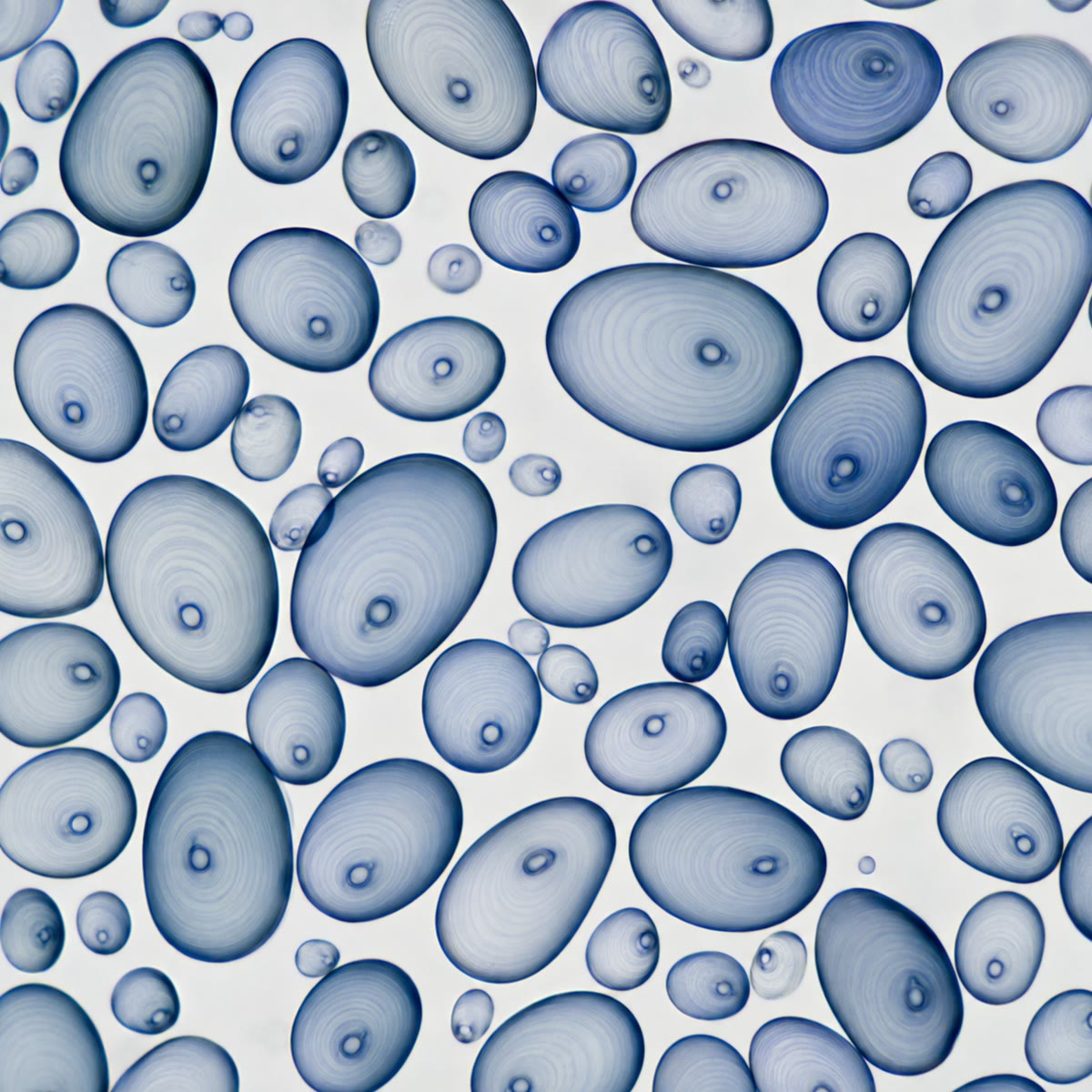
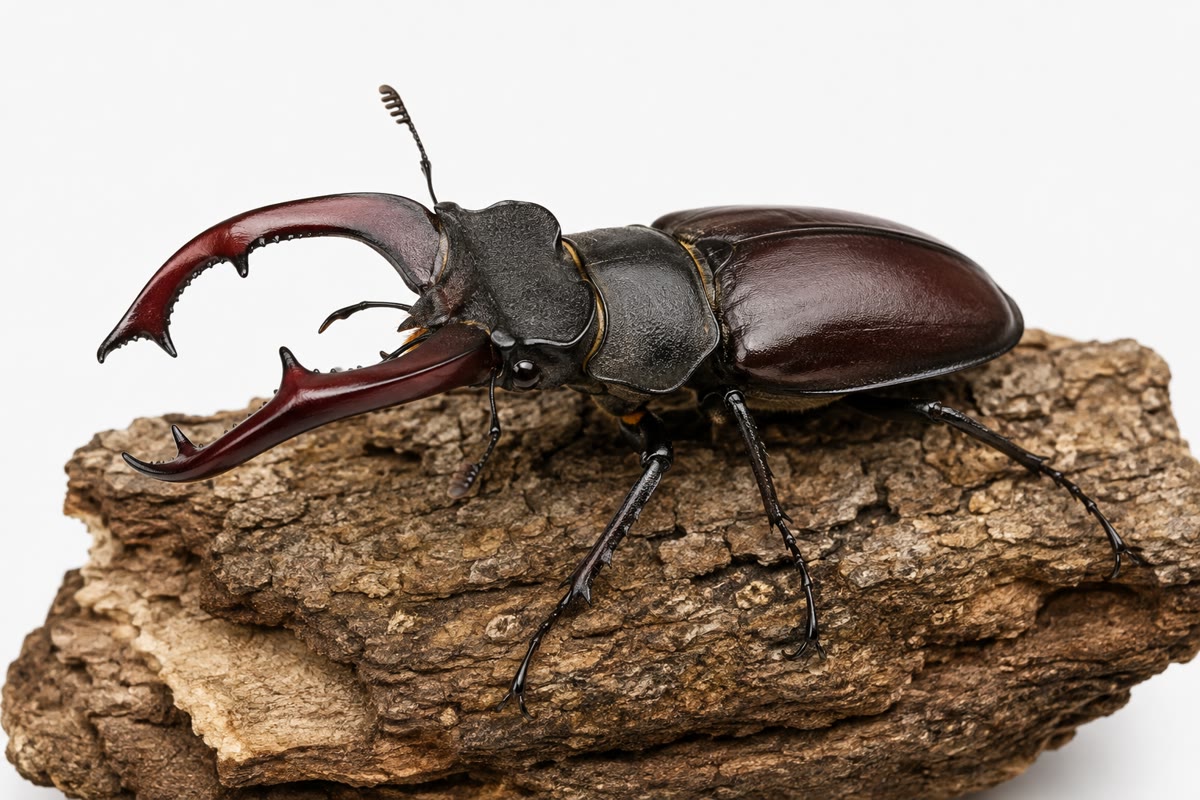
Left: potato starch grains under the microscope, stained by iodine; the concentric rings are layers of amylopectin laid down day by day. Right: a stag beetle’s cuticle — chitin fibres in a protein matrix, hardened and dark: the same (1 4) design as cellulose, on a different sugar.
Left: potato starch grains under the microscope, stained by iodine; the concentric rings are layers of amylopectin laid down day by day. Right: a stag beetle’s cuticle — chitin fibres in a protein matrix, hardened and dark: the same β(1→4)\beta(1{\to}4) design as cellulose, on a different sugar.

উদাহরণ

Example 10.9 (Why glycogen is branched)

Glycogen is degraded from its non-reducing ends, one glucose at a time, by glycogen phosphorylase. An unbranched chain of 50 00050\,000 glucoses would have one such end and release one glucose per enzyme turnover; a glycogen particle of the same size, branched every twelve residues, has some 20002000 ends and releases two thousand at once. Branching also keeps the particle compact and soluble. The liver’s hundred grams of glycogen can be mobilised at ten grams an hour; the same glucose stored as one long chain would take years to unwind.

Example 10.10 (Why not store glucose itself)

A hundred grams of glucose (0.55 mol0.55\,\mathrm{mol}) dissolved in the 1 L1\,\mathrm{L} of water of a liver’s cells would add 0.55 osmol/L0.55\,\mathrm{osmol}/\mathrm{L} to a cytosol at 0.3 osmol/L0.3\,\mathrm{osmol}/\mathrm{L}: the cells would swell to three times their volume and burst. As glycogen the same glucose is 7×10187 \times 10^{18} particles, 1×10⁻⁵ mol/L1 \times 10^{-5}\,\mathrm{mol}/\mathrm{L}, osmotically invisible. A polymer is a way of storing a great many molecules as one.

Example 10.4 (Sugars that are not (CH2O)n(\mathrm{CH_2O})_n)

Deoxyribose lacks the hydroxyl at C2 (Chapter 11); glucosamine and N-acetylglucosamine carry an amine instead of the C2 hydroxyl (chitin, peptidoglycan); glucuronic acid has a carboxyl at C6 (the matrix polysaccharides); sugar phosphates (glucose-6-phosphate, ribose-5-phosphate) are the forms in which sugars enter metabolism; sugar alcohols (glycerol, sorbitol) have no carbonyl. The core is the same: a small polyhydroxylated carbon chain that water loves.

প্রসঙ্গসহ পড়ো →