
Biology · Glossary

What is RNA polymerase, promoter, transcription?

Definition 19.2 University Biology — Year 1 · Chapter 19 — Gene Expression: Transcription and Translation

RNA polymerase synthesises RNA on a DNA template, 535' \to 3', from the four ribonucleoside triphosphates, without a primer. It starts at a promoter, a sequence just upstream of the gene that it recognises and binds; in bacteria a subunit called σ\sigma (sigma) does the recognising, at two conserved stretches ten and thirty-five pairs before the start. The enzyme opens about fifteen pairs of the helix into a transcription bubble, copies the template strand (read 353' \to 5') into an RNA identical in sequence to the other, coding strand, and moves along at about fifty nucleotides a second, re-closing the helix behind it; the RNA peels off as it is made. It stops at a terminator: in bacteria a self-complementary sequence whose RNA folds into a hairpin that pulls the transcript free. Many polymerases can follow one another along a gene, so a transcript can be started every second.
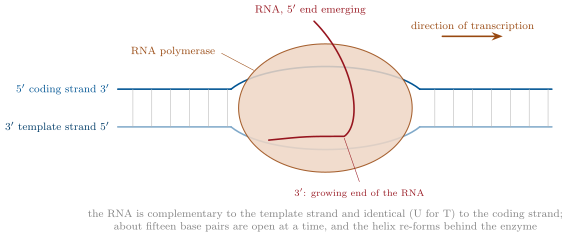
Transcription. The polymerase opens a bubble, pairs ribonucleotides to the template strand and joins them 5' 3'; the RNA leaves through a channel as the enzyme advances.
Transcription. The polymerase opens a bubble, pairs ribonucleotides to the template strand and joins them 535' \to 3'; the RNA leaves through a channel as the enzyme advances.
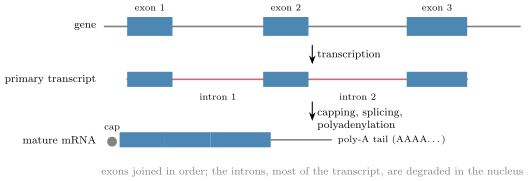
From gene to messenger in a eukaryote: the whole gene is transcribed, then the introns are cut out and the exons joined, a cap and a poly-A tail are added, and the mature message leaves the nucleus.
Read in context →