
Biology · Glossary

What is Stoma, guard cells?

Definition 24.1 University Biology — Year 1 · Chapter 24 — Plant Gas Exchange and Sap Transport

A stoma is a pore in the epidermis of a leaf (or a green stem) bounded by two guard cells, kidney-shaped cells whose walls are thickened on the side facing the pore and whose cellulose microfibrils run around them like hoops. When the guard cells take up water and swell, the hoops prevent them from widening and force them to bow apart: the pore opens. When they lose water, it closes. A leaf carries a few hundred stomata per square millimetre, mostly on its lower surface; open, their pores are one or two percent of the leaf’s area and nearly all of its gas exchange passes through them.
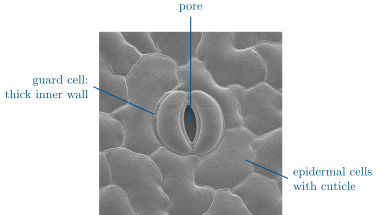
A stoma seen from outside: two guard cells around the pore, set in a waxed epidermis. The pore opens when the guard cells swell.
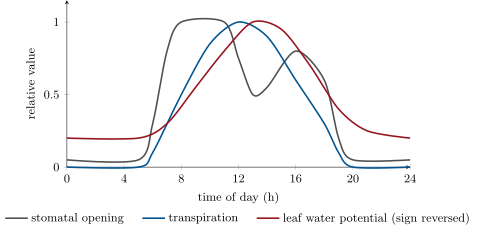
A summer day for a leaf. The stomata open at dawn, transpiration rises with the sun and the dryness of the air, and the leaf’s water potential falls as the column is put under tension; at midday, in dry air, the stomata partly close and the leaf recovers a little before the afternoon.
Read in context →