University Biology — Year 1 · Bachelor Year 1
24Plant Gas Exchange and Sap Transport
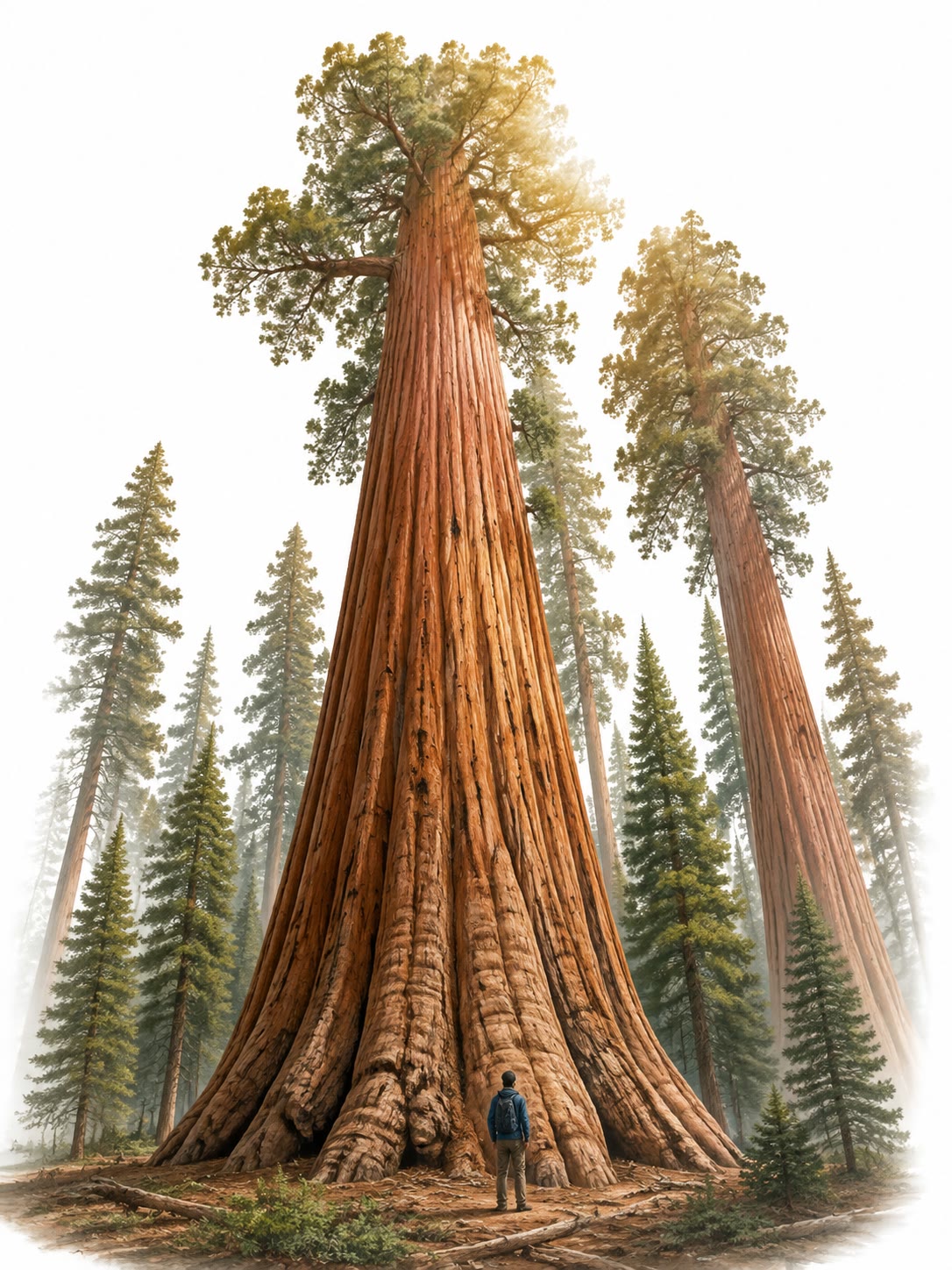
At the top of a sequoia a hundred metres above the ground, water is being pulled out of the soil by the evaporation from leaves, up a column of dead cells no wider than a hair, under a tension that would snap a steel wire of the same cross-section. There is no pump; the water is hauled by the same hydrogen bonds that make it cling to itself. Meanwhile, in a second set of tubes beside the first, the sugar those leaves made is flowing the other way, pushed by pressure the leaves themselves generate. A plant’s two plumbing systems, the xylem and the phloem, are driven by physics that the plant sets up and then leaves to run. This chapter describes the stomata through which a leaf trades water for carbon dioxide, the cohesion–tension mechanism that lifts sap, the vessels that carry it, the pressure-flow mechanism that moves sugar, and the compromise between drinking and eating that governs the whole.
24.1 Stomata: the gate
Definition 24.1 (Stoma, guard cells)
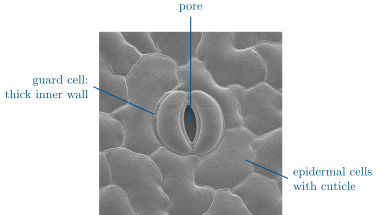
A stoma is a pore in the epidermis of a leaf (or a green stem) bounded by two guard cells, kidney-shaped cells whose walls are thickened on the side facing the pore and whose cellulose microfibrils run around them like hoops. When the guard cells take up water and swell, the hoops prevent them from widening and force them to bow apart: the pore opens. When they lose water, it closes. A leaf carries a few hundred stomata per square millimetre, mostly on its lower surface; open, their pores are one or two percent of the leaf’s area and nearly all of its gas exchange passes through them.
Proposition 24.2 (How a stoma opens, and when)
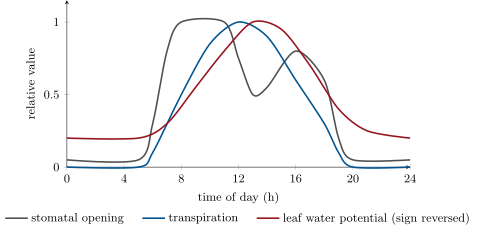
The guard cells open the pore by pumping protons out (Chapter 23), which drives potassium and chloride in and makes malate inside; the solutes lower their water potential, water follows from the neighbouring cells, and their turgor rises by a megapascal. Reversing the ion fluxes closes the pore in minutes. The signals: light (blue light directly on the guard cells, and the fall of internal as photosynthesis starts) opens; high internal closes; water stress closes, through the hormone abscisic acid, made in wilting roots and leaves, which triggers ion loss from the guard cells within minutes; dry air closes. The leaf opens its gate when carbon is worth the water and shuts it when water is scarce — and most plants do so in a daily rhythm, opening at dawn and closing at dusk, that persists for days in constant light.
24.2 Lifting water: cohesion and tension
Theorem 24.3 (The cohesion–tension mechanism)
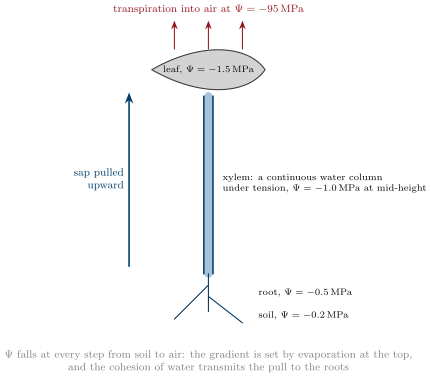
Water rises in the xylem because it is pulled from above, not pushed from below. Evaporation from the wet walls of the leaf’s mesophyll cells into the air spaces (transpiration) draws the water in the wall’s fine pores into curved menisci, whose surface tension puts the water behind them under tension; the tension is transmitted, through the continuous columns of water in the xylem held together by cohesion (the hydrogen bonds of Chapter 8), down the stem and into the roots, and lifts water from the soil. To hold a column of height against gravity requires a tension — per hundred metres — plus what is needed to overcome the friction of flow, about as much again; the columns of a tall tree are at , well within the tensile strength of water in a fine tube.
Evidence. Dixon and Joly (1894) showed that water in a sealed glass tube withstands tensions of many megapascals without breaking, and that a transpiring leafy branch, sealed to a tube of water dipping into mercury, lifts the mercury higher than atmospheric pressure could. Scholander’s pressure chamber (1965) measures the tension directly: a cut leaf is sealed into a chamber with its stalk protruding, and the gas pressure that just forces sap back to the cut surface equals the tension the sap was under — in a well-watered crop at noon, in a desert shrub or the crown of a tall tree. A dendrometer shows the trunk of a tree shrinking by day, as the tension squeezes the vessels, and swelling by night; a thermometer in the wood shows sap flowing fastest when transpiration is highest, and stopping at night. No living cell is required: a stem killed with poison or heat still conducts. ∎
Definition 24.4 (Xylem conduits, cavitation)
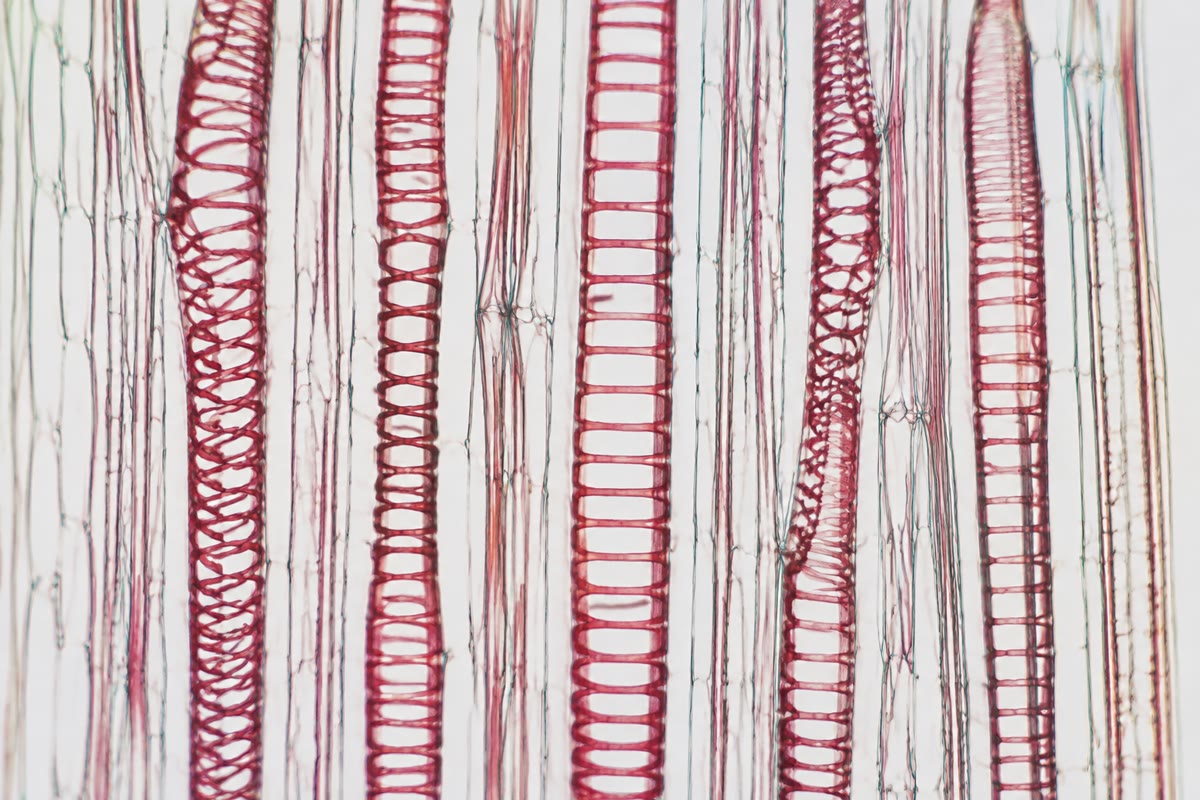
Water travels in the tracheids and vessels of the xylem (Chapter 3): dead cells emptied of their contents, their lignified walls thickened in rings and spirals that keep them from collapsing under the tension inside, joined end to end through perforations (vessels) or through pits in their side walls (tracheids). A vessel may be wide and centimetres to metres long: wide tubes carry far more (flow through a tube rises as the fourth power of its radius) but are more vulnerable to cavitation — the sudden formation of a gas bubble in water under tension, which empties the conduit and puts it out of service. Pits between conduits stop bubbles spreading; freezing and drought both cause cavitation, and a tree’s vessels are partly refilled by root pressure in spring or replaced by new wood each year.
Example 24.5 (The top of the tree)
At the column’s weight alone demands of tension; friction in the vessels adds as much again by day, so the xylem at the crown is near and the leaf cells, to draw water from it, lower than that: their stomata must close earlier in the day and their photosynthesis is slower than a low branch’s, and the leaves at the top are small and thick. The height of the tallest trees, some , is probably set by this: above it, the leaves cannot keep the tension without cavitating on a dry afternoon.
24.3 Moving sugar: pressure flow
Definition 24.6 (Phloem, sieve tubes, source and sink)
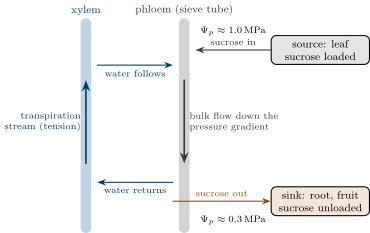
Sugar travels in the phloem, in sieve tubes: files of living cells that have lost their nuclei and most organelles but keep their membranes, joined end to end through perforated sieve plates, each cell nursed by a companion cell that supplies its proteins and ATP. The sap is sucrose, with amino acids, ions and signalling molecules, and it flows from sources — photosynthesising leaves, or storage organs being emptied — to sinks — growing tips, roots, fruits, seeds, storage organs being filled — at , in any direction, and in different directions in different tubes.
Theorem 24.7 (Pressure flow)
Phloem sap moves by bulk flow driven by a difference of hydrostatic pressure between source and sink (Münch, 1930). At the source, companion cells load sucrose into the sieve tubes against its gradient (by proton symport, from the apoplast, or through plasmodesmata); the tube’s water potential falls, water enters from the neighbouring xylem, and the turgor rises to or more. At the sink, sucrose is unloaded and consumed or stored, the water potential rises, water leaves, and the turgor is low. Between them the sap flows down the pressure gradient through the sieve plates, carrying whatever is dissolved in it. The plant spends energy only at the two ends; the flow itself is passive.
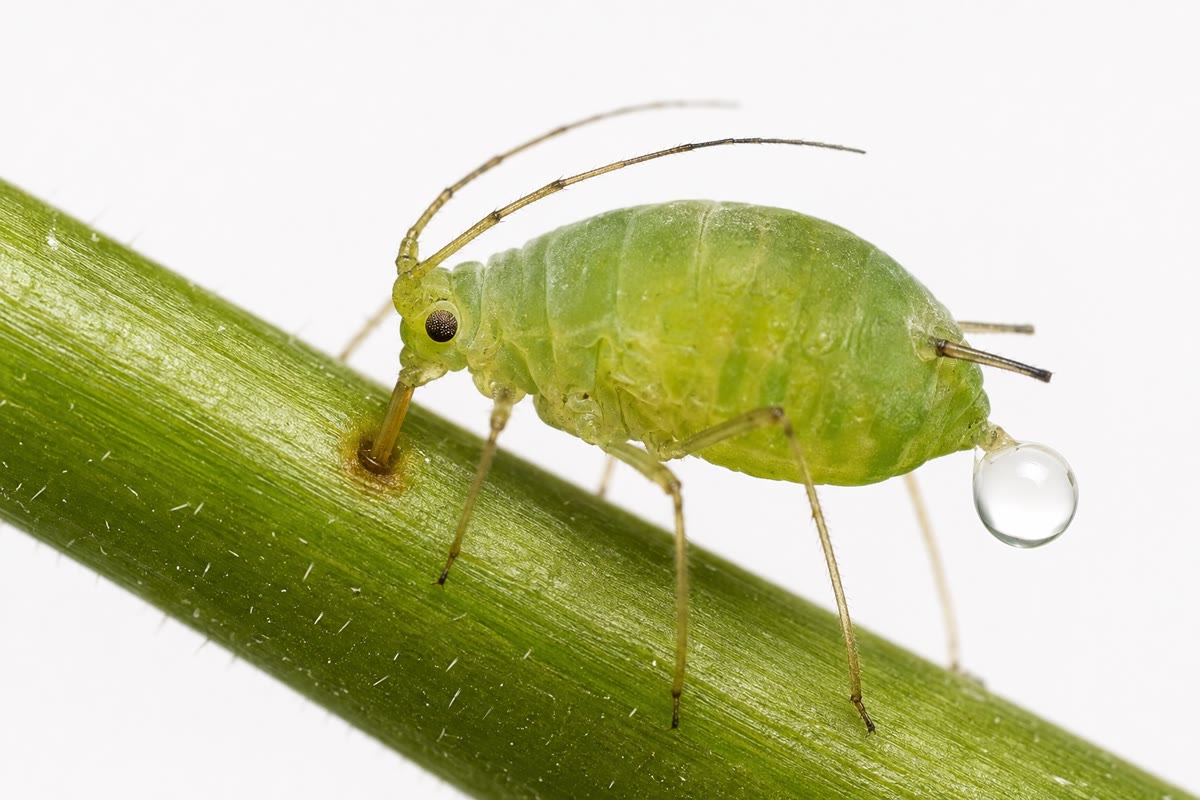
Evidence. An aphid feeding on a stem inserts its stylet into a single sieve tube; cut the aphid away and the stylet, left in place, exudes sap for hours under the tube’s own pressure — pure phloem sap, whose sucrose concentration and rate of flow can be measured, and whose pressure, measured with a manometer on the stylet, is about near a source and lower toward the sink. Labelled fed to a leaf appears in the stem’s phloem within minutes and moves at the speed the stylet flow predicts; chilling a length of stem, which slows the living cells but barely affects a pressure-driven flow, slows transport only slightly; poisoning the source leaf’s loading stops it. ∎
Method 24.8 (Reading a translocation experiment)
- Feed a leaf labelled ; sample the stem above and below at intervals: the label’s position against time gives the direction and speed of flow.
- Girdle the stem (remove a ring of bark, which carries the phloem, leaving the xylem): sugar accumulates above the ring and the roots starve below — the phloem, not the xylem, carries it; the tree dies in a season.
- Collect sap from severed aphid stylets at two heights: the drop in sucrose and in pressure between them is the gradient that drives the flow.
- Change the sinks: remove the fruits, and the label goes to the roots; shade the leaf, and it becomes a sink itself. The pattern of flow is the pattern of demand.
Example 24.9 (A potato in two seasons)
In summer the leaves are sources and the tubers underground the sinks: sucrose flows down, is unloaded, converted to starch, and the tubers swell. In spring the tuber sprouts: its starch is turned back to sucrose, loaded into the phloem, and flows up to the growing shoot — the same tube, the opposite direction, because the source and the sink have changed places.
24.4 The compromise
Proposition 24.10 (Water-use efficiency)
Every stoma that admits carbon dioxide loses water, and the exchange is unequal: the inside of the leaf is saturated with vapour and the air outside is dry, while is at outside and lower inside, so the outward gradient of water is hundreds of times the inward gradient of carbon dioxide. A C3 leaf loses molecules of water per fixed; a C4 leaf, concentrating and keeping its stomata narrower, ; a CAM plant, opening only at night, (Chapter 14). The water-use efficiency is the carbon gained per water lost, and its improvement — by closing at midday, by sunken stomata and thick cuticles, by the C4 and CAM pathways — is the plant’s side of the bargain with a dry atmosphere.
Example 24.11 (The bargain in numbers)
A maize plant transpiring a litre and a half a day fixes some of carbon dioxide: of water for of , three hundred and fifty to one. A wheat field in a season transpires five hundred tonnes of water per hectare to make eight tonnes of grain; the water is the price of the carbon, and in most of the world’s fields it is the price that limits the harvest.
24.5 Exercises
Exercise 24.1 ★
Explain how the shape and walls of guard cells turn a rise of turgor into an open pore.
Exercise 24.2 ★
State the cohesion–tension mechanism in three sentences: where the force comes from, what transmits it, what it does at the root.
Solution
Solution of Exercise 24.2.
Evaporation from the wet cell walls of the leaf into the air spaces creates the force, as surface tension in the walls’ fine pores puts the water under tension. The cohesion of water — its hydrogen bonds — transmits that tension down the unbroken columns in the xylem. At the root the tension lowers the xylem’s water potential below the soil’s and draws water in.
Exercise 24.3 ★
From the daily figure, at what hour is transpiration highest, when does the leaf’s water potential reach its minimum, and why do the stomata partly close at midday?
Solution
Solution of Exercise 24.3.
About noon; about 13:00; because the dry midday air raises transpiration faster than the roots can supply water, the leaf’s potential falls and abscisic acid and the leaf’s own water stress close the stomata partly.
Exercise 24.4 ★
Define source and sink, and say what happens at each in the pressure-flow mechanism.
Solution
Solution of Exercise 24.4.
Source: an organ exporting sugar (a leaf, a sprouting tuber), where sucrose is loaded into the sieve tubes, water follows and the turgor rises. Sink: an organ importing it (root, fruit, growing tip, filling tuber), where sucrose is unloaded, water leaves and the turgor falls.
Exercise 24.5 ★★
Compute the tension needed to hold a column of water high (), and the total if friction doubles it. What must the water potential of the leaves at that height be at least?
Exercise 24.6 ★★
Flow through a tube scales as . Compare the flow through one vessel of radius with that through the number of tracheids of the same total cross-section. Why do plants keep the narrow ones?
Solution
Solution of Exercise 24.6.
Same cross-section: 100 tracheids. Flow per tube : one vessel units, each tracheid 1 unit, a hundred of them 100: the vessel carries a hundred times more. Tracheids cavitate less readily and a bubble in one puts only a tiny conduit out of use; conifers, all tracheids, survive freezing winters that empty a vessel-bearing tree’s wood.
Exercise 24.7 ★★
Phloem sap at sucrose () has a solute potential of about . Beside a xylem at , what turgor does the sieve tube reach at equilibrium? At a sink where the sap is sucrose () beside the same xylem, what turgor? What pressure difference drives the flow?
Solution
Solution of Exercise 24.7.
at the source; at the sink in principle (the tube would need a slight tension, i.e. in practice about zero turgor); the difference of about drives the flow.
Exercise 24.8 ★★
An aphid stylet exudes per hour of sap at sucrose. If the sieve tube has a radius of , compute the speed of the sap and the sugar delivered per hour.
Solution
Solution of Exercise 24.8.
Cross-section ; per hour: speed — on the high side, since the stylet’s flow is faster than the undisturbed tube’s. Sugar: per hour.
Exercise 24.9 ★★
Explain why girdling a tree kills it in a season, yet its leaves stay green for weeks after the ring is cut.
Solution
Solution of Exercise 24.9.
The ring removes the phloem, so sugar can no longer reach the roots, which starve and die over months, after which water uptake fails and the crown dies. The xylem in the wood is untouched, so water still reaches the leaves, which go on photosynthesising for weeks — and sugar accumulates above the ring, swelling the bark there.
Exercise 24.10 ★★★
A leaf’s air spaces are saturated at ( of vapour); the outside air holds . is outside and inside. The two gases diffuse through the same pores, with water diffusing 1.6 times faster than . Compute the ratio of water lost to gained, by mass and by molecule.
Solution
Solution of Exercise 24.10.
Gradients: water , ; ratio of fluxes by mass; by molecule water molecules per .
Exercise 24.11 ★★★
On a hot dry afternoon a vessel cavitates. Describe what happens to the water column, to the tension in the neighbouring vessels, and to the leaf it supplied; explain how pits limit the damage and how the plant recovers in the night or the spring.
Solution
Solution of Exercise 24.11.
The column snaps: a bubble expands to fill the vessel, the water above it is no longer pulled and the vessel stops conducting; the flow shifts to neighbouring vessels, raising their tension and their risk; the leaf it supplied wilts partly. Pits between conduits are too fine for the bubble’s meniscus to pass, so the bubble stays in one conduit. At night, with tension gone, the bubble may dissolve under root pressure; in spring the tree grows a ring of new vessels and abandons the old.
Exercise 24.12 ★★★
“A tree is a wick between the soil and the sky, with a sugar pipe running the other way.” Discuss in a paragraph: what each system carries, what drives it, where the plant spends energy, and where it spends none.
Solution
Solution of Exercise 24.12.
The xylem carries water and minerals upward, driven by evaporation at the leaves — the sun’s energy, none of the plant’s; the phloem carries sugar (and signals) from sources to sinks, driven by a pressure difference the plant creates by spending ATP to load and unload sucrose at the two ends, with the flow in between free. The plant spends its energy only at the interfaces: the proton pumps of the guard cells and the phloem loaders, and the wood it must build to hold the tension. Everything in between — the metres of pipe — runs on physics.
24.6 Problem: The Sequoia
Problem 24.1
Weekend problem — a hundred-metre tree on a summer day: the tension at its crown, the sap’s speed, the water it moves, the sugar it sends down and the carbon it buys, ending on the xylem tension at the crown
A sequoia is tall with a crown of of leaf. On a summer day it transpires of water in through sapwood of cross-section , of which is conducting lumen. Water: , , . Friction along the trunk costs as much tension as gravity. Soil water potential . The crown fixes of per square metre of leaf per second for ; sucrose is and carries twelve carbons; phloem sap is sucrose by mass (density ) and flows at .
Part I — Tension.
- Compute the tension needed to support the column against gravity.
- Add the friction: what is the xylem tension at the crown?
- Compute the xylem water potential at the crown, taking for the sap.
- What must the leaf cells’ water potential be at the crown for water to enter them? If their , what turgor do they have?
- Compare with a leaf at on the same tree ().
- Water in fine tubes withstands about ; why does the tree not simply grow to ?
Part II — Flow.
- Compute the transpiration rate in litres per hour and in cubic metres per second.
- Compute the conducting cross-section of the sapwood.
- Compute the mean speed of the sap.
- Compute the mass of water held in the conducting lumen of the trunk ( of it).
- How long does a water molecule take to travel from root to crown at that speed?
- Compute the transpiration per square metre of leaf per hour, in grams, and per second in millimoles.
- The sap flows down a potential gradient from at the soil to the crown’s value of question 3 over . What is the gradient in megapascals per metre? How does it compare with the gravitational part alone?
Part III — Sugar.
- Compute the fixed by the crown per day, in moles.
- Compute the sucrose it corresponds to, in moles and in kilograms.
- Half is respired in the crown; the rest is sent down the phloem. Compute the mass of sucrose translocated per day and the mass of sap that carries it.
- Compute the volume of sap and, at , the cross-section of sieve tubes needed to carry it in .
- Compute the time for sucrose to travel from crown to root.
- Compute the water-use ratio: moles of water transpired per mole of fixed.
Part IV — Compromises.
- The phloem sap’s water potential at the crown, with and turgor : compute it and compare with the xylem’s there. Which way does water move between the two, and is that consistent with loading?
- At the root the phloem sap is sucrose () and the xylem at . What turgor makes the phloem’s equal to the xylem’s? What pressure difference between crown and root drives the flow?
- The stomata close at midday and transpiration halves. Recompute the friction tension and the crown xylem potential. What does the tree gain and lose?
- In a dry year the soil falls to . Recompute the crown potential with full transpiration. Can the crown leaves () keep any turgor? What must the tree do?
- Explain why the tallest leaves are the smallest and thickest.
- State the result: the xylem tension at the crown of a tree on a summer day, and the sap speed that goes with it.
Solution
Solution of Problem 24.1.
1. . 2. About of tension. 3. (soil plus the two tensions). 4. Below : with , turgor at most — a leaf near the edge of wilting all afternoon. 5. At : gravity , friction , xylem ; leaf turgor up to : comfortably turgid. 6. At the tension would be at the crown, and the leaves would need below that to draw water: impossible for living cells, and any vessel would cavitate on the first dry afternoon long before; the limit is set by cavitation and by the leaves, not by the strength of water. 7. ; . 8. . 9. , . 10. : ten tonnes of water hanging in the trunk. 11. , eight days. 12. per square metre per hour; per square metre per second. 13. , twice the gravitational gradient of . 14. . 15. of sucrose, . 16. of sucrose in of sap. 17. ; over at , flow at : cross-section , of sieve tubes — a thin cylinder of bark. 18. , a week. 19. of water for of : about 96 to 1 — low for a C3 plant, because a sequoia’s crown lives in humid coastal air. 20. against the xylem’s : water would move from phloem to xylem, so the phloem cannot draw water from the crown’s xylem at those values; loading at the crown of a tall tree must lower the phloem’s further (more concentrated sap) or the crown’s xylem is less tense than the simple estimate — a real puzzle of tall-tree physiology. 21. ; difference over . 22. Friction halves to : tension , crown potential ; the leaves regain turgor () and the risk of cavitation falls, but carbon fixation halves for the hours the stomata are closed. 23. Crown : below the leaves’ , so no turgor is possible and the crown wilts; the tree must close its stomata (raising the crown to about , zero turgor), shed leaves at the top, and wait for rain. 24. Their water potential is the lowest in the tree: to keep turgor they carry more solutes and thicker walls, and to limit transpiration, smaller blades; they grow slowly, because their stomata close early. 25. About of tension at the crown (a water potential near ), with sap moving at about through the sapwood.