
সব বই

পেশাদার

1 Markets I: The Ecosystem and Exchange-Traded Marketsবাজার অনলাইন 2 Markets II: Rates, FX and Creditবাজার অনলাইন 3 Markets III: Commodities, Energy and Cryptoবাজার অনলাইন 4 Quantitative Methodsপদ্ধতি অনলাইন 5 Derivatives and Volatilityডেরিভেটিভস অনলাইন 6 Rates, Credit, XVA and Riskসুদহার, ঋণ ও ঝুঁকি অনলাইন 7 Research Craft: Predictors, Backtests, Measurement, Portfoliosগবেষণা অনলাইন 8 Strategies I: Equities and Futuresকৌশল অনলাইন 9 Strategies II: Volatility, Relative Value, Macro and the Bank Desksকৌশল অনলাইন 10 Microstructure and Executionএক্সিকিউশন অনলাইন 11 Market Making and High-Frequency Tradingমার্কেট মেকিং অনলাইন 12 Machine Learning for Marketsমেশিন লার্নিং অনলাইন 13 Low-Latency Softwareপ্রযুক্তি অনলাইন 14 Networks, Hardware and Trading Infrastructureপ্রযুক্তি অনলাইন 15 Research, Data and Risk Platformsপ্রযুক্তি অনলাইন 16 The Desk and the Firmপ্রতিষ্ঠান অনলাইন 17 The Industry: Firms, Roles and Careersক্যারিয়ার অনলাইন 18 Interviews I: Maths, Probability and Speedক্যারিয়ার অনলাইন 19 Interviews II: Markets, Trading Games and the Final Roundক্যারিয়ার অনলাইন 20 Interviews III: Codeক্যারিয়ার অনলাইন
অ্যাপ পরিচিতি Coach সাইন ইন পড়া শুরু করো

বইগুলো এখনো বাংলা ভাষায় পাওয়া যায় না — ইংরেজি সংস্করণ দেখানো হচ্ছে।

Biology · পরিভাষা

The fern life cycle কী?

Definition 5.5 University Biology — Year 2 · অধ্যায় 5 — Life Cycles and Reproduction of Land Plants

The fern is the sporophyte: a rhizome with roots, xylem and phloem, and fronds. On the underside of fertile fronds, clusters of sporangia (sori, often under a protective flap) each make 64 spores by meiosis and fling them by the snap of a drying ring of thick-walled cells. A spore that lands on damp soil grows into a prothallus: a heart-shaped green gametophyte a few millimetres across, one cell thick, with rhizoids, living free for a few weeks. It bears antheridia and archegonia on its underside; sperm swim in the soil film to the egg; the zygote grows into a young sporophyte that draws its first food from the prothallus and then roots, and the prothallus dies. The two generations are both independent, but unequal: the sporophyte lives for decades and can be metres tall, the gametophyte for weeks and millimetres.
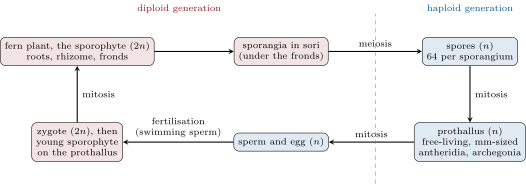
The fern cycle. The plant we call a fern is the diploid sporophyte; the haploid gametophyte is a short-lived prothallus on which the sperm swim to the eggs.
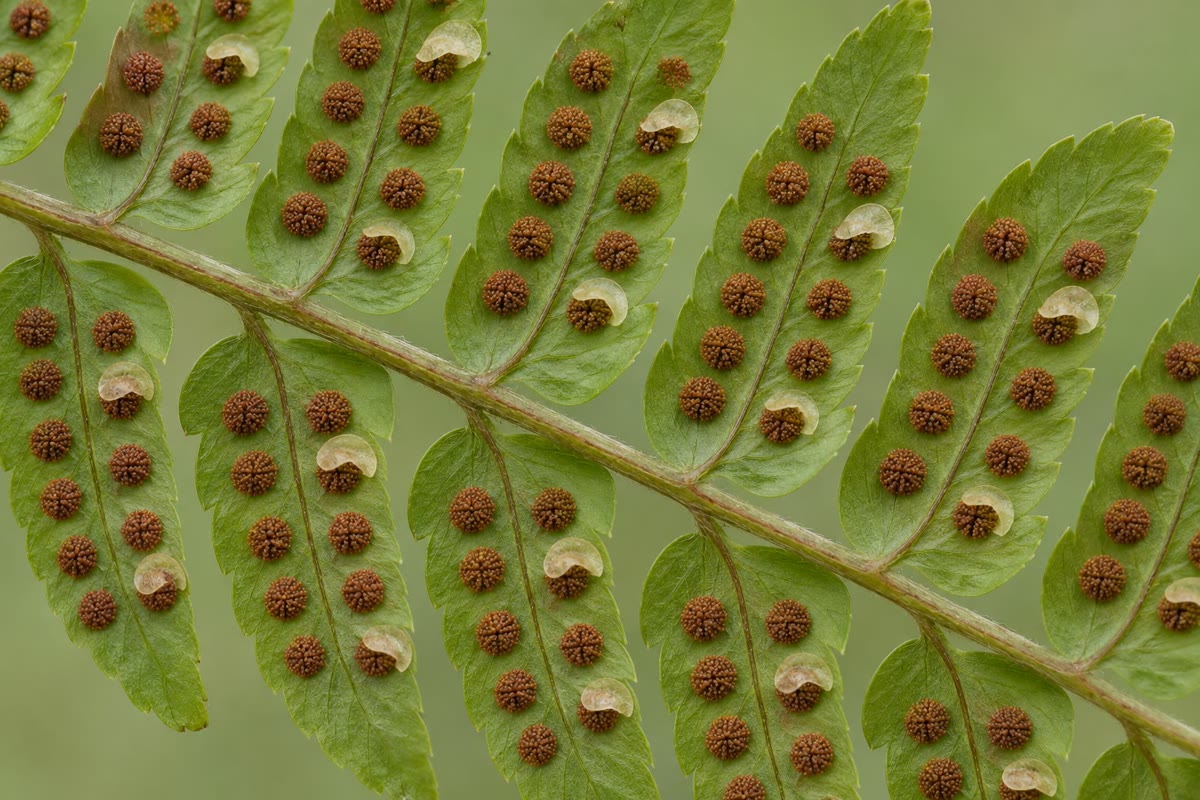
The underside of a fertile fern frond: each brown dot is a sorus, a cluster of sporangia, some still covered by the flap that protects them until they ripen.

উদাহরণ

Example 5.4 (The cost of swimming sperm)

A moss sperm swims at about 100 µm/s100\,\text{µ}\mathrm{m}/\mathrm{s}; to reach an archegonium 2 cm2\,\mathrm{cm} away it needs 200 s200\,\mathrm{s} of continuous water film — a splash of rain, a heavy dew. Fertilisation is therefore confined to wet weather and to short distances, and most mosses, ferns and their relatives live in damp places or reproduce in the wet season; the antheridia of some mosses sit in a splash cup whose shape throws raindrops, and the sperm they carry, half a metre. It is this dependence that the seed plants escaped.

Example 5.11 (The groups compared)

mossesfernsconifers
dominant generationgametophytesporophytesporophyte
gametophyteleafy shoot, cmprothallus, mm, freepollen grain (4 cells); ovule contents (thousands of cells)
sporesone kindone kindmicrospores, megaspores
fertilisationsperm swim in watersperm swim in waterpollen tube
dispersal unitsporesporeseed
vascular tissuenonexylem, phloemxylem, phloem, wood
প্রসঙ্গসহ পড়ো →