 Coach
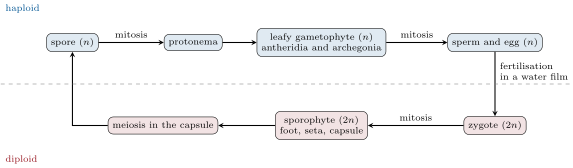
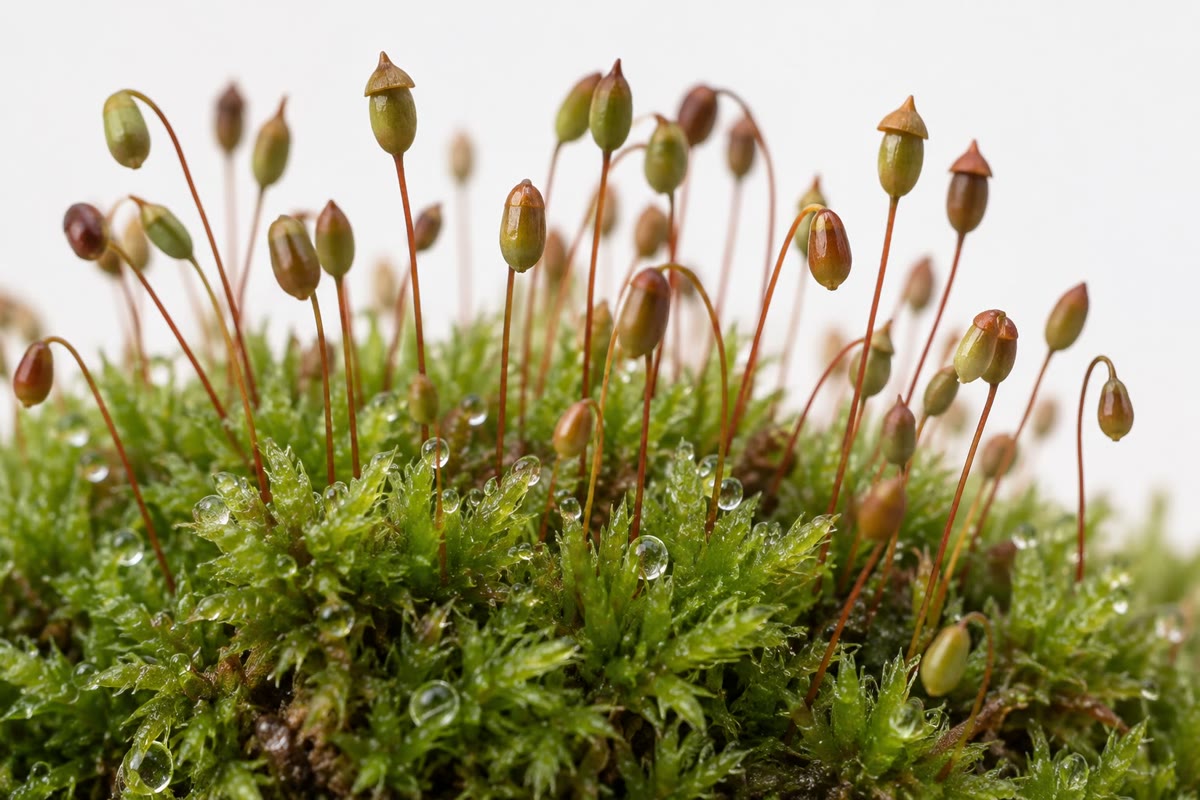
CoachA moss spore germinates into a branching green filament, the protonema, from which buds grow into the leafy shoots — the gametophyte, a few centimetres tall, without true roots, xylem or phloem, anchored by rhizoids and drawing water over its whole surface. At the shoot tips it bears antheridia, which release biflagellate sperm into a film of rain or dew, and archegonia, each with one egg at the base of a neck; the sperm swim a few centimetres at most, guided by chemical attractants, and fertilise the egg in place. The zygote grows into the sporophyte: a foot embedded in the gametophyte, a stalk (seta), and a capsule in which meiosis makes tens of thousands of spores, shed through a ring of hygroscopic teeth that open in dry air. The sporophyte photosynthesises a little but is fed by the gametophyte through its foot and never lives alone.
Examples
Example 5.4 (The cost of swimming sperm)
A moss sperm swims at about ; to reach an archegonium away it needs of continuous water film — a splash of rain, a heavy dew. Fertilisation is therefore confined to wet weather and to short distances, and most mosses, ferns and their relatives live in damp places or reproduce in the wet season; the antheridia of some mosses sit in a splash cup whose shape throws raindrops, and the sperm they carry, half a metre. It is this dependence that the seed plants escaped.