
সব বই

পেশাদার

1 Markets I: The Ecosystem and Exchange-Traded Marketsবাজার অনলাইন 2 Markets II: Rates, FX and Creditবাজার অনলাইন 3 Markets III: Commodities, Energy and Cryptoবাজার অনলাইন 4 Quantitative Methodsপদ্ধতি অনলাইন 5 Derivatives and Volatilityডেরিভেটিভস অনলাইন 6 Rates, Credit, XVA and Riskসুদহার, ঋণ ও ঝুঁকি অনলাইন 7 Research Craft: Predictors, Backtests, Measurement, Portfoliosগবেষণা অনলাইন 8 Strategies I: Equities and Futuresকৌশল অনলাইন 9 Strategies II: Volatility, Relative Value, Macro and the Bank Desksকৌশল অনলাইন 10 Microstructure and Executionএক্সিকিউশন অনলাইন 11 Market Making and High-Frequency Tradingমার্কেট মেকিং অনলাইন 12 Machine Learning for Marketsমেশিন লার্নিং অনলাইন 13 Low-Latency Softwareপ্রযুক্তি অনলাইন 14 Networks, Hardware and Trading Infrastructureপ্রযুক্তি অনলাইন 15 Research, Data and Risk Platformsপ্রযুক্তি অনলাইন 16 The Desk and the Firmপ্রতিষ্ঠান অনলাইন 17 The Industry: Firms, Roles and Careersক্যারিয়ার অনলাইন 18 Interviews I: Maths, Probability and Speedক্যারিয়ার অনলাইন 19 Interviews II: Markets, Trading Games and the Final Roundক্যারিয়ার অনলাইন 20 Interviews III: Codeক্যারিয়ার অনলাইন
অ্যাপ পরিচিতি Coach সাইন ইন পড়া শুরু করো

বইগুলো এখনো বাংলা ভাষায় পাওয়া যায় না — ইংরেজি সংস্করণ দেখানো হচ্ছে।

Biology · পরিভাষা

The moss life cycle কী?

Definition 5.3 University Biology — Year 2 · অধ্যায় 5 — Life Cycles and Reproduction of Land Plants

A moss spore germinates into a branching green filament, the protonema, from which buds grow into the leafy shoots — the gametophyte, a few centimetres tall, without true roots, xylem or phloem, anchored by rhizoids and drawing water over its whole surface. At the shoot tips it bears antheridia, which release biflagellate sperm into a film of rain or dew, and archegonia, each with one egg at the base of a neck; the sperm swim a few centimetres at most, guided by chemical attractants, and fertilise the egg in place. The zygote grows into the sporophyte: a foot embedded in the gametophyte, a stalk (seta), and a capsule in which meiosis makes tens of thousands of spores, shed through a ring of hygroscopic teeth that open in dry air. The sporophyte photosynthesises a little but is fed by the gametophyte through its foot and never lives alone.
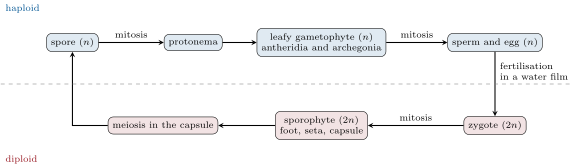
The moss cycle. The leafy plant is the haploid gametophyte; the sporophyte is a stalk and capsule that grows on it, fed by it, and makes spores by meiosis.
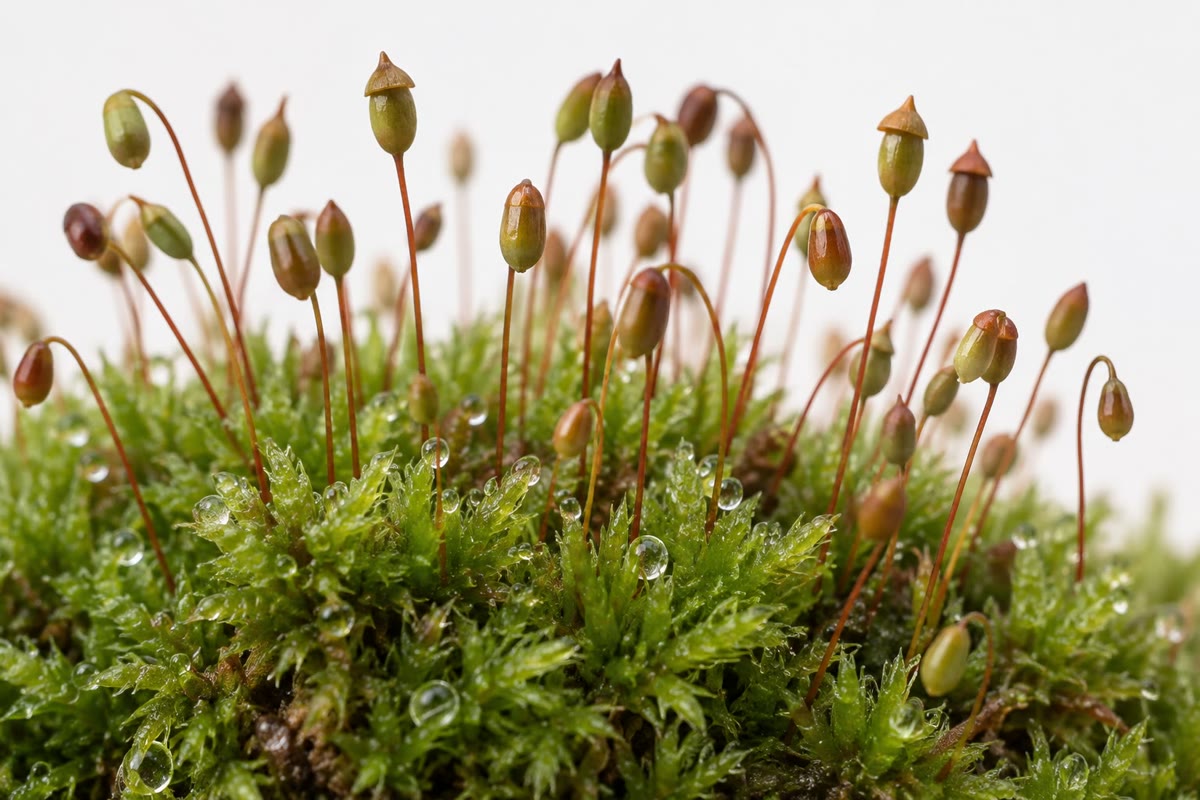
A moss cushion in spring: the green shoots are the gametophytes, and each reddish stalk with its capsule is a sporophyte grown from a fertilised egg, still attached to the shoot that made the egg.

উদাহরণ

Example 5.4 (The cost of swimming sperm)

A moss sperm swims at about 100 µm/s100\,\text{µ}\mathrm{m}/\mathrm{s}; to reach an archegonium 2 cm2\,\mathrm{cm} away it needs 200 s200\,\mathrm{s} of continuous water film — a splash of rain, a heavy dew. Fertilisation is therefore confined to wet weather and to short distances, and most mosses, ferns and their relatives live in damp places or reproduce in the wet season; the antheridia of some mosses sit in a splash cup whose shape throws raindrops, and the sperm they carry, half a metre. It is this dependence that the seed plants escaped.

প্রসঙ্গসহ পড়ো →