Put a zinc strip in a solution of zinc sulfate, a copper strip in a solution of copper(II) sulfate, join the two solutions by a tube of salt solution and the two metals by a wire through a light-emitting diode: the diode lights. The reaction of zinc with copper ions, which in a single beaker only warms the solution, now drives electrons through a wire. A battery is this arrangement, packaged; a pH meter and a chloride electrode are its measuring cousins. This chapter makes the electron exchange quantitative: oxidation numbers to count the electrons, electrode potentials to rank the couples, and the Nernst equation to follow them with concentration.
You already know
The school volume (grades 11 and 12) defined oxidants and reductants, wrote half-equations, built cells from two metals and two solutions and read the zinc–copper cell as a battery. The reaction quotient and the equilibrium constant are those of Chapter 7; activities are c/c∘ for solutes and p/p∘ for gases, 1 for pure solids and liquids.
An oxidant is a species able to gain electrons, a reductant a species able to give them. An oxidant Ox and the reductant Red it becomes form a redox couple Ox/Red, described by its half-equationαOx+ne−⇌βRed, balanced in atoms with HX2O and HX+ when needed and in charge with the electrons.
A redox reaction is the exchange of electrons between two couples: the oxidant of one is reduced while the reductant of the other is oxidised, and the electrons cancel. To count them in a complicated species, each atom is given an oxidation number.
Definition 13.2(Oxidation number)
The oxidation number of an atom in a species is the charge it would carry if every bond were broken giving both bonding electrons to the more electronegative atom (shared equally between two identical atoms). It is written in Roman numerals: iron(III), MnX+VII in the permanganate ion.
Proposition 13.3(Rules for oxidation numbers)
An atom in an element has oxidation number 0; a monatomic ion has its charge.
The oxidation numbers of the atoms of a species add up to its charge.
Hydrogen is +I (except in metal hydrides, −I); oxygen is −II (except in peroxides, −I, and bound to fluorine); fluorine is −I.
In a half-equation the number of electrons equals the change of the oxidation number of the element that changes, times the number of its atoms.
Proof. 1 and 2: breaking all bonds conserves charge, and between identical atoms nothing is transferred. 3: hydrogen is less electronegative than every non-metal it bonds to (Chapter 2) and more than the alkali metals; oxygen is more electronegative than every element but fluorine, and in O−O the shared pair is split. 4: H and O keep their numbers, so the only atoms whose fictitious charge changes are those of the element concerned, and the electrons appear in the half-equation exactly to balance that change of charge. ∎
Method 13.4(Oxidation numbers of a species)
Give H, O, F and the ions their usual numbers; the number of the remaining atom follows from rule 2. In MnOX4X−: x+4(−2)=−1, x=+7. In CrX2OX7X2−: 2x−14=−2, x=+6. In SX4OX6X2−, the average is +2.5; the Lewis structure shows two kinds of sulfur.
Add the electrons: the change of oxidation number times the number of atoms.
Balance the charge with HX+ (acidic solution) or OHX− (basic solution).
Balance hydrogen and oxygen with HX2O; check oxygen last.
For the permanganate ion in acid: Mn goes from +VII to +II, so 5 electrons; the charge on the left is −1−5=−6 and on the right +2, so 8HX+; then 4HX2O: MnOX4X−+8HX++5eX−MnX2++4HX2O.
13.2 Electrochemical cells
Definition 13.6(Electrochemical cell)
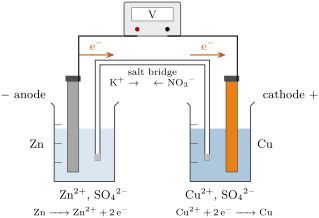
An electrochemical cell is two half-cells, each made of a couple and an electronic conductor, the electrode, joined by an ionic conductor, often a salt bridge (a gel or tube of a concentrated inert salt such as potassium nitrate). The electrode where oxidation takes place is the anode, the one where reduction takes place the cathode. The cell voltage is the difference of electric potential between the two electrodes, positive pole minus negative pole, measured when no current flows.
The zinc–copper (Daniell) cell. Zinc is oxidised at the anode, the negative pole; copper ions are reduced at the cathode, the positive pole. Electrons flow through the external circuit from zinc to copper; in the salt bridge the cations move towards the cathode and the anions towards the anode, keeping each solution neutral.
A cell is written as a line, anode on the left: Zn∣ZnX2+∥CuX2+∣Cu, single bars for the interfaces, a double bar for the salt bridge. With all concentrations at 1mol/L its voltage is 1.10V. The reaction that runs when the cell delivers current, Zn+CuX2+ZnX2++Cu, is the one that would happen in a single beaker; separating the half-cells forces the electrons through the wire, where they can do work.
13.3 Electrode potentials
A voltage is a difference: only differences between two half-cells can be measured. A reference half-cell is therefore chosen once and for all.
Definition 13.7(Electrode potential, standard potential)
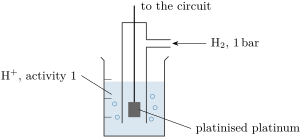
The standard hydrogen electrode is a platinum electrode in contact with hydrogen gas at 1bar and an ideal solution of HX+ of activity 1. The electrode potentialE of a half-cell is the voltage of the cell formed with the standard hydrogen electrode on the left: E=Vhalf-cell−VSHE. When every species of the couple has activity 1, it is the standard potentialE∘ of the couple, a constant at a given temperature.
The standard hydrogen electrode: hydrogen gas bubbles over a platinum plate coated with fine platinum, dipped in a solution where HX+ has activity 1. Its couple is HX+/HX2, of potential 0 by convention.
The hydrogen electrode is awkward to use; laboratories measure against a more convenient half-cell whose potential is known.
Definition 13.8(Reference electrode)
A reference electrode is a half-cell whose potential is fixed and known: the silver–silver chloride electrode (a silver wire coated with silver chloride in a chloride solution of fixed concentration) or the calomel electrode (mercury in contact with HgX2ClX2 and a chloride solution).
The table below gives the standard potentials used in this volume; the vertical scale of the next section shows the most common.
couple
E∘ (V)
couple
E∘ (V)
LiX+/Li
−3.04
CuX2+/Cu
0.34
KX+/K
−2.94
[Fe(CN)X6]3−/[Fe(CN)X6]4−
0.36
NaX+/Na
−2.71
CuX+/Cu
0.52
MgX2+/Mg
−2.36
IX2/IX−
0.53
AlX3+/Al
−1.68
OX2/HX2OX2
0.69
ZnX2+/Zn
−0.76
FeX3+/FeX2+
0.77
FeX2+/Fe
−0.41
HgX2X2+/Hg
0.80
NiX2+/Ni
−0.24
AgX+/Ag
0.80
PbX2+/Pb
−0.13
BrX2/BrX−
1.08
HX+/HX2
0
OX2/HX2O
1.23
SX4OX6X2−/SX2OX3X2−
0.02
MnOX2/MnX2+
1.23
CuX2+/CuX+
0.16
ClX2/ClX−
1.36
AgCl/Ag
0.22
PbOX2/PbX2+
1.46
HgX2ClX2/Hg
0.27
MnOX4X−/MnX2+
1.51
HClO/ClX2
1.63
HX2OX2/HX2O
1.76
Standard potentials at 25∘C, computed from the tabulated standard Gibbs energies of formation of the species of each couple. They may differ by a few hundredths of a volt from other compilations.
13.4 The Nernst equation
Theorem 13.9(Nernst equation)
For a couple αOx+ne−⇌βRed, with possibly other species (HX+, HX2O, ClX−) on either side, the electrode potential is given by the Nernst equation
The Nernst equation follows from the relation between the Gibbs energy of a reaction and the voltage of the cell, derived in the Year 2 volume.
Example 13.10(Three couples)
CuX2+/Cu: E=0.34+0.030log[CuX2+] (copper metal has activity 1). FeX3+/FeX2+: E=0.77+0.059log([FeX3+]/[FeX2+]). MnOX4X−/MnX2+: E=1.51+50.059log[MnX2+][MnOX4X−][HX+]8; at equal concentrations of permanganate and manganese(II), E=1.51−0.094pH: the oxidising power of permanganate falls as the pH rises.
A tenfold change of a concentration moves the potential by 0.059/n volt: a few tens of millivolts. This is why a voltage measured to the millivolt is an accurate measure of a concentration, the principle of the pH electrode and of the chloride electrode of the weekend problem.
History— Walther Nernst
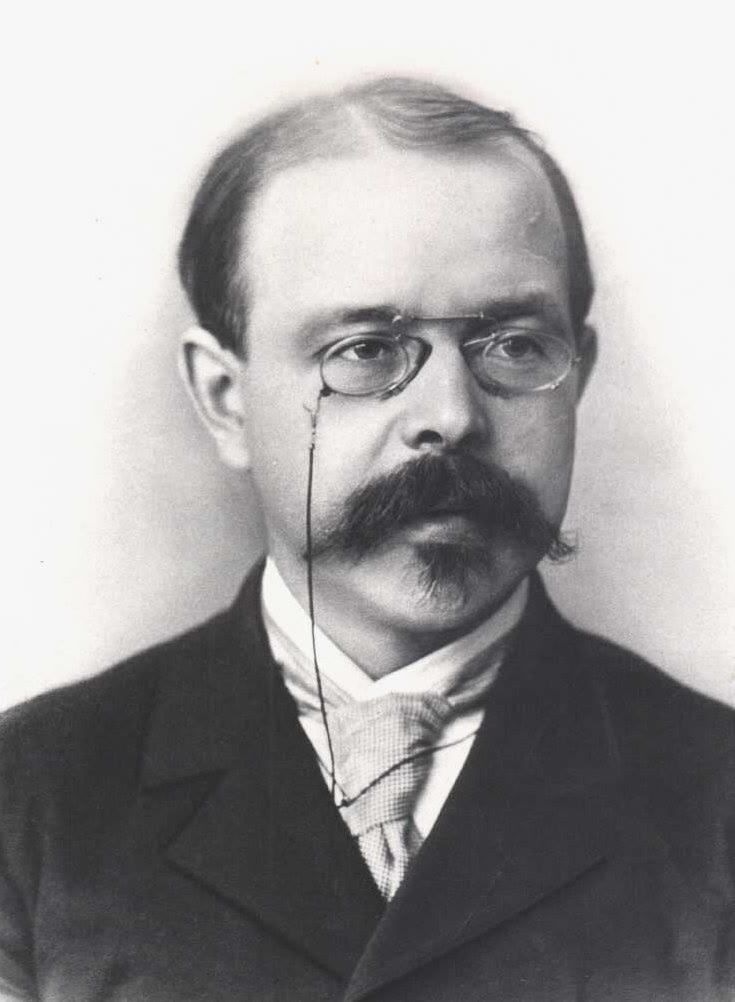
Walther Nernst (1864–1941), here at twenty-five, in 1889. The equation of this section, which links the voltage of a cell to the concentrations of its ions, carries his name, and so does a third principle of thermodynamics met in the Year 2 volume. (Photograph: Smithsonian Libraries, public domain, Wikimedia Commons.)
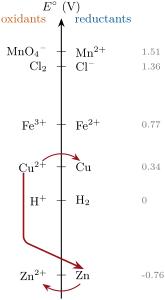
The strongest oxidant present (highest E∘) reacts with the strongest reductant present (lowest E∘): the arrow from the oxidant down to the reductant, then up to the products, draws a Greek gamma, γ.
The reaction is favoured (K>1) when the oxidant’s couple is above the reductant’s; it is quantitative in practice when the gap exceeds about 0.25V for one exchanged electron.
A scale of standard potentials. The gamma rule: the oxidantCuX2+ reacts with the reductantZn below it on the other side (thick arrow); CuX2+ is reduced to Cu (upper curved arrow) and Zn oxidised to ZnX2+ (lower curved arrow). The reverse reaction, Cu with ZnX2+, is not favoured.
Proposition 13.12(Equilibrium constant from standard potentials)
For the reaction Ox1+Red2⇌Red1+Ox2 exchanging n electrons,
logK=0.059n(E1∘−E2∘)at 25∘C.
Proof. At equilibrium no current flows in a cell built from the two couples: the two electrodes have the same potential, E1=E2. Write the Nernst equation for each with the same n: E1∘+n0.059loga(Red1)a(Ox1)=E2∘+n0.059loga(Red2)a(Ox2), so 0.059n(E1∘−E2∘)=loga(Ox1)a(Red2)a(Red1)a(Ox2)=logK, the activities being those of equilibrium. ∎
For the Daniell reaction, logK=2(0.34+0.76)/0.059=37: zinc reduces copper ions completely. For 2FeX3++2IX−2FeX2++IX2, logK=2(0.77−0.53)/0.059=8.1. The criterion of the method follows: with n=1, a gap of 0.25V gives K=104.2.
Proposition 13.13(Combining potentials)
If the couples A/B (n1 electrons) and B/C (n2) combine into A/C (n3=n1+n2), then n3E3∘=n1E1∘+n2E2∘. Potentials do not add; electron-weighted potentials do.
Proof. In a solution containing A, B and C at equilibrium with one electrode, the three couples have the same potential E. Multiply the Nernst equation of the first by n1 and of the second by n2 and add: the activity of B cancels and (n1+n2)E=n1E1∘+n2E2∘+0.059loga(C)a(A), which is n3 times the Nernst equation of A/C with E3∘ as stated. ∎
Copper: 2E∘(CuX2+/Cu)=0.16+0.52=0.68, so E∘(CuX2+/Cu)=0.34 V, as in the table. Because E∘(CuX+/Cu)>E∘(CuX2+/CuX+), the copper(I) ion oxidises and reduces itself, 2CuX+CuX2++Cu: it does not survive in water (Chapter 14).
Proposition 13.14(Electrode of the second kind)
A silver wire coated with silver chloride in a chloride solution has the potential
Proof. The wire is in equilibrium with the AgX+ of the solution: E=E∘(AgX+/Ag)+0.059log[AgX+], and silver chloride fixes [AgX+]=Ks/[ClX−]. Substituting, E=E∘(AgX+/Ag)+0.059logKs−0.059log[ClX−]. ∎
Numerically 0.80−0.059×9.75=0.22 V, the value of the table obtained independently from the Gibbs energies. Such an electrode measures chloride, or, at fixed chloride, serves as a reference.
13.6 Exercises
Exercise 13.1★
Give the oxidation number of the underlined atom: NHX3, NOX3X−, SOX4X2−, HX2O2, Cr2OX7X2−, ClOX−, Fe3OX4 (average), CHX3OH.
Solution
Solution of Exercise 13.1.
N in NHX3: −III; in NOX3X−: +V. S in SOX4X2−: +VI. O in HX2OX2: −I. Cr in CrX2OX7X2−: +VI. Cl in ClOX−: +I. Fe in FeX3OX4: +8/3 on average (one iron(II) and two iron(III)). C in CHX3OH: x+4(+1)+(−2)=0, −II.
Exercise 13.2★
Balance in acid the half-equations of CrX2OX7X2−/CrX3+, HX2OX2/HX2O, OX2/HX2OX2 and SOX4X2−/SOX2.
Write the Nernst equation of ZnX2+/Zn, ClX2/ClX−, OX2/HX2O and HgX2ClX2/Hg. Compute the potential of a zinc strip in 0.010mol/L zinc sulfate.
Solution
Solution of Exercise 13.3.
E=−0.76+0.030log[ZnX2+]; E=1.36+0.030log(p(ClX2)/[ClX−]2); E=1.23+0.015log(p(OX2)[HX+]4); E=0.27−0.059log[ClX−] (pressures in bar). In 0.010mol/L zinc sulfate: E=−0.76+0.030×(−2)=−0.82 V.
Exercise 13.4★
A Daniell cell contains ZnX2+ at 0.10mol/L and CuX2+ at 0.010mol/L. Compute the potential of each electrode, the cell voltage, and say which electrode is the anode.
Solution
Solution of Exercise 13.4.
E(Zn)=−0.76+0.030log0.10=−0.79 V, E(Cu)=0.34+0.030log0.010=0.28 V. Voltage 0.28−(−0.79)=1.07 V. Zinc, at the lower potential, is the negative pole, where oxidation takes place: the anode.
Exercise 13.5★★
Balance MnOX4X−+FeX2+ in acid, compute its equilibrium constant and say whether it can serve for a titration.
Solution
Solution of Exercise 13.5.
MnOX4X−+5FeX2++8HX+MnX2++5FeX3++4HX2O, n=5, logK=5(1.51−0.77)/0.059=63: quantitative and fast, a classic titration (permanganate is its own indicator).
Exercise 13.6★★
Which of these metals dissolve in a 1mol/L acid that is not itself an oxidant (hydrochloric acid), giving hydrogen: Mg, Zn, Fe, Ni, Pb, Cu, Ag? Write the reactions and compute logK for magnesium and for iron.
Solution
Solution of Exercise 13.6.
Metals whose E∘ is below 0 react: Mg, Zn, Fe, Ni, Pb (lead only slowly: the gap is small); Cu and Ag do not. Mg+2HX+MgX2++HX2, logK=2×2.36/0.059=80; Fe+2HX+FeX2++HX2, logK=2×0.41/0.059=13.9.
Exercise 13.7★★
Iodine titrations use IX2+2SX2OX3X2−2IX−+SX4OX6X2−. Compute its constant from the table. Is it quantitative?
From E∘(FeX2+/Fe)=−0.41 V and E∘(FeX3+/FeX2+)=0.77 V, compute E∘(FeX3+/Fe). Show that iron(III) ions react with iron metal and compute the constant.
Solution
Solution of Exercise 13.8.
3E∘(FeX3+/Fe)=2(−0.41)+0.77, E∘=−0.02 V. 2FeX3++Fe3FeX2+: oxidantFeX3+ (0.77) above reductantFe (−0.41), n=2, logK=2(0.77+0.41)/0.059=40. Iron filings keep a solution of iron(II) from turning into iron(III).
Exercise 13.9★★
Show that the potential of the couple OX2/HX2O under 1bar of oxygen is 1.23−0.059pH, and that of HX+/HX2 under 1bar of hydrogen is −0.059pH. What is the voltage of a hydrogen–oxygen fuel cell? Does it depend on the pH?
Solution
Solution of Exercise 13.9.
OX2+4HX++4eX−2HX2O: E=1.23+40.059log[HX+]4=1.23−0.059pH. 2HX++2eX−HX2: E=20.059log[HX+]2=−0.059pH. The difference is 1.23 V at any pH: the voltage of the fuel cell does not depend on the pH.
Exercise 13.10★★★
The copper(I) ion. Using the table, show that CuX+ disproportionates in water, compute the constant of 2CuX+CuX2++Cu, and the concentration of CuX+ left in equilibrium with copper metal and CuX2+ at 0.10mol/L.
Solution
Solution of Exercise 13.10.
E∘(CuX+/Cu)=0.52>E∘(CuX2+/CuX+)=0.16: the oxidantCuX+ of the upper couple reacts with the reductantCuX+ of the lower. logK=(0.52−0.16)/0.059=6.1, K=[CuX2+]/[CuX+]2, so [CuX+]=0.10/106.1=2.8×10−4mol/L.
Exercise 13.11★★★
A cell Ag∣AgX+ (1.0×10⁻³mol/L) ∥AgX+ (0.10mol/L) ∣Ag has the same couple on both sides. Compute its voltage, identify its poles and describe how the concentrations evolve while it delivers current. When does it stop?
Solution
Solution of Exercise 13.11.
U=0.059log(0.10/1.0×10−3)=0.118 V. The positive pole is the silver in the concentrated solution, where AgX+ is reduced; in the dilute solution silver is oxidised. The concentrated solution becomes more dilute and the dilute one more concentrated; the voltage falls and reaches zero when the two concentrations are equal.
Exercise 13.12★★★
Hydrogen peroxide. Compute, from the table, the constant of 2HX2OX22HX2O+OX2 and explain why a bottle of hydrogen peroxide is nevertheless stable for months. Which couple of the table makes it an oxidant, which a reductant?
Solution
Solution of Exercise 13.12.
HX2OX2 is the oxidant of HX2OX2/HX2O (1.76 V) and the reductant of OX2/HX2OX2 (0.69 V): it reacts with itself, 2HX2OX22HX2O+OX2, logK=2(1.76−0.69)/0.059=36. The reaction is favoured but very slow without a catalyst (Chapter 9); clean bottles, cold and dark storage keep it slow.
13.7 Problem: The Electrode that Measures Chloride
Problem 13.1
Weekend problem — oxidation numbers of the silver chloride couple, a cell against the hydrogen electrode, measuring the chloride of a water sample, and the standard potential of the silver–silver chloride electrode
A water laboratory measures chloride with a silver wire coated with silver chloride, dipped in the sample and connected to a reference electrode. Data at 25∘C: E∘(AgX+/Ag)=0.80 V, E∘(AgCl/Ag)=0.22 V, E∘(HgX2ClX2/Hg)=0.27 V, pKs(AgCl)=9.75, RTln10/F=0.059 V, M(Cl)=35.5g/mol.
Part I — The couple.
Give the oxidation number of silver in Ag, AgX+ and AgCl, and that of chlorine in AgCl and ClX−.
In the presence of solid silver chloride, express [AgX+] as a function of [ClX−].
Deduce the potential of the silver wire as a function of [ClX−].
Identify E∘(AgCl/Ag) in this expression.
Compute it from E∘(AgX+/Ag) and pKs, and compare with the value of the table.
State the standard potential of the silver–silver chloride electrode to two decimals.
Solution
Solution of Problem 13.1.
1. Ag: 0, +I, +I; Cl: −I in both. 2.AgCl(s)+eX−Ag(s)+ClX−. 3.E=E∘(AgCl/Ag)−0.059log[ClX−]. 4. The two solids have activity 1; only the chloride ion is in solution. 5.E∘=0.22 V. 6.0.22+0.118=0.34 V. 7.Pt∣HX2 (1bar) ∣HX+ (activity 1) ∥ClX− (0.10mol/L) ∣AgCl∣Ag. 8. The silver electrode: 0.22+0.059=0.28 V >0. 9.0.28 V. 10.2AgCl+HX22Ag+2HX++2ClX−. 11.logK=2×0.22/0.059=7.5. 12. From the platinum (negative pole, where HX2 is oxidised) to the silver. 13.0.27−0.059log1.0=0.27 V. 14.E(Ag)=0.22+0.177=0.40 V >0.27: the silver electrode is positive, U=0.13 V. 15.U=0.22−0.059log[ClX−]−0.27=−0.05−0.059log[ClX−] (volts). 16.log[ClX−]=−(0.115+0.05)/0.059=−2.80, [ClX−]=1.6×10⁻³mol/L, that is 57mg/L. 17.Δc/c=ln10×0.001/0.059=0.039: about 4% per millivolt. 18. When the chloride of the sample becomes comparable to what silver chloride itself releases, Ks=1.3×10⁻⁵mol/L; the electrode is used well above, from about 1×10⁻⁴mol/L. 19.E=0.80+0.059log[AgX+]. 20.[AgX+]=Ks/[ClX−]. 21.E=0.80+0.059logKs−0.059log[ClX−]=0.80−0.059pKs−0.059log[ClX−]. 22.E∘(AgCl/Ag)=E∘(AgX+/Ag)−0.059pKs (Proposition 13.14). 23.0.80−0.059×9.75=0.225 V, in agreement with the table (0.22 V), computed independently from Gibbs energies. 24.E∘(AgCl/Ag)=0.22 V.