All books

Professional

Apps About Coach Log in Start reading

Chemistry · Glossary

What is Ionisation energies?

Also known as: first ionisation energy · successive ionisation energies

Definition 2.9 University Chemistry — Year 1 · Chapter 2 — Periodicity

The first ionisation energy Ei1E_{i1} of an element is the energy needed to remove one electron from the isolated atom in its ground state, in the gas phase:

X(g)→XX+(g)+eX−,Ei1=E(XX+)+E(eX−)−E(X)>0.\ce{X(g) -> X+(g) + e-}, \qquad E_{i1} = E(\ce{X+}) + E(\ce{e-}) - E(\ce{X}) > 0 .

The successive ionisation energies Ei2,Ei3,…E_{i2}, E_{i3}, \dots remove the second, the third electron… from XX+\ce{X+}, XX2+\ce{X^{2+}}… They are given in electronvolts per atom or in kilojoules per mole (1 eV↔96.49 kJ/mol1\,\mathrm{eV} \leftrightarrow 96.49\,\mathrm{kJ}/\mathrm{mol}).

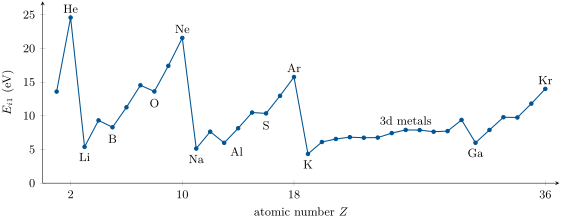
First ionisation energies of the first 36 elements. Maxima at the noble gases, minima at the alkali metals; the small dips at B, Al, Ga and at O, S are the subshell effects of .
First ionisation energies of the first 36 elements. Maxima at the noble gases, minima at the alkali metals; the small dips at B, Al, Ga and at O, S are the subshell effects of Proposition 2.12.
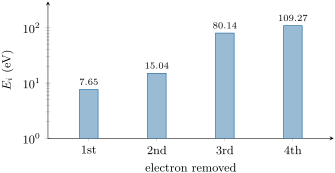
Successive ionisation energies of magnesium (logarithmic axis). The third is five times the second: the 3s shell is empty and the core is reached.

Examples

Example 2.11 (Magnesium)

The successive ionisation energies of magnesium are 7.65, 15.04, 80.14 and 109.27 eV109.27\,\mathrm{eV}. The ratio Ei2/Ei1≈2E_{i2}/E_{i1} \approx 2 is moderate; Ei3/Ei2≈5.3E_{i3}/E_{i2} \approx 5.3 is a jump: the third electron comes from the 2p core. Magnesium gives up its two 3s electrons and stops at MgX2+\ce{Mg^{2+}}, the noble-gas configuration of neon.

Example 2.24 (Lithium in a battery)

Lithium has the lowest electronegativity of period 2 and loses its 2s electron easily, while it is the lightest metal: it carries the most transferable charge per gram of any element, the reason it powers rechargeable batteries. Its first ionisation energy, 5.39 eV5.39\,\mathrm{eV}, is larger than that of sodium (5.14) or potassium (4.34), yet in water it is the most reducing alkali metal, a paradox resolved by the strong hydration of the small LiX+\ce{Li+} ion (Chapter 13).

Read in context →