
All books

Professional

Apps About Coach Log in Start reading

Chemistry · Glossary

What is Hartree–Fock method, Fock operator, self-consistent field?

Also known as: Hartree--Fock method · Fock operator · self-consistent field

Definition 3.11 University Chemistry — Year 3 · Chapter 3 — Computational Chemistry: Hartree–Fock and DFT

The Hartree–Fock method approximates the ground state by the single Slater determinant of lowest energy. Its orbitals are eigenfunctions of the Fock operator

f^(1)=h^(1)+∑b[2J^b(1)−K^b(1)],\hat f(1) = \hat h(1) + \sum_b\big[2\hat J_b(1) - \hat K_b(1)\big],

in the closed-shell case: h^\hat h is the kinetic energy and attraction to the nuclei of one electron, J^b\hat J_b the repulsion by the charge cloud of orbital bb, and K^b\hat K_b the exchange operator, whose expectation values are the exchange integrals of Chapter 2. Since f^\hat f depends on the orbitals it determines, the equations are solved by iteration until the orbitals no longer change: a self-consistent field (SCF).
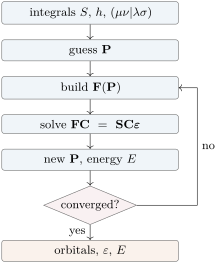
The self-consistent-field loop of a Hartree–Fock calculation.
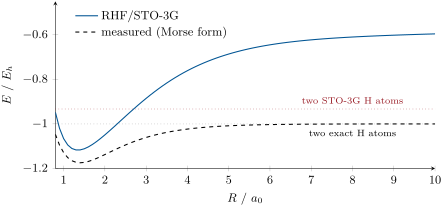
The energy of H2 against the internuclear distance: restricted Hartree–Fock in the STO-3G basis (solid) and the true curve (dashed, Morse form built from the measured D_0, _e, _ex_e, r_e). Near the minimum RHF is good; at large R it rises far above two hydrogen atoms.
The energy of HX2\ce{H2} against the internuclear distance: restricted Hartree–Fock in the STO-3G basis (solid) and the true curve (dashed, Morse form built from the measured D0D_0, ωe\omega_e, ωexe\omega_ex_e, rer_e). Near the minimum RHF is good; at large RR it rises far above two hydrogen atoms.
Read in context →