Mathematics · Glossary

What is Area?

Also known as: area of a surface

Definition 43.5 Primary & Middle School Mathematics · Chapter 43 — Perimeter, Area, Volume

The area of a figure measures the surface it covers: how many unit squares fit inside. Units: cm2^2 (a square of side 11 cm), m2^2, km2^2, … Careful:

1 m2=100×100 cm2=10000 cm21 \text{ m}^2 = 100 \times 100 \text{ cm}^2 = 10\,000 \text{ cm}^2

— one square meter is a 100100 cm by 100100 cm square, so each step of the units ladder is worth 100100, not 1010.

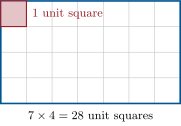
The area of a rectangle: 7 columns of 4 unit squares each, so 7 × 4 = 28 squares in total. This is why area = length × width.
The area of a rectangle: 77 columns of 44 unit squares each, so 7×4=287 \times 4 = 28 squares in total. This is why area == length ×\times width.

Examples

Example 43.7 (Composite figures)

An L-shaped room is a 66 m ×\times 44 m rectangle with a 22 m ×\times 22 m square corner removed. Its area, step by step:

  1. full rectangle: 6×4=246 \times 4 = 24 m2^2;
  2. removed square: 2×2=42 \times 2 = 4 m2^2;
  3. remaining area: 244=2024 - 4 = 20 m2^2.

Its perimeter is not 2020 anything: walking around the L, the border still measures 6+4+6+4=206 + 4 + 6 + 4 = 20 m — the two cuts of the corner replace two equal pieces of wall. Same number by coincidence, but square meters for one, meters for the other!
Read in context →
Definition 19.20 University Mathematics — Year 2 · Chapter 19 — Surfaces

Let σ ⁣:UR3\sigma \colon U \to \R^3 be a regular injective C1\mathcal{C}^1 surface and KUK \subseteq U a compact domain on which double integrals make sense (Chapter 20). The area of the piece σ(K)\sigma(K) is

A=Kσuσv ⁣du ⁣dv=KEGF2   ⁣du ⁣dv.\mathcal{A} = \iint_K \norm{\sigma_u \wedge \sigma_v}\,\dd u\,\dd v = \iint_K \sqrt{EG - F^2}\;\dd u\,\dd v .
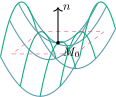
The saddle z = x2 - y2 near the origin, with its coordinate curves (u-curves in blue, v-curves in green), the tangent plane at M_0 = (0,0,0) (dashed) and the unit normal n. The surface crosses its tangent plane — the two-dimensional analogue of an inflection.
Figure 19.1. The saddle z=x2y2z = x^2 - y^2 near the origin, with its coordinate curves (uu-curves in blue, vv-curves in green), the tangent plane at M0=(0,0,0)M_0 = (0,0,0) (dashed) and the unit normal nn. The surface crosses its tangent plane — the two-dimensional analogue of an inflection.
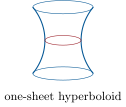
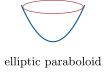
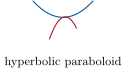
Four of the nine quadric surfaces classified in the weekend problem, sketched by their silhouettes and a level curve (red): the bounded ellipsoid, the doubly ruled one-sheet hyperboloid with its waist, the bowl of the elliptic paraboloid, and the saddle, whose two parabolic sections bend in opposite directions. Four of the nine quadric surfaces classified in the weekend problem, sketched by their silhouettes and a level curve (red): the bounded ellipsoid, the doubly ruled one-sheet hyperboloid with its waist, the bowl of the elliptic paraboloid, and the saddle, whose two parabolic sections bend in opposite directions. Four of the nine quadric surfaces classified in the weekend problem, sketched by their silhouettes and a level curve (red): the bounded ellipsoid, the doubly ruled one-sheet hyperboloid with its waist, the bowl of the elliptic paraboloid, and the saddle, whose two parabolic sections bend in opposite directions. Four of the nine quadric surfaces classified in the weekend problem, sketched by their silhouettes and a level curve (red): the bounded ellipsoid, the doubly ruled one-sheet hyperboloid with its waist, the bowl of the elliptic paraboloid, and the saddle, whose two parabolic sections bend in opposite directions.
Four of the nine quadric surfaces classified in the weekend problem, sketched by their silhouettes and a level curve (red): the bounded ellipsoid, the doubly ruled one-sheet hyperboloid with its waist, the bowl of the elliptic paraboloid, and the saddle, whose two parabolic sections bend in opposite directions.

Examples

Example 19.22 (Two different graphs, one area)

Over the unit disk, compare the bowl z=12(x2+y2)z = \frac12(x^2 + y^2) and the saddle z=xyz = xy. Their area integrands (Exercise 19.5) are

1+x2+y2and1+y2+x2:\sqrt{1 + x^2 + y^2} \qquad\text{and}\qquad \sqrt{1 + y^2 + x^2} :

identical. The two surfaces — one curving the same way in all directions, the other saddle-shaped — have exactly equal areas over every domain, 2π3(221)\frac{2\pi}3(2\sqrt2 - 1) over the unit disk. The area element only sees the length of the gradient, not the arrangement of the bending; telling the bowl from the saddle requires second-order data (the sign structure exhibited in Figure 19.1), which no amount of area measurement detects. First fundamental form: metric, blind to shape; the shape-seeing second form belongs to Year 3.

Example 19.23 (Area of the sphere)

For the spherical chart of Example 19.2:

σθ=R(sinθcosφ, cosθcosφ, 0),σφ=R(cosθsinφ, sinθsinφ, cosφ),\sigma_\theta = R(-\sin\theta\cos\varphi,\ \cos\theta\cos\varphi,\ 0), \qquad \sigma_\varphi = R(-\cos\theta\sin\varphi,\ -\sin\theta\sin\varphi,\ \cos\varphi),

so E=R2cos2φE = R^2\cos^2\varphi, F=0F = 0, G=R2G = R^2 and EGF2=R2cosφ\sqrt{EG - F^2} = R^2\cos\varphi. Hence

A=π/2π/2 ⁣ ⁣02πR2cosφ   ⁣dθ ⁣dφ=2πR2[sinφ]π/2π/2=4πR2.\mathcal{A} = \int_{-\pi/2}^{\pi/2}\!\!\int_0^{2\pi} R^2\cos\varphi\;\dd\theta\,\dd\varphi = 2\pi R^2\,\bigl[\sin\varphi\bigr]_{-\pi/2}^{\pi/2} = \boxed{4\pi R^2} .

Example 19.24 (The cone, checked against the school formula)

For the cone z=x2+y2z = \sqrt{x^2 + y^2} over the annulus aρba \leq \rho \leq b, the graph formula of Exercise 19.5 gives 1+fx2+fy2=21 + f_x^2 + f_y^2 = 2 (compute fx=x/ρf_x = x/\rho, fy=y/ρf_y = y/\rho), so

A=2π(b2a2).\mathcal A = \sqrt2\,\pi\,(b^2 - a^2) .

Consistency check with the slant-height formula πρ\pi\rho\ell of Example 19.26: the full cones of base radii bb and aa have lateral areas πbb2\pi b\cdot b\sqrt2 and πaa2\pi a\cdot a\sqrt2, whose difference is exactly 2π(b2a2)\sqrt2\pi(b^2 - a^2). Two charts, two formulas, one area — the invariance proved in Exercise 19.8, seen in the wild.

Read in context →