
Mathematics · Glossary

What is Axis of symmetry?

Definition 27.1 Primary & Middle School Mathematics · Chapter 27 — Symmetry

A line is an axis of symmetry of a figure when folding the figure along that line makes the two halves match exactly. A figure can have no axis, one axis, or several.
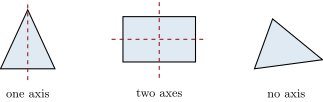
Fold along the dashed line: the halves match. The last triangle has no fold that works — no axis of symmetry.

Examples

Example 27.2 (Testing with tracing paper)

Trace the figure, flip the tracing paper over along the candidate axis, and lay it back: if the tracing covers the figure exactly, the axis is genuine. Eyes alone are often fooled — a rectangle’s diagonal looks like an axis, but the fold test says no (try it!).
Read in context →
Definition 42.6 Primary & Middle School Mathematics · Chapter 42 — Axial Symmetry

A line dd is an axis of symmetry of a figure when the reflection across dd sends the figure exactly onto itself — folding along dd makes the two halves match.

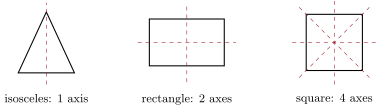
Axes of symmetry of familiar shapes. Careful with the rectangle: its diagonals are not axes of symmetry (fold along a diagonal — the halves do not match unless it is a square).

Examples

Example 42.7

Counting axes of symmetry:

  • isosceles triangle: 11 (through the top vertex and the middle of the base); equilateral triangle: 33;
  • rectangle: 22 (the two “middle lines”, not the diagonals); rhombus: 22 (its diagonals!); square: 44;
  • circle: every line through the center — infinitely many.

Example 42.8 (Symmetry proves equalities)

Why are the two base angles of an isosceles triangle equal? Fold the triangle along its axis of symmetry: the left half lands exactly on the right half, so the left base angle lands on the right base angle — they must have the same measure (Proposition 42.4: reflections preserve angles).

Read in context →