Primary & Middle School Mathematics · Grades 1–9
27Symmetry
Butterflies, faces, snowflakes: nature loves figures whose two halves match when folded. This chapter explores symmetry with folds and grid paper — constructions with the set square wait for Chapter 42.
27.1 Folding and matching
Definition 27.1 (Axis of symmetry)
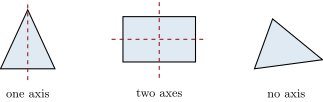
A line is an axis of symmetry of a figure when folding the figure along that line makes the two halves match exactly. A figure can have no axis, one axis, or several.
Example 27.2 (Testing with tracing paper)
Trace the figure, flip the tracing paper over along the candidate axis, and lay it back: if the tracing covers the figure exactly, the axis is genuine. Eyes alone are often fooled — a rectangle’s diagonal looks like an axis, but the fold test says no (try it!).
27.2 Completing figures on a grid
Method 27.3 (Symmetric of a figure across a grid line)
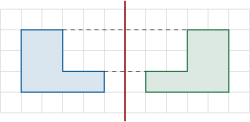
The axis is a vertical (or horizontal) line of the grid.
Example 27.4 (Same shape, same size, flipped)
The image has exactly the same lengths and the same angles as the original: symmetry copies the figure — but flips it over, like a left hand and a right hand. If the original letter is F, its mirror image is a backwards F, not another F.
27.3 Axes of the usual shapes
Example 27.5 (Counting axes)
By folding:
- a square: axes (two through the middles of opposite sides, two along the diagonals);
- a rectangle: axes (middles of opposite sides only!);
- an isosceles triangle: ; an equilateral triangle: ;
- a circle: every line through its center — more axes than one can count.
Example 27.6 (Symmetry in the alphabet)
A, M, T, U, V have a vertical axis; B, C, D, E have a horizontal one; H, I, O, X have both. Words made of the right letters can be symmetric too: MUM has a vertical axis; OXO works both ways.
27.4 Exercises
Exercise 27.1 ★
Trace and fold: which of these have an axis of symmetry — a square; a (non-square) rectangle; a scalene triangle (all sides different); a circle?
Solution
Solution of Exercise 27.1.
Square: yes ( axes). Rectangle: yes (). Scalene triangle: no fold works. Circle: yes — any line through the center.
Exercise 27.2 ★
Draw the axes of symmetry of: a square; a rectangle; an equilateral triangle. How many for each?
Solution
Solution of Exercise 27.2.
Square: (two middle lines, two diagonals). Rectangle: (the middle lines only). Equilateral triangle: (one through each vertex).
Exercise 27.3 ★
Use the tracing-paper test of Example 27.2 to show that the diagonal of a rectangle is not an axis of symmetry.
Solution
Solution of Exercise 27.3.
Folding along the diagonal, the two triangular halves have the same shape but do not lie on each other — one is “turned the wrong way”: the tracing lands beside the figure, not on it. So the diagonal is not an axis.
Exercise 27.4 ★
On grid paper, draw a vertical axis and the letter L (three squares tall, two wide) at squares from the axis. Construct its mirror image.
Solution
Solution of Exercise 27.4.
The image L is squares on the other side of the axis, written backwards (a mirror L), same sizes.
Exercise 27.5 ★
On grid paper, draw a horizontal axis and a small flag (a triangle on a -square mast) above it. Complete the figure by symmetry below the axis.
Solution
Solution of Exercise 27.5.
The completed figure shows the flag and its upside-down reflection below the axis, mast under mast.
Exercise 27.6 ★
A figure touches its axis of symmetry at a point . Where is the image of ? Explain with the folding picture.
Solution
Solution of Exercise 27.6.
does not move: folding along the axis leaves every point on the axis exactly where it is — is its own image.
Exercise 27.7 ★
Sort the capital letters A, B, E, F, H, N, O, T: vertical axis? horizontal axis? both? neither?
Solution
Solution of Exercise 27.7.
Vertical axis: A, H, O, T. Horizontal axis: B, E, H, O. Both: H, O. Neither: F, N.
Exercise 27.8 ★
A triangle has sides cm, cm and cm. Does it have an axis of symmetry? Which sides does the fold exchange?
Solution
Solution of Exercise 27.8.
Yes: the triangle is isosceles, and its axis passes through the tip between the two cm sides and the middle of the cm base. The fold exchanges the two equal sides.
Exercise 27.9 ★★
On grid paper, draw a figure of your own that has exactly two axes of symmetry, and draw both axes. (Hint: think of a rectangle, or of a cross.)
Solution
Solution of Exercise 27.9.
Any figure with exactly two axes works: a (non-square) rectangle, a plus-sign with arms of two different lengths (long horizontal, short vertical), an oval. The two axes always cross at the center of the figure.
Exercise 27.10 ★★
Half of a symmetric drawing is given: the left half of a house (a square wall and half a triangular roof), with a vertical axis along its right edge. Describe or draw the complete house. How do the lengths of the completed right half compare to the left half?
Solution
Solution of Exercise 27.10.
The complete house is the left half plus its mirror twin: a wall twice as wide as the half-wall, under a full triangular roof. Every length on the right equals its partner on the left — symmetry copies lengths exactly.
Exercise 27.11 ★★
Aya claims: “every triangle with two equal sides has an axis of symmetry, and every triangle with an axis of symmetry has two equal sides.” Test her double claim on drawings: an isosceles triangle, an equilateral one, a scalene one. Does the folding support her?
Solution
Solution of Exercise 27.11.
The drawings support both directions: the isosceles triangle folds along the line through its tip (two equal sides axis); the equilateral one folds three ways; the scalene one has no axis (no equal sides no axis). Aya’s double claim is right — it will be proved in Chapter 42.