 Coach
CoachA quadrilateral has four vertices and four sides. It is a:
- rectangle when its four angles are right angles;
- rhombus when its four sides have the same length;
- square when it is both: four right angles and four equal sides.
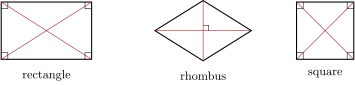
Examples
Example 41.6 (Recognizing a shape from its properties)
A quadrilateral has four sides of length cm and one right angle. What is it? Four equal sides make it a rhombus. In a rhombus, opposite angles are equal and the four angles add up to ; one right angle then forces all four to be right (this will be proved with parallelograms in Chapter 52). So the shape is a square.
Example 41.8
Program for a square of side cm:
- Draw a segment with cm.
- Draw the perpendicular to at ; on it, place at cm from (choose one side of the line and stick to it).
- Draw the perpendicular to at ; on it, place at cm from , on the same side as .
- Join and .
Check with the ruler: should measure cm too.