Primary & Middle School Mathematics · Grades 1–9
42Axial Symmetry
Fold a sheet of paper along a line: every point lands on another point, its mirror image. This folding is axial symmetry (or reflection), the first geometric transformation of the book — the second, central symmetry, comes in Chapter 52.
42.1 Reflections
Definition 42.1 (Symmetric point)
Let be a line. The symmetric of a point across is the point such that is the perpendicular bisector of : the segment is perpendicular to , and cuts it at its midpoint. A point on is its own symmetric.
![Reflecting across the line d: the axis is perpendicular to [MM'] and passes through its midpoint (equal tick marks). A point P on the axis does not move.](/images/onecourse/chapters/math-1/g6-symmetry/fig-c8d65390f364.svg)
Method 42.2 (Constructing a symmetric point)
To construct the symmetric of across the line :
- draw the perpendicular to through (set square); call the point where it crosses ;
- measure with the compass or ruler;
- place on the same perpendicular, on the other side of , with .
On grid paper it is faster: count the squares from to the axis, and count the same number on the other side.
Example 42.3 (On a grid)
If the axis is a vertical grid line and is squares to its left, then is squares to its right, on the same row. For a diagonal axis, the counting works along diagonals — always perpendicular to the axis.
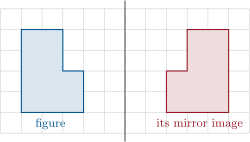
Proposition 42.4 (What a reflection preserves)
The symmetric of a figure across a line is a figure of the same shape and same size: lengths, angles, perimeters and areas are all preserved. The symmetric of a segment is a segment, of a circle a circle of the same radius, of a line a line.
Proof. Admitted at this level. ∎
Remark 42.5
One thing is not preserved: orientation. A reflected “b” becomes a “d” — mirror writing. If tracing your figure and flipping the tracing paper reproduces the image, the reflection is correct.
42.2 Axes of symmetry of a figure
Definition 42.6 (Axis of symmetry)
A line is an axis of symmetry of a figure when the reflection across sends the figure exactly onto itself — folding along makes the two halves match.
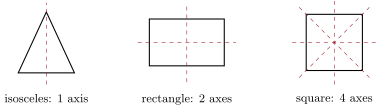
Example 42.7
Counting axes of symmetry:
- isosceles triangle: (through the top vertex and the middle of the base); equilateral triangle: ;
- rectangle: (the two “middle lines”, not the diagonals); rhombus: (its diagonals!); square: ;
- circle: every line through the center — infinitely many.
Example 42.8 (Symmetry proves equalities)
Why are the two base angles of an isosceles triangle equal? Fold the triangle along its axis of symmetry: the left half lands exactly on the right half, so the left base angle lands on the right base angle — they must have the same measure (Proposition 42.4: reflections preserve angles).
42.3 Perpendicular bisector
Definition 42.9 (Perpendicular bisector)
The perpendicular bisector of a segment is the line perpendicular to through its midpoint — it is the axis of symmetry that swaps and .
Proposition 42.10 (Equidistance)
A point is on the perpendicular bisector of exactly when it is at the same distance from and from : .
Proof. Admitted at this level. ∎
Method 42.11 (Compass construction)
To draw the perpendicular bisector of without measuring:
- open the compass to more than half of ;
- draw two arcs centered at , above and below the segment;
- with the same opening, draw two arcs centered at ;
- join the two crossing points: this line is the perpendicular bisector (each crossing point is equidistant from and ).
42.4 Exercises
Exercise 42.1 ★
Copy on grid paper: a vertical axis , a point two squares to its left, a point five squares to its left and one square higher. Construct their symmetric points and across .
Solution
Solution of Exercise 42.1.
is two squares to the right of , on the same row as ; is five squares to the right, one square higher — mirror positions.
Exercise 42.2 ★
Draw a line and a point at cm from (not on grid paper). Construct the symmetric of across with set square and ruler, following Method 42.2. How far apart are and ?
Solution
Solution of Exercise 42.2.
Perpendicular to through , foot ; then on the other side with cm. The distance is cm.
Exercise 42.3 ★
Which capital letters of the alphabet, written in their simplest form, have a vertical axis of symmetry (like A)? A horizontal one (like B)? Both?
Solution
Solution of Exercise 42.3.
Vertical axis (like A): A, H, I, M, O, T, U, V, W, X, Y. Horizontal axis (like B): B, C, D, E, H, I, K, O, X. Both: H, I, O, X. (Exact answers depend slightly on how the letters are drawn.)
Exercise 42.4 ★
How many axes of symmetry has: an equilateral triangle? a rectangle (that is not a square)? a rhombus (not a square)? a square? a circle? Draw each figure with its axes.
Solution
Solution of Exercise 42.4.
Equilateral triangle: axes. Rectangle: (the perpendicular bisectors of its sides). Rhombus: (its diagonals). Square: . Circle: infinitely many (every line through the center).
Exercise 42.5 ★
True or false? “The diagonals of a rectangle are axes of symmetry of the rectangle.” Explain with a folding argument or a drawing.
Solution
Solution of Exercise 42.5.
False. Folding a (non-square) rectangle along a diagonal does not make the two halves coincide: the two triangles have the same shape but sit differently — try it with a sheet of paper. Only for a square do the diagonals work as axes.
Exercise 42.6 ★
A triangle is reflected across a line into . Given cm, and the perimeter of is cm: give, without any construction, , and the perimeter of .
Solution
Solution of Exercise 42.6.
Reflections preserve lengths, angles and perimeters (Proposition 42.4): cm, , perimeter of cm.
Exercise 42.7 ★
Draw a segment of cm and construct its perpendicular bisector with the compass (Method 42.11). Choose any point on it and check with the ruler that .
Solution
Solution of Exercise 42.7.
Compass construction as in Method 42.11. For any on the line, the ruler confirms (Proposition 42.10).
Exercise 42.8 ★★
Two trees stand at points and of a (flat) garden. Where can one plant a fountain so that it is at the same distance from both trees? Describe all the possible spots.
Solution
Solution of Exercise 42.8.
All the points at equal distance from and form the perpendicular bisector of (Proposition 42.10). The fountain can go anywhere on that line (within the garden).
Exercise 42.9 ★★
On grid paper, draw the axis (a diagonal of the grid at ) and a small L-shaped figure on one side. Construct its symmetric figure across . (Reflect each vertex: for a axis, a point squares right of the axis lands squares above it.)
Solution
Solution of Exercise 42.9.
Each vertex is reflected perpendicular to the axis: for the axis, a point squares to the right of the axis lands squares above it (and vice versa) — horizontal and vertical displacements are exchanged. Reflect the vertices one by one, then join them in order.
Exercise 42.10 ★★
Draw a circle of center , a line through , and a point on the circle. Where is the symmetric of across ? Explain why the reflection sends the circle onto itself.
Solution
Solution of Exercise 42.10.
The symmetric of is the second intersection of the circle with the perpendicular to through — it lies on the circle. Reason: the reflection preserves distances and fixes (which is on ), so the image of any point at distance from is again at distance from : the circle maps onto itself.
Exercise 42.11 ★★
Using the equidistance property (Proposition 42.10), explain why the two crossing points of the arcs in Method 42.11 really do lie on the perpendicular bisector of .
Solution
Solution of Exercise 42.11.
Each crossing point was drawn with the same compass opening from and from : so . By Proposition 42.10, a point equidistant from and lies on the perpendicular bisector of ; two such points determine the line.
Exercise 42.12 ★★★
A billiard ball at point must bounce off a straight wall and reach point (both on the same side of the wall). Reflect across into , and draw the segment . Explain why the best bouncing point is where crosses the wall. (Idea: the path has the same length as .)
Solution
Solution of Exercise 42.12.
For any bounce point on the wall, (reflection across preserves distances), so the path length . The broken line is shortest when it is straight, i.e. when is on the segment . So the best bounce point is the intersection of with the wall.
42.5 Problem: The fountain, the broken plate, and the walking mirror
Problem 42.1
Weekend problem — the three perpendicular bisectors of a triangle meet at one point: the circle through three points, and what two mirrors do together
In Exercise 42.8 a fountain had to stand at equal distance from two trees, and the answer was a whole line of spots. This problem plants a third tree — and the whole line collapses to a single, perfectly determined point. That point hides a treasure of geometry: it lets you draw the one circle passing through three given points, rebuild a whole plate from a broken shard, and it belongs to every triangle. The last part performs an experiment with two mirrors whose result announces next year’s geometry.
Part I — Two trees, then a map of territories.
- Draw two points and with cm and construct the perpendicular bisector of with the compass (Method 42.11). Pick a point on it and check with the ruler that .
- Proposition 42.10 says two things at once: every point on the bisector is equidistant from and , and every equidistant point is on the bisector. Which of the two answers the fountain question of Exercise 42.8? What does the proposition say about a point that is not on the bisector?
- Take a point on the same side of the bisector as . The segment crosses the bisector at a point . Compare the path with the path , and explain why is closer to than to : the bisector splits the sheet into an “-side” and a “-side”.
- Two schools and serve a town. Every child walks to the closer school. Draw a small map with and , and shade the exact region of the town served by school . What line forms the border?
- A third school opens (place it so the three schools make a triangle). Construct the perpendicular bisector of and the perpendicular bisector of , and call their crossing point. What two equalities of distances does satisfy, and why?
Part II — Three trees, one point, one circle.
- Deduce from question 5 that — and therefore that also lies on the perpendicular bisector of , which you never drew. Conclude: the three perpendicular bisectors of the sides of a triangle all pass through one point.
- Explain why the circle of center and radius passes through and through as well: it is the circle through the three points — the circumscribed circle of the triangle .
- Construct a triangle with sides cm, cm and cm (Method 41.2), then its circumscribed circle. Why is it enough to draw only two perpendicular bisectors to find the center?
- The broken plate: an archaeologist digs up a shard whose only intact part is a piece of the plate’s circular rim. Describe a recipe that recovers the center and the radius of the original plate — and test it: draw an arc of circle with your compass, “forget” the center, mark three points on the arc, and rebuild it.
- Could three points ever have no circle through them? Suppose , , are aligned. What can be said of the perpendicular bisectors of and of (Proposition 40.3)? Conclude.
Part III — Axes everywhere, and the walking mirror.
- Example 42.7 counted axes for the equilateral triangle and for the square. Conjecture the count for a regular pentagon and a regular hexagon, and describe where the axes pass in each case (odd number of sides against even: the two situations differ).
- Fold a sheet of paper once and cut a shape through both layers; unfold. Why does the hole always have an axis of symmetry, whatever you cut, and which line is the axis?
- Fold the sheet twice — the second fold perpendicular to the first — cut, and unfold. How many axes of symmetry does the hole have at least, and how many copies of your cut do you see? (Paper snowflakes are this idea folded further.)
- The walking mirror: on grid paper, draw a vertical axis , a small flag to its left, and a second vertical axis , squares to the right of . Reflect across (image ), then reflect across (image ). Compare and : same orientation or mirrored? By how many squares did the figure move? Compare with the distance between the axes.
- Same experiment with perpendicular to : reflect the flag across the vertical axis, then the image across the horizontal one. Describe how sits relative to and to the crossing point of the two axes. (You have just discovered next year’s transformation: Chapter 52.)
Solution
Solution of Problem 42.1.
1. Construction as in Method 42.11; for any on the line, the ruler confirms (Proposition 42.10).
2. The fountain question needs the second direction: all the equidistant points are on the bisector, so the possible spots are exactly that line and nothing else. And a point not on the bisector is therefore not equidistant: it is strictly closer to one of the two trees.
3. The two paths share the leg , and since is on the bisector. So the path has the same length as the path , namely . Now is the straight route to — here it is the path through , so ; and the straight route to is shorter than the detour through : . Every point on ’s side of the bisector is closer to .
4. The border is the perpendicular bisector of : school serves exactly the half of the town on its side of that line (question 3), school the other half, and children living on the line itself may pick either.
5. lies on the bisector of , so ; and on the bisector of , so (Proposition 42.10).
6. From and : . By the second direction of Proposition 42.10, a point equidistant from and lies on the perpendicular bisector of : the third bisector passes through without being asked. The three perpendicular bisectors of any triangle are concurrent.
7. The circle of center and radius consists of all points at distance from (Definition 40.5); since and , the points and are on it. One center, one radius, three points served: it is the circle through , and .
8. Two bisectors suffice because the third is automatic (question 6): their crossing point already satisfies all three equalities of distance. The circle is drawn with center and the compass opened from to any one of the three vertices.
9. Recipe: mark three points , , on the surviving arc; draw the perpendicular bisectors of the chords and ; their crossing point is the center of the plate, and its distance to is the radius. It works because the plate’s rim is a circle through the three marked points — and question 8 finds the circle through them. The test arc rebuilds exactly.
10. If , , are aligned, the bisector of and the bisector of are both perpendicular to the same line — so they are parallel to each other (Proposition 40.3) and, being distinct, never cross. No point is equidistant from all three, and no circle passes through three aligned points.
11. Regular pentagon: axes, each through one vertex and the midpoint of the opposite side (odd count: every axis is of this one kind). Regular hexagon: axes — three through opposite vertices and three through midpoints of opposite sides (even count: two kinds, half and half). The pattern: a regular polygon with sides has axes.
12. The cut goes through both layers at once, so the two layers lose exactly matching pieces; unfolding is the reflection across the fold line, which sends each layer’s edge onto the other’s. The hole is its own mirror image: the fold line is its axis of symmetry — whatever was cut.
13. The unfolded hole has at least axes of symmetry, the two fold lines, and the cut appears in copies (each unfolding doubles the picture: ). Folding more times in the snowflake style multiplies the copies and the axes further.
14. has the same orientation as (two mirror flips cancel the mirroring), the same size and the same height — it is simply slid to the right. The slide measures squares: exactly twice the distance between the two axes. Two parallel mirrors together do not mirror at all: they translate.
15. is again the same size, but now it appears upside down, turned by half a turn about the crossing point of the two axes: each point of is diametrically opposite the corresponding point of through that center. Two perpendicular mirrors compose into the half-turn — the central symmetry of Chapter 52.