
সব বই

পেশাদার

1 Markets I: The Ecosystem and Exchange-Traded Marketsবাজার অনলাইন 2 Markets II: Rates, FX and Creditবাজার অনলাইন 3 Markets III: Commodities, Energy and Cryptoবাজার অনলাইন 4 Quantitative Methodsপদ্ধতি অনলাইন 5 Derivatives and Volatilityডেরিভেটিভস অনলাইন 6 Rates, Credit, XVA and Riskসুদহার, ঋণ ও ঝুঁকি অনলাইন 7 Research Craft: Predictors, Backtests, Measurement, Portfoliosগবেষণা অনলাইন 8 Strategies I: Equities and Futuresকৌশল অনলাইন 9 Strategies II: Volatility, Relative Value, Macro and the Bank Desksকৌশল অনলাইন 10 Microstructure and Executionএক্সিকিউশন অনলাইন 11 Market Making and High-Frequency Tradingমার্কেট মেকিং অনলাইন 12 Machine Learning for Marketsমেশিন লার্নিং অনলাইন 13 Low-Latency Softwareপ্রযুক্তি অনলাইন 14 Networks, Hardware and Trading Infrastructureপ্রযুক্তি অনলাইন 15 Research, Data and Risk Platformsপ্রযুক্তি অনলাইন 16 The Desk and the Firmপ্রতিষ্ঠান অনলাইন 17 The Industry: Firms, Roles and Careersক্যারিয়ার অনলাইন 18 Interviews I: Maths, Probability and Speedক্যারিয়ার অনলাইন 19 Interviews II: Markets, Trading Games and the Final Roundক্যারিয়ার অনলাইন 20 Interviews III: Codeক্যারিয়ার অনলাইন
অ্যাপ পরিচিতি Coach সাইন ইন পড়া শুরু করো

বইগুলো এখনো বাংলা ভাষায় পাওয়া যায় না — ইংরেজি সংস্করণ দেখানো হচ্ছে।

Mathematics · পরিভাষা

compact metric space কী?

Definition 4.15 University Mathematics — Year 2 · অধ্যায় 4 — Topology of Metric Spaces

A metric space XX is compact when every sequence in XX has a subsequence converging in XX (the Bolzano–Weierstrass property). A subset is compact when it is so with the induced distance.
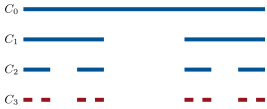
The first stages of the Cantor set (): each level deletes the open middle third of every segment. The intersection C = _n C_n is compact, has empty interior and length zero, yet is equipotent to ℝ — and it returns as a fixed point of a contraction on sets in this chapter’s weekend problem (question 22).
The first stages of the Cantor set (Exercise 4.8): each level deletes the open middle third of every segment. The intersection C=⋂nCnC = \bigcap_n C_n is compact, has empty interior and length zero, yet is equipotent to R\R — and it returns as a fixed point of a contraction on sets in this chapter’s weekend problem (question 22).

উদাহরণ

Example 4.17 (Heine’s theorem, with and without compactness)

On [0, 1]\intcc{0}{1}, the function x↦x2x \mapsto x^2 is uniformly continuous — Heine says so with no computation, but the direct estimate is instructive:

∣x2−y2∣=∣x+y∣ ∣x−y∣≤2∣x−y∣,\abs{x^2 - y^2} = \abs{x + y}\,\abs{x - y} \leq 2\abs{x - y},

so δ=ε/2\delta = \varepsilon/2 works for every point at once. On R\R the same function is not uniformly continuous: with xn=nx_n = n and yn=n+1ny_n = n + \frac1n, the gap ∣xn−yn∣=1n→0\abs{x_n - y_n} = \frac1n \to 0 while ∣xn2−yn2∣=2+1n2≥2\abs{x_n^2 - y_n^2} = 2 + \frac1{n^2} \geq 2: no single δ\delta serves ε=1\varepsilon = 1. The mechanism is visible: the local Lipschitz constant ∣x+y∣\abs{x + y} is bounded on a compact and unbounded on R\R — Heine’s theorem is exactly the statement that compactness caps such local constants uniformly.

Example 4.19 (Distances between sets: compactness earns its keep)

Let KK be compact, FF closed, K∩F=∅K \cap F = \emptyset in a metric space. Then

d(K,F)=inf⁡ {d(x,y):x∈K, y∈F}>0:d(K, F) = \inf\,\{d(x, y) : x \in K,\ y \in F\} > 0 :

the function x↦d(x,F)x \mapsto d(x, F) is continuous (Exercise 4.11) and positive on KK (d(x,F)=0d(x, F) = 0 would put x∈F‾=Fx \in \overline F = F), so it attains a positive minimum on the compact KK (Theorem 4.16 (3)). Compactness is not decorative: for two closed sets the infimum can vanish without being attained — in R2\R^2, the hyperbola F1={xy=1}F_1 = \{xy = 1\} and the axis F2={y=0}F_2 = \{y = 0\} are disjoint closed sets with d(F1,F2)=0d(F_1, F_2) = 0 (the points (n,1n)(n, \frac1n) approach the axis). Escape to infinity is exactly what compactness forbids.

Example 4.21 (An ε\varepsilon-net, counted)

Total boundedness (from the proof of Theorem 4.20) is very concrete on [0, 1]\intcc{0}{1}: for ε>0\varepsilon > 0, the ⌈12ε⌉\lceil \frac{1}{2\varepsilon}\rceil balls centered at ε,3ε,5ε,…\varepsilon, 3\varepsilon, 5\varepsilon, \dots of radius ε\varepsilon cover it — about 12ε\frac1{2\varepsilon} balls, and no cover can do with fewer than 12ε\frac{1}{2\varepsilon} of them (each ball covers length at most 2ε2\varepsilon). In [0, 1]2\intcc01^2 the count squares to order ε−2\varepsilon^{-2}: covering numbers grow like ε−d\varepsilon^{-d} in dimension dd — a quantitative face of compactness, and the reason the infinite-dimensional unit balls of Chapter 5 (where no finite 13\frac13-net exists at all) cannot be compact.

প্রসঙ্গসহ পড়ো →