সব বই

পেশাদার

1 Markets I: The Ecosystem and Exchange-Traded Marketsবাজার অনলাইন 2 Markets II: Rates, FX and Creditবাজার অনলাইন 3 Markets III: Commodities, Energy and Cryptoবাজার অনলাইন 4 Quantitative Methodsপদ্ধতি অনলাইন 5 Derivatives and Volatilityডেরিভেটিভস অনলাইন 6 Rates, Credit, XVA and Riskসুদহার, ঋণ ও ঝুঁকি অনলাইন 7 Research Craft: Predictors, Backtests, Measurement, Portfoliosগবেষণা অনলাইন 8 Strategies I: Equities and Futuresকৌশল অনলাইন 9 Strategies II: Volatility, Relative Value, Macro and the Bank Desksকৌশল অনলাইন 10 Microstructure and Executionএক্সিকিউশন অনলাইন 11 Market Making and High-Frequency Tradingমার্কেট মেকিং অনলাইন 12 Machine Learning for Marketsমেশিন লার্নিং অনলাইন 13 Low-Latency Softwareপ্রযুক্তি অনলাইন 14 Networks, Hardware and Trading Infrastructureপ্রযুক্তি অনলাইন 15 Research, Data and Risk Platformsপ্রযুক্তি অনলাইন 16 The Desk and the Firmপ্রতিষ্ঠান অনলাইন 17 The Industry: Firms, Roles and Careersক্যারিয়ার অনলাইন 18 Interviews I: Maths, Probability and Speedক্যারিয়ার অনলাইন 19 Interviews II: Markets, Trading Games and the Final Roundক্যারিয়ার অনলাইন 20 Interviews III: Codeক্যারিয়ার অনলাইন
অ্যাপ পরিচিতি Coach সাইন ইন পড়া শুরু করো

বইগুলো এখনো বাংলা ভাষায় পাওয়া যায় না — ইংরেজি সংস্করণ দেখানো হচ্ছে।

Mathematics · পরিভাষা

isometry কী?

Definition 23.15 University Mathematics — Year 1 · অধ্যায় 23 — Euclidean Spaces

An endomorphism uu of a Euclidean space is an isometry (or orthogonal map) when it preserves the norm: ∥u(x)∥=∥x∥\norm{u(x)} = \norm x for all xx — equivalently (polarization) it preserves the inner product; equivalently its matrix AA in an orthonormal basis satisfies ATA=IA^{\mathsf T} A = I. Isometries form a group, the orthogonal group O(E)O(E).

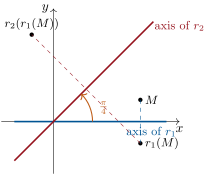
Two reflections make a rotation: reflecting M = (2, 0.5) in the x-axis, then in the line y = x, lands at (-0.5, 2) — the image of M under the rotation of angle π2 about the origin, twice the angle π4 between the axes. The weekend problem turns this picture into the composition law of all plane isometries.
Two reflections make a rotation: reflecting M=(2,0.5)M = (2, 0.5) in the xx-axis, then in the line y=xy = x, lands at (−0.5,2)(-0.5, 2) — the image of MM under the rotation of angle π2\frac\pi2 about the origin, twice the angle π4\frac\pi4 between the axes. The weekend problem turns this picture into the composition law of all plane isometries.

উদাহরণ

Example 23.16 (Recognizing an isometry at sight)

Is A=15(3−443)A = \dfrac15\begin{pmatrix} 3 & -4\\ 4 & 3\end{pmatrix} orthogonal? Columns: norms 159+16=1\frac15\sqrt{9 + 16} = 1 and 1516+9=1\frac15\sqrt{16 + 9} = 1; product 125(3⋅(−4)+4⋅3)=0\frac1{25}(3\cdot(-4) + 4\cdot3) = 0. Yes — and det⁡A=9+1625=1\det A = \frac{9 + 16}{25} = 1, so it is the rotation RθR_\theta with cos⁡θ=35\cos\theta = \frac35, sin⁡θ=45\sin\theta = \frac45 (the “33-44-55 rotation”, whose angle is no remarkable fraction of π\pi). By contrast B=12(1101)B = \frac{1}{\sqrt2}\begin{pmatrix} 1 & 1\\ 0 & 1\end{pmatrix} has unit determinant-scaled look but non-unit first column (12\frac1{\sqrt2}): not orthogonal — determinant ±1\pm1 alone certifies nothing, the columns must be checked.

প্রসঙ্গসহ পড়ো →