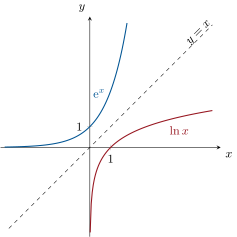
The exponential is continuous and strictly increasing from onto ; by the bijection theorem (Theorem 21.15), for every the equation has a unique solution. This solution is the natural logarithm of , written . Thus
In particular , , and , .
 Coach
Log in
Start reading
Coach
Log in
Start reading
Mathematics · Glossary
Also known as: logarithm
The exponential is continuous and strictly increasing from onto ; by the bijection theorem (Theorem 21.15), for every the equation has a unique solution. This solution is the natural logarithm of , written . Thus
In particular , , and , .