High School Mathematics · Grades 10–12
23Exponential and Logarithm
The exponential function is the unique function equal to its own derivative and taking the value at . It converts sums into products; its inverse, the natural logarithm, converts products into sums. Together they describe every phenomenon whose rate of change is proportional to its size: radioactive decay, population growth, compound interest.
23.1 The exponential function
Theorem 23.1 (Existence and uniqueness)
There exists a unique differentiable function such that
It is called the exponential function and written , or .
Proof of uniqueness. First, such a function never vanishes. Indeed, let ; then
so is constant equal to : for every , , and in particular .
Now let be two solutions and (legitimate since never vanishes). Then
so is constant equal to , i.e. .
Existence is admitted at this level (it can be obtained via the sequence of Exercise 20.10, or as the inverse of the logarithm constructed by integration in Chapter 25). ∎
Proposition 23.2 (Functional equation)
For all and :
Moreover for all .
Proof. Fix and consider . Its numerator and denominator, as functions of , are both solutions of up to the constant ; differentiating directly (quotient rule) gives , so , proving the first identity. Taking gives the second (with the value ), and the third follows. The fourth is an induction from the first for , extended to by the second.
Positivity: and (shown in Theorem 23.1), so . ∎
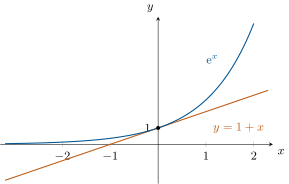
Proposition 23.3 (Variations and limits)
The exponential is strictly increasing, convex, and
Proof. gives strict increase; gives convexity. By convexity, (tangent at , see Example 22.15), so as by comparison. Then as . ∎
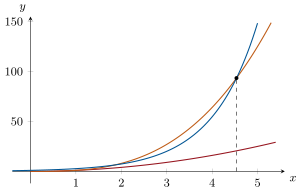
Theorem 23.4 (Growth comparison)
For every integer ,
In words: the exponential beats every power of .
Proof. For : applying at ,
For general , write
by the case and composition. The limit at follows by the substitution : . ∎
23.2 The natural logarithm
Definition 23.5 (Natural logarithm)
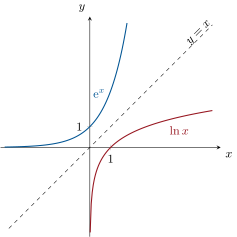
The exponential is continuous and strictly increasing from onto ; by the bijection theorem (Theorem 21.15), for every the equation has a unique solution. This solution is the natural logarithm of , written . Thus
In particular , , and , .
Proposition 23.6 (Algebraic properties)
For all and :
Proof. , and taking of both sides gives the first identity. The others follow by the same mechanism from the corresponding identities of Proposition 23.2. ∎
Proposition 23.7 (Analytic properties)
The function is differentiable on with
strictly increasing, concave, and , . Moreover, for every integer ,
Proof. Differentiability of the inverse function is admitted at this level; granting it, differentiate the identity by the chain rule: , so , whence strict increase, and , whence concavity. The limits at and mirror those of through the bijection. For the growth comparison, substitute : as by Theorem 23.4, and similarly for the other limits with , giving . ∎
Method 23.8 (Solving equations with and )
Both functions are strictly increasing, so they can be applied to (or removed from) both sides of an equation or inequality without changing its direction:
and likewise for on positive quantities. Always check domains first ( requires positive arguments). For equations like with , , rewrite and solve .
Example 23.9
A radioactive sample decays following . Its half-life satisfies , i.e. , so : the half-life does not depend on the initial quantity.
23.3 Exercises
Exercise 23.1 ★
Simplify and .
Solution
Solution of Exercise 23.1.
.
.
Exercise 23.2 ★
Solve in :
Exercise 23.3 ★
Compute the limits:
Solution
Solution of Exercise 23.3.
Divide by : , using (Theorem 23.4).
by Proposition 23.7 (case ).
.
since .
Exercise 23.4 ★★
Study the function on : variations, limits, extremum; show that its curve has an inflection point and give its coordinates.
Solution
Solution of Exercise 23.4.
, of the sign of : increases on , decreases on , with a global maximum .
Limits: as , (Theorem 23.4); as , and , so .
, which changes sign at : inflection point at .
Exercise 23.5 ★★
Show that for all , , with equality only at . Deduce that for all ,
Solution
Solution of Exercise 23.5.
Let on . Then , negative on and positive on : attains its minimum , so with equality only at . Hence .
Apply this with : , so . Apply it with : , so and .
Exercise 23.6 ★★
A capital is invested at an annual rate of , interest compounded each year.
- Express the capital after years.
- After how many years does the capital double? Give the exact answer using , then a numerical value.
- Compare with the approximation “ divided by the rate in percent” used by bankers.
Solution
Solution of Exercise 23.6.
1. Each year multiplies the capital by : .
2. : the capital doubles after years.
3. , close to the exact . The rule works because for small , so .
Exercise 23.7 ★★
Solve the inequality , then the inequality .
Solution
Solution of Exercise 23.7.
(the exponential is strictly increasing): .
Domain of the second inequality: and , i.e. . On this domain, being strictly increasing,
Intersecting with the domain: .
Exercise 23.8 ★★★
Let for .
- Study the variations of on and give its minimum.
- For which values of does the equation have , or solutions in ?
Solution
Solution of Exercise 23.8.
1. , negative on , positive on : minimum . Limits: at (numerator , denominator ) and at (Theorem 23.4).
2. For , . From the variation table (, continuous and strictly monotonic on each side): no solution for ; exactly one () for ; exactly two for (one in , one in , by the bijection theorem on each interval).
Exercise 23.9 ★★★
For , let .
- Using Exercise 23.5, show that is bounded above by .
- Show that , and deduce that . (Hint: recognize a difference quotient of at .)
Solution
Solution of Exercise 23.9.
1. Direct from the first inequality of Exercise 23.5: .
2. Write
a difference quotient of at the point with increment . Since is differentiable at with derivative , . By continuity of (Proposition 21.12), .
23.4 Problem: The logarithm tames the world
Problem 23.1
Weekend problem — doubling times and the rule of 72, the scales of earthquakes, acids and pianos, and the constant leaving fingerprints everywhere
Whatever grows by a fixed percentage grows exponentially — savings, bacteria, epidemics — and whatever spans too many powers of ten to grasp — earthquake energies, acidities, sound intensities — is tamed by a logarithm. This problem computes doubling times and unmasks the bankers’ rule of 72, reads the world’s logarithmic scales, and collects the fingerprints that the number leaves at every crime scene (Proposition 23.2, Theorem 23.4, Method 23.8).
Part I — Fluency.
- Solve: ; ; (a quadratic in disguise).
- Simplify: ; ; .
- Prove the mother inequality: for all real (study ), and deduce for .
- Compute , (Theorem 23.4), and (recognize a derivative).
- Study on : variations, minimum, and the limit at (admitted: ). This little function measures information and entropy across the university volumes.
Part II — Doubling times and the rule of 72.
- Savings grow at per year. Solve : how long to double the capital?
- Bankers estimate doubling time as . Test the rule at , and against the exact , then explain it: for small , (question 3’s inequality is half of the story), so the exact constant is — why do bankers prefer ?
- A bacterium divides every minutes: ( in minutes). Rewrite it as , then compute after hours. The answer (more than ) proves what about the model — and what stops real colonies?
- Caffeine leaves the body with a half-life of about hours. After a mg coffee at 15:00, how much remains at 23:00? At what time does it drop below mg? (Insomnia has a logarithm.)
- One euro at annual interest: compute the year-end capital under yearly, monthly and daily compounding, and give the ceiling that Exercise 23.9 proved unbreakable. Which famous constant is the limit of pure greed?
- Why do scientists plot against time during an epidemic’s early phase? What does a straight line on that plot reveal, and what does its slope measure?
Part III — The world’s logarithmic scales. (Write .)
- Sound level in decibels: . A conversation measures dB, a rock concert dB: by what factor do the sound intensities differ?
- Earthquake magnitudes rise by when the seismic amplitude is multiplied by , and the released energy scales like amplitude. Compare magnitude- and magnitude- quakes: amplitude ratio, then energy ratio.
- Chemistry: . Lemon juice has pH , milk pH : what is the ratio of their acid concentrations?
- Music: each octave doubles the frequency. From the piano’s lowest A ( Hz) to its highest C ( Hz), how many octaves does the keyboard span? And why do our senses — hearing, sight, quake-feeling — prefer logarithmic scales? (One sentence.)
- The slide rule, the engineers’ calculator for years: two sticks graduated so that the length to the mark is proportional to . Explain how sliding one stick along the other multiplies numbers, and name the identity of Proposition 23.6 doing the work.
Part IV — ’s fingerprints.
- From Exercise 23.8: the equation () has , or solutions according to the position of relative to a threshold. Restate the result — and verify the geometric fact behind it: the line is exactly the tangent to the exponential through the origin.
- The near-miss constant: with lottery tickets of winning probability each, . Compute its limit via (use the standard limit ), and reconcile with the mysterious of Problem 19.1.
- The rule: to choose the best of candidates interviewed in random order (no going back), the optimal strategy rejects the first and then takes the first candidate better than all so far — succeeding with probability about . Where do the two ’s of questions 18 and 19 come from — state the common mechanism (many independent small-chance events), and compute to three decimals.
- Finale — ’s portrait: the ceiling of compounding (question 10); the base whose tangent at has slope exactly (questions 3 and 4); the growth no polynomial catches (question 4); the constant of near-misses and of optimal stopping (questions 18–19); and its inverse , which turns products into sums (question 16) and decades into inches (Part III). One sentence each.
Solution
Solution of Problem 23.1.
1. . : . With : : or .
2. ; ; .
3. : negative before , positive after: minimum , so everywhere: . Substituting : , i.e. .
4. and : exponentials crush powers, powers crush logarithms. And .
5. : zero at , negative before, positive after: minimum ; and at : the curve leaves the origin, dips to , and climbs away.
6. years.
7. Exact: , , years; rule of 72: , , . Since , , i.e. ; bankers round up to because it divides beautifully by — mental arithmetic beats a decimal of accuracy.
8. : per minute. After minutes: bacteria — more than the grains of sand on Earth, from one cell in one day. The model is honest only while food and space last: real growth bends into the logistic S-curve (the epidemiologist’s curve of Problem 22.1).
9. At 23:00 ( hours): mg. Below mg: gives h: around 7:40 the next morning — the espresso at three has a long tail.
10. Yearly: . Monthly: . Daily: . The ceiling: (Exercise 23.9) — compounding continuously, greed converges.
11. If cases grow exponentially, , then : a straight line of slope — the growth rate. A straight stretch on the log plot is the exponential phase, and its steepness is the epidemic’s tempo.
12. dB means : the concert is — a million times — more intense than the conversation.
13. Amplitude: . Energy: : two magnitude points hide three orders of magnitude in energy.
14. : lemon juice is thirty thousand times more acidic than milk — pH compresses chemistry’s chasms into a pocket scale.
15. : a piano spans just over seven octaves. Senses respond to ratios of stimuli — doubling the intensity feels like one step, whatever the starting level — so perception is built on a logarithmic scale, and so are the units we invented for it.
16. Placing the stick for end-to-end with the stick position for adds the lengths , and the graduation sitting at that total length reads : the slide rule computes products by adding logarithms — (Proposition 23.6) carved in boxwood.
17. The minimum of on is , at : no solution for , exactly one for , two for . Tangent check: at the tangent to is : it passes through the origin — the threshold line, grazing the curve at .
18. , so : the of Problem 19.1, explained — the lottery’s near-miss constant is .
19. Both are the limit shape of “many independent events, each individually unlikely”: the chance that none of chances of size fires tends to , and the secretary rule tunes its rejection window so that success concentrates at that same constant. .
20. The ceiling of compounding; the unique base whose tangent at has slope (which is why calculus loves it); the growth that outruns every power; the constant where near-misses and optimal stopping settle; and the logarithm — multiplication become addition, the world’s wildest ranges folded onto a ruler.