সব বই

পেশাদার

1 Markets I: The Ecosystem and Exchange-Traded Marketsবাজার অনলাইন 2 Markets II: Rates, FX and Creditবাজার অনলাইন 3 Markets III: Commodities, Energy and Cryptoবাজার অনলাইন 4 Quantitative Methodsপদ্ধতি অনলাইন 5 Derivatives and Volatilityডেরিভেটিভস অনলাইন 6 Rates, Credit, XVA and Riskসুদহার, ঋণ ও ঝুঁকি অনলাইন 7 Research Craft: Predictors, Backtests, Measurement, Portfoliosগবেষণা অনলাইন 8 Strategies I: Equities and Futuresকৌশল অনলাইন 9 Strategies II: Volatility, Relative Value, Macro and the Bank Desksকৌশল অনলাইন 10 Microstructure and Executionএক্সিকিউশন অনলাইন 11 Market Making and High-Frequency Tradingমার্কেট মেকিং অনলাইন 12 Machine Learning for Marketsমেশিন লার্নিং অনলাইন 13 Low-Latency Softwareপ্রযুক্তি অনলাইন 14 Networks, Hardware and Trading Infrastructureপ্রযুক্তি অনলাইন 15 Research, Data and Risk Platformsপ্রযুক্তি অনলাইন 16 The Desk and the Firmপ্রতিষ্ঠান অনলাইন 17 The Industry: Firms, Roles and Careersক্যারিয়ার অনলাইন 18 Interviews I: Maths, Probability and Speedক্যারিয়ার অনলাইন 19 Interviews II: Markets, Trading Games and the Final Roundক্যারিয়ার অনলাইন 20 Interviews III: Codeক্যারিয়ার অনলাইন
অ্যাপ পরিচিতি Coach সাইন ইন পড়া শুরু করো

বইগুলো এখনো বাংলা ভাষায় পাওয়া যায় না — ইংরেজি সংস্করণ দেখানো হচ্ছে।

Mathematics · পরিভাষা

parametrized curve কী?

Definition 24.1 University Mathematics — Year 1 · অধ্যায় 24 — Plane Curves

A parametrized curve is a map f ⁣:I→R2f \colon I \to \R^2, t↦M(t)=(x(t),y(t))t \mapsto M(t) = (x(t), y(t)), with x,yx, y of class C1C^1 (at least) on the interval II. The velocity vector is f′(t)=(x′(t),y′(t))f'(t) = (x'(t), y'(t)); the point M(t0)M(t_0) is regular when f′(t0)≠(0,0)f'(t_0) \neq (0,0), and the tangent there is the line through M(t0)M(t_0) directed by f′(t0)f'(t_0).

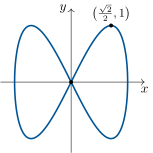
The Lissajous curve ( t, 2t): a double point at the origin, where two regular branches cross with velocities (1, 2) and (-1, 2), and horizontal tangents at the four summits. Symmetry reduced all the work to a quarter-period.
The Lissajous curve (sin⁡t,sin⁡2t)(\sin t, \sin 2t): a double point at the origin, where two regular branches cross with velocities (1,2)(1, 2) and (−1,2)(-1, 2), and horizontal tangents at the four summits. Symmetry reduced all the work to a quarter-period.
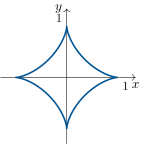
The astroid ( 3 t, 3 t): four arcs meeting at four cusps. It is the curve traced by a point of a circle of radius 1/4 rolling inside the unit circle.
The astroid (cos⁡3t,sin⁡3t)(\cos^3 t, \sin^3 t): four arcs meeting at four cusps. It is the curve traced by a point of a circle of radius 14\frac14 rolling inside the unit circle.

উদাহরণ

Example 24.3 (Asymptotic branches, worked)

x(t)=tx(t) = t, y(t)=t+1ty(t) = t + \dfrac1t on (0, +∞)\intoo{0}{+\infty}. As t→0+t \to 0^{+}: x→0x \to 0 while y→+∞y \to +\infty — the curve climbs along the vertical asymptote x=0x = 0 (finite limit for one coordinate, infinite for the other). As t→+∞t \to +\infty: both coordinates blow up, so test a line: the difference

y(t)−x(t)=1t⟶0+y(t) - x(t) = \frac1t \longrightarrow 0^{+}

exhibits the oblique asymptote y=xy = x, approached from above. In between, y′=1−1t2y' = 1 - \frac1{t^2} vanishes at t=1t = 1: the point (1,2)(1, 2) is the low point of the branch, and x′=1>0x' = 1 > 0 throughout, so the curve always advances rightward. One arc, two asymptotes, one minimum: a complete picture from three computations — with the general recipe visible underneath: when x,y→∞x, y \to \infty together, examine y/xy/x for a candidate slope (here →1\to 1), then y−(slope) xy - (\text{slope})\,x for the intercept and the side of approach.

Example 24.4 (The astroid)

x(t)=cos⁡3tx(t) = \cos^3 t, y(t)=sin⁡3ty(t) = \sin^3 t. Symmetries: M(t+2π)=M(t)M(t + 2\pi) = M(t) (study a period); M(−t)M(-t) is the reflection of M(t)M(t) in the xx-axis; M(π−t)M(\pi - t) in the yy-axis; M(π2−t)M(\frac\pi2 - t) in the diagonal y=xy = x: it suffices to study t∈[0, π4]t \in \intcc{0}{\frac\pi4} and unfold.

Velocity: f′(t)=3sin⁡tcos⁡t (−cos⁡t,sin⁡t)f'(t) = 3\sin t\cos t\,(-\cos t, \sin t). On (0, π2)\intoo{0}{\frac\pi2} all points are regular with tangent directed by (−cos⁡t,sin⁡t)(-\cos t, \sin t); at t=0t = 0 (the point (1,0)(1,0)) the velocity vanishes: a cusp, where the curve reverses along the tangent direction (−1,0)⋅(±)(-1, 0)\cdot(\pm) — by symmetry the four cusps sit at (±1,0),(0,±1)(\pm1, 0), (0, \pm1).

Example 24.5 (A figure-eight, studied in full)

x(t)=sin⁡tx(t) = \sin t, y(t)=sin⁡2ty(t) = \sin 2t (a Lissajous curve). Symmetries: M(t+π)=(−x(t),y(t))M(t + \pi) = (-x(t), y(t)) (reflection in the yy-axis), M(−t)=(−x(t),−y(t))M(-t) = (-x(t), -y(t)) (central symmetry), M(π−t)=(x(t),−y(t))M(\pi - t) = (x(t), -y(t)) (reflection in the xx-axis): it suffices to study t∈[0, π2]t \in \intcc{0}{\frac\pi2} and unfold. Variations: x′=cos⁡t≥0x' = \cos t \geq 0 throughout, while y′=2cos⁡2ty' = 2\cos 2t is positive before t=π4t = \frac\pi4 and negative after: the arc climbs rightward to the summit (22, 1)\bigl(\frac{\sqrt2}2,\ 1\bigr) at t=π4t = \frac\pi4 (horizontal tangent), then descends rightward to (1,0)(1, 0) at t=π2t = \frac\pi2, where x′=0≠y′x' = 0 \neq y': vertical tangent. Double point: M(0)=M(π)=(0,0)M(0) = M(\pi) = (0,0), with two different velocities

f′(0)=(1, 2),f′(π)=(−1, 2):f'(0) = (1,\ 2), \qquad f'(\pi) = (-1,\ 2) :

two regular branches crossing at the origin at distinct angles — a double point, not a singular point: each passage is perfectly smooth, the two passages merely share their location. The whole curve is the figure-eight below.

প্রসঙ্গসহ পড়ো →