
সব বই

পেশাদার

1 Markets I: The Ecosystem and Exchange-Traded Marketsবাজার অনলাইন 2 Markets II: Rates, FX and Creditবাজার অনলাইন 3 Markets III: Commodities, Energy and Cryptoবাজার অনলাইন 4 Quantitative Methodsপদ্ধতি অনলাইন 5 Derivatives and Volatilityডেরিভেটিভস অনলাইন 6 Rates, Credit, XVA and Riskসুদহার, ঋণ ও ঝুঁকি অনলাইন 7 Research Craft: Predictors, Backtests, Measurement, Portfoliosগবেষণা অনলাইন 8 Strategies I: Equities and Futuresকৌশল অনলাইন 9 Strategies II: Volatility, Relative Value, Macro and the Bank Desksকৌশল অনলাইন 10 Microstructure and Executionএক্সিকিউশন অনলাইন 11 Market Making and High-Frequency Tradingমার্কেট মেকিং অনলাইন 12 Machine Learning for Marketsমেশিন লার্নিং অনলাইন 13 Low-Latency Softwareপ্রযুক্তি অনলাইন 14 Networks, Hardware and Trading Infrastructureপ্রযুক্তি অনলাইন 15 Research, Data and Risk Platformsপ্রযুক্তি অনলাইন 16 The Desk and the Firmপ্রতিষ্ঠান অনলাইন 17 The Industry: Firms, Roles and Careersক্যারিয়ার অনলাইন 18 Interviews I: Maths, Probability and Speedক্যারিয়ার অনলাইন 19 Interviews II: Markets, Trading Games and the Final Roundক্যারিয়ার অনলাইন 20 Interviews III: Codeক্যারিয়ার অনলাইন
অ্যাপ পরিচিতি Coach সাইন ইন পড়া শুরু করো

বইগুলো এখনো বাংলা ভাষায় পাওয়া যায় না — ইংরেজি সংস্করণ দেখানো হচ্ছে।

Physics · পরিভাষা

Displacement field and strain tensor কী?

Definition 3.1 University Physics — Year 3 · অধ্যায় 3 — Continuum Mechanics and Elasticity

When a solid deforms, the particle initially at r→\vect r moves to r→+u→(r→)\vect r + \vect u(\vect r): u→\vect u is the displacement field. For small deformations, the local distortion is measured by the strain tensor, the symmetric array

εij=12(∂ui∂xj+∂uj∂xi),i,j∈{x,y,z}.\varepsilon_{ij} = \frac12\Big( \frac{\partial u_i}{\partial x_j} + \frac{\partial u_j}{\partial x_i} \Big) , \qquad i, j \in \{x, y, z\} .

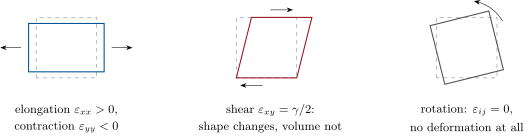
A diagonal component εxx\varepsilon_{xx} is the relative elongation of the material along xx (dimensionless, e.g. 10−310^{-3} for a steel cable in service); an off-diagonal component εxy\varepsilon_{xy} is half the closing of the angle between the xx and yy material directions — a shear. The trace is the relative change of volume, the dilatation:
δVV=εxx+εyy+εzz=div⁡u→.\frac{\delta V}{V} = \varepsilon_{xx} + \varepsilon_{yy} + \varepsilon_{zz} = \operatorname{div}\vect u .
The strain tensor sees only true deformation: stretching (diagonal components), shearing (off-diagonal components) — and a rigid rotation not at all.

উদাহরণ

Example 3.2 (Three elementary deformations)

Uniform dilation u→=αr→\vect u = \alpha\vect r: εij=α δij\varepsilon_{ij} = \alpha\,\delta_{ij}, volume change 3α3\alpha, no shear. Simple shear u→=(γy,0,0)\vect u = (\gamma y, 0, 0): εxy=γ/2\varepsilon_{xy} = \gamma/2, all diagonal components zero — shape changes, volume does not. Rigid rotation u→=(−ωy,ωx,0)\vect u = (-\omega y, \omega x, 0): εij=0\varepsilon_{ij} = 0 identically — the antisymmetric part of ∂ui/∂xj\partial u_i/\partial x_j, discarded by the symmetrisation, is exactly the part that rotates without deforming. Strain measures deformation only.

প্রসঙ্গসহ পড়ো →