Definition 3.1University Physics — Year 3 · 第 3 章 — Continuum Mechanics and Elasticity
When a solid deforms, the particle initially at r moves to r+u(r): u is the displacement field. For small deformations, the local distortion is measured by the strain tensor, the symmetric array
εij=21(∂xj∂ui+∂xi∂uj),i,j∈{x,y,z}.
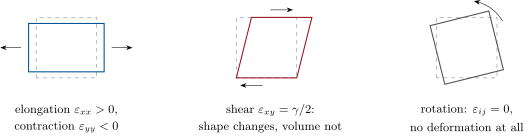
A diagonal component εxx is the relative elongation of the material along x (dimensionless, e.g. 10−3 for a steel cable in service); an off-diagonal component εxy is half the closing of the angle between the x and y material directions — a shear. The trace is the relative change of volume, the dilatation:
VδV=εxx+εyy+εzz=divu.
The strain tensor sees only true deformation: stretching (diagonal components), shearing (off-diagonal components) — and a rigid rotation not at all.
示例
Example 3.2(Three elementary deformations)
Uniform dilation u=αr: εij=αδij, volume change 3α, no shear. Simple shear u=(γy,0,0): εxy=γ/2, all diagonal components zero — shape changes, volume does not. Rigid rotation u=(−ωy,ωx,0): εij=0 identically — the antisymmetric part of ∂ui/∂xj, discarded by the symmetrisation, is exactly the part that rotates without deforming. Strain measures deformation only.
 Coach