全部书籍

专业

应用 关于 Coach 登录 开始阅读

书籍暂未推出简体中文版——当前显示英文版。

Physics · 术语表

什么是 Spectrum and timbre?

又称: spectrum · timbre

Definition 21.14 High School Physics · 第 21 章 — Sound and Acoustics

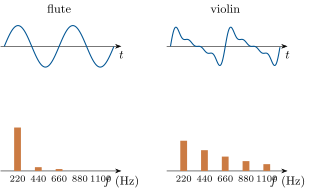
The spectrum of a sound is the bar chart of its harmonics: one bar per fnf_n, the height that harmonic’s strength. The ear hears f1f_1 as the pitch and the mix of strengths as the timbre — the sound’s color: instruments playing the same note share f1f_1, differing only in their spectra.

The same A (220\, Hz): waveforms (top), spectra (bottom) — same fundamental and pitch; the violin’s harmonic ladder is its timbre.
The same A (220 Hz220\,\mathrm{Hz}): waveforms (top), spectra (bottom) — same fundamental and pitch; the violin’s harmonic ladder is its timbre.

示例

Example 21.15 (Why you recognize the caller)

A flute’s A is nearly a pure tone; a violin bowing the same 220 Hz220\,\mathrm{Hz} adds strong harmonics at 440 Hz, 660 Hz and 880 Hz440\,\mathrm{Hz}\text{, }660\,\mathrm{Hz}\text{ and }880\,\mathrm{Hz}. Same pitch and loudness, yet no one confuses them: a voice, too, is a spectrum you know by heart.

Example 21.19 (A violin’s A string)

A violin’s A string has L=32.8 cmL = 32.8\,\mathrm{cm} and sounds f1=440 Hzf_1 = 440\,\mathrm{Hz}: waves run along it at v=2Lf1=2×0.328×440≈289 m/sv = 2Lf_1 = 2 \times 0.328 \times 440 \approx 289\,\mathrm{m}/\mathrm{s} — set by tension and mass, tuned by the peg. Pressing a finger shortens LL and raises every fnf_n at once: the spectrum slides up.

在原文中阅读 →