সব বই

পেশাদার

1 Markets I: The Ecosystem and Exchange-Traded Marketsবাজার অনলাইন 2 Markets II: Rates, FX and Creditবাজার অনলাইন 3 Markets III: Commodities, Energy and Cryptoবাজার অনলাইন 4 Quantitative Methodsপদ্ধতি অনলাইন 5 Derivatives and Volatilityডেরিভেটিভস অনলাইন 6 Rates, Credit, XVA and Riskসুদহার, ঋণ ও ঝুঁকি অনলাইন 7 Research Craft: Predictors, Backtests, Measurement, Portfoliosগবেষণা অনলাইন 8 Strategies I: Equities and Futuresকৌশল অনলাইন 9 Strategies II: Volatility, Relative Value, Macro and the Bank Desksকৌশল অনলাইন 10 Microstructure and Executionএক্সিকিউশন অনলাইন 11 Market Making and High-Frequency Tradingমার্কেট মেকিং অনলাইন 12 Machine Learning for Marketsমেশিন লার্নিং অনলাইন 13 Low-Latency Softwareপ্রযুক্তি অনলাইন 14 Networks, Hardware and Trading Infrastructureপ্রযুক্তি অনলাইন 15 Research, Data and Risk Platformsপ্রযুক্তি অনলাইন 16 The Desk and the Firmপ্রতিষ্ঠান অনলাইন 17 The Industry: Firms, Roles and Careersক্যারিয়ার অনলাইন 18 Interviews I: Maths, Probability and Speedক্যারিয়ার অনলাইন 19 Interviews II: Markets, Trading Games and the Final Roundক্যারিয়ার অনলাইন 20 Interviews III: Codeক্যারিয়ার অনলাইন
অ্যাপ পরিচিতি Coach সাইন ইন পড়া শুরু করো

বইগুলো এখনো বাংলা ভাষায় পাওয়া যায় না — ইংরেজি সংস্করণ দেখানো হচ্ছে।

Physics · পরিভাষা

Spectrum and timbre কী?

অন্য নাম: spectrum · timbre

Definition 21.14 High School Physics · অধ্যায় 21 — Sound and Acoustics

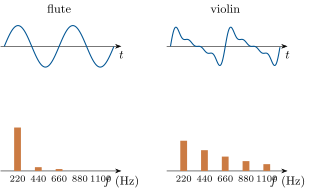
The spectrum of a sound is the bar chart of its harmonics: one bar per fnf_n, the height that harmonic’s strength. The ear hears f1f_1 as the pitch and the mix of strengths as the timbre — the sound’s color: instruments playing the same note share f1f_1, differing only in their spectra.

The same A (220\, Hz): waveforms (top), spectra (bottom) — same fundamental and pitch; the violin’s harmonic ladder is its timbre.
The same A (220 Hz220\,\mathrm{Hz}): waveforms (top), spectra (bottom) — same fundamental and pitch; the violin’s harmonic ladder is its timbre.

উদাহরণ

Example 21.15 (Why you recognize the caller)

A flute’s A is nearly a pure tone; a violin bowing the same 220 Hz220\,\mathrm{Hz} adds strong harmonics at 440 Hz, 660 Hz and 880 Hz440\,\mathrm{Hz}\text{, }660\,\mathrm{Hz}\text{ and }880\,\mathrm{Hz}. Same pitch and loudness, yet no one confuses them: a voice, too, is a spectrum you know by heart.

Example 21.19 (A violin’s A string)

A violin’s A string has L=32.8 cmL = 32.8\,\mathrm{cm} and sounds f1=440 Hzf_1 = 440\,\mathrm{Hz}: waves run along it at v=2Lf1=2×0.328×440≈289 m/sv = 2Lf_1 = 2 \times 0.328 \times 440 \approx 289\,\mathrm{m}/\mathrm{s} — set by tension and mass, tuned by the peg. Pressing a finger shortens LL and raises every fnf_n at once: the spectrum slides up.

প্রসঙ্গসহ পড়ো →