
সব বই

পেশাদার

1 Markets I: The Ecosystem and Exchange-Traded Marketsবাজার অনলাইন 2 Markets II: Rates, FX and Creditবাজার অনলাইন 3 Markets III: Commodities, Energy and Cryptoবাজার অনলাইন 4 Quantitative Methodsপদ্ধতি অনলাইন 5 Derivatives and Volatilityডেরিভেটিভস অনলাইন 6 Rates, Credit, XVA and Riskসুদহার, ঋণ ও ঝুঁকি অনলাইন 7 Research Craft: Predictors, Backtests, Measurement, Portfoliosগবেষণা অনলাইন 8 Strategies I: Equities and Futuresকৌশল অনলাইন 9 Strategies II: Volatility, Relative Value, Macro and the Bank Desksকৌশল অনলাইন 10 Microstructure and Executionএক্সিকিউশন অনলাইন 11 Market Making and High-Frequency Tradingমার্কেট মেকিং অনলাইন 12 Machine Learning for Marketsমেশিন লার্নিং অনলাইন 13 Low-Latency Softwareপ্রযুক্তি অনলাইন 14 Networks, Hardware and Trading Infrastructureপ্রযুক্তি অনলাইন 15 Research, Data and Risk Platformsপ্রযুক্তি অনলাইন 16 The Desk and the Firmপ্রতিষ্ঠান অনলাইন 17 The Industry: Firms, Roles and Careersক্যারিয়ার অনলাইন 18 Interviews I: Maths, Probability and Speedক্যারিয়ার অনলাইন 19 Interviews II: Markets, Trading Games and the Final Roundক্যারিয়ার অনলাইন 20 Interviews III: Codeক্যারিয়ার অনলাইন
অ্যাপ পরিচিতি Coach সাইন ইন পড়া শুরু করো

বইগুলো এখনো বাংলা ভাষায় পাওয়া যায় না — ইংরেজি সংস্করণ দেখানো হচ্ছে।

Physics · পরিভাষা

Standing wave কী?

অন্য নাম: node · antinode

Definition 21.16 High School Physics · অধ্যায় 21 — Sound and Acoustics

A wave confined between the fixed ends of a string can settle into a standing wave: an oscillation in place, motionless points — nodes — alternating with points of maximal swing — antinodes. Nothing travels any more; the string vibrates in a fixed pattern.
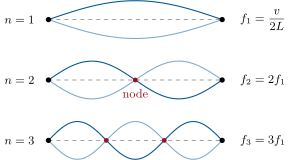
The first three modes of a string fixed at both ends: n half-wavelengths fit in L, so _n = 2L/n and f_n = nf_1.
The first three modes of a string fixed at both ends: nn half-wavelengths fit in LL, so λn=2L/n\lambda_n = 2L/n and fn=nf1f_n = nf_1.

উদাহরণ

Example 21.19 (A violin’s A string)

A violin’s A string has L=32.8 cmL = 32.8\,\mathrm{cm} and sounds f1=440 Hzf_1 = 440\,\mathrm{Hz}: waves run along it at v=2Lf1=2×0.328×440≈289 m/sv = 2Lf_1 = 2 \times 0.328 \times 440 \approx 289\,\mathrm{m}/\mathrm{s} — set by tension and mass, tuned by the peg. Pressing a finger shortens LL and raises every fnf_n at once: the spectrum slides up.

প্রসঙ্গসহ পড়ো →