সব বই

পেশাদার

1 Markets I: The Ecosystem and Exchange-Traded Marketsবাজার অনলাইনইংরেজি 2 Markets II: Rates, FX and Creditবাজার অনলাইনইংরেজি 3 Markets III: Commodities, Energy and Cryptoবাজার অনলাইনইংরেজি 4 Quantitative Methodsপদ্ধতি অনলাইনইংরেজি 5 Derivatives and Volatilityডেরিভেটিভস অনলাইনইংরেজি 6 Rates, Credit, XVA and Riskসুদহার, ঋণ ও ঝুঁকি অনলাইনইংরেজি 7 Research Craft: Predictors, Backtests, Measurement, Portfoliosগবেষণা অনলাইনইংরেজি 8 Strategies I: Equities and Futuresকৌশল অনলাইনইংরেজি 9 Strategies II: Volatility, Relative Value, Macro and the Bank Desksকৌশল অনলাইনইংরেজি 10 Microstructure and Executionএক্সিকিউশন অনলাইনইংরেজি 11 Market Making and High-Frequency Tradingমার্কেট মেকিং অনলাইনইংরেজি 12 Machine Learning for Marketsমেশিন লার্নিং অনলাইনইংরেজি 13 Low-Latency Softwareপ্রযুক্তি অনলাইনইংরেজি 14 Networks, Hardware and Trading Infrastructureপ্রযুক্তি অনলাইনইংরেজি 15 Research, Data and Risk Platformsপ্রযুক্তি অনলাইনইংরেজি 16 The Desk and the Firmপ্রতিষ্ঠান অনলাইনইংরেজি 17 The Industry: Firms, Roles and Careersক্যারিয়ার অনলাইনইংরেজি 18 Interviews I: Maths, Probability and Speedক্যারিয়ার অনলাইনইংরেজি 19 Interviews II: Markets, Trading Games and the Final Roundক্যারিয়ার অনলাইনইংরেজি 20 Interviews III: Codeক্যারিয়ার অনলাইনইংরেজি
অ্যাপ পরিচিতি Coach সাইন ইন পড়া শুরু করো

বইগুলো এখনো বাংলা ভাষায় পাওয়া যায় না — Français সংস্করণ দেখানো হচ্ছে।

Mathématiques · পরিভাষা

Volume par comptage কী?

অন্য নাম: volume

Définition 35.5 Mathématiques du primaire et du collège · অধ্যায় 35 — Cubes et pavés

Le volume d’un solide construit avec des cubes unitaires est le nombre de cubes qu’il contient. L’unité peut être le centimètre cube (cm3^3) ou le mètre cube (m3^3).

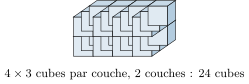
Un pavé 4 × 3 × 2 de cubes unitaires, compté couche par couche.
Un pavé 4×3×24 \times 3 \times 2 de cubes unitaires, compté couche par couche.

উদাহরণ

Exemple 35.6 (Compter un pavé couche par couche)

Un pavé de 44 cubes de long, 33 de large, 22 de haut : la couche du bas contient 4×3=124 \times 3 = 12 cubes, et il y a 22 couches :

12×2=24 cubes.12 \times 2 = 24 \text{ cubes} .

Compter par couches marche toujours — et prouve discrètement la formule V=L×ℓ×hV = L \times \ell \times h de Chapitre 43.

Exemple 35.7 (Mêmes cubes, formes différentes)

Huit cubes unitaires peuvent construire un cube 2×2×22 \times 2 \times 2, un bâton 8×1×18 \times 1 \times 1, ou une plaque 4×2×14 \times 2 \times 1 : trois solides différents, un volume (88 cubes). Le volume compte la matière, pas la forme.

প্রসঙ্গসহ পড়ো →