Markets II: Rates, FX and Credit · Markets
12Mortgages and Agencies
An American who borrows to buy a house usually borrows for thirty years at a fixed rate and keeps the right to repay at any time, without penalty. When rates fall, millions of borrowers refinance, and the investors who own their mortgages get their money back just when they can reinvest it only at the lower rate. The mortgage bond that should have gained from the fall gains little; its duration collapses; and the investors who hedged it must buy duration in a hurry, from Treasuries or swaps. In March 2003 two Federal Reserve economists estimated that a fall of half a point in rates would have shortened the duration of outstanding mortgage securities by as much as receiving fixed on USD 289 billion of new ten-year swaps. This chapter explains the mortgage-backed security that makes the American fixed-rate mortgage possible, the forward market in which almost all of it trades, and the negative convexity that makes its holders move the rest of the rates market.
12.1 The agency pass-through
Definition 12.1 (Agency mortgage-backed security, pass-through)
An agency mortgage-backed security is a security backed by a pool of residential mortgages whose timely payment of interest and principal is guaranteed by a government-sponsored enterprise (Fannie Mae, Freddie Mac) or by a government agency (Ginnie Mae, whose guarantee carries the full faith and credit of the United States). The basic form is the pass-through: each month it passes the borrowers’ payments, interest at the pool’s coupon and all principal, scheduled and prepaid, to the investors pro rata, after the servicer and the guarantor have taken their fees.
The pool’s loans pay a gross rate, the weighted average coupon; investors receive a lower net coupon, the difference paying the servicer who collects the payments and the guarantor who bears the credit risk. A pool of 6.5% loans may back a 6% pass-through. The investor has, in effect, no credit risk and one large risk instead: the timing of the principal.

The market is among the largest in fixed income: a 2022 survey by economists of the Federal Reserve Bank of New York put American mortgage-backed securities above USD 11 trillion outstanding and their trading near USD 300 billion a day, most of it in the agency securities. In mid-2021 banks held about a third of them and the Federal Reserve, the largest single holder, about a quarter, bought in its programmes of asset purchases after 2008 and after 2020 (Figure 12.4).
As of September 2026 — Agency mortgages
Agency MBS trading averaged USD 367.0 billion a day in 2026 to August (SIFMA); MBS issuance was USD 1 432.5 billion over the same period. The Federal Reserve held USD 1 913.5 billion of MBS on 16 September 2026, down from a peak of USD 2 740.2 billion on 13 April 2022, letting its holdings run off. The thirty-year fixed mortgage rate in the Freddie Mac survey was 6.95% on 17 September 2026.
12.2 Prepayment
Definition 12.2 (Prepayment, conditional prepayment rate, PSA benchmark)
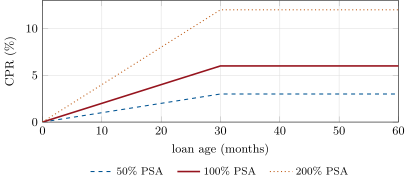
A prepayment is a repayment of mortgage principal ahead of the amortisation schedule: a sale of the house, a refinancing, a partial repayment, or a default bought out of the pool by the guarantor. The conditional prepayment rate (CPR) is the annualised fraction of the balance, after scheduled principal, prepaid in a month; the monthly fraction, the single monthly mortality, is . The PSA benchmark is a standard speed path: 100% PSA is a CPR of 0.2% in a loan’s first month, rising by 0.2% a month to 6% in its thirtieth and constant after; 200% PSA doubles every rate.
Prepayment speeds follow the borrowers’ incentives. New loans prepay slowly, since few people move or refinance in the first months; this is the ramp the PSA benchmark describes (Figure 12.2). The benchmark is a quoting convention, not a model: the Ginnie Mae offering documents that define it say that it does not describe history or predict anything. What drives speeds is the refinancing incentive, the gap between the rate borrowers pay and the rate they could get today. Out of the money, a pool prepays at the slow pace of house sales; in the money, several times faster; the transition between the two, an S-shaped curve in the incentive, is where the risk lies. The chapter’s illustrative curve runs from a CPR of 6% far out of the money to 50% far in it, and gives 11.9% at the money.
Example 12.3 (A new pool)
USD 100 million of new thirty-year 6.5% loans back a 6% pass-through. The level monthly payment is USD 632 068; in the first month it contains USD 541 667 of interest and USD 90 401 of scheduled principal, and at 100% PSA (a CPR of 0.2%) USD 16 667 is prepaid. Investors receive USD 500 000 of interest, the 6% coupon, and all USD 107 068 of principal. The weighted average life, the average time to the return of a dollar of principal, is 19.6 years with no prepayment, 11.5 at 100% PSA and 5.8 at 300%.
12.3 The to-be-announced market and dollar rolls
Definition 12.4 (To-be-announced trade, specified pool, dollar roll)
A to-be-announced trade (TBA) is a forward trade in agency pass-throughs in which the buyer and the seller agree on six parameters (agency, coupon, maturity, price, face value and settlement month), but not on the pools: two business days before the monthly settlement date the seller names pools that meet the industry’s good-delivery guidelines. A specified pool is a pool traded by its identifier, at a price above the TBA price (a pay-up) when its loans are expected to prepay more slowly. A dollar roll is the sale of a TBA for one settlement month together with the purchase of the same TBA for a later month.
The TBA market turns around a million distinct pools into a handful of liquid contracts, one per agency family, coupon and settlement month; since mid-2019 pools of Fannie Mae and Freddie Mac trade in the same Uniform MBS contracts. The seller delivers the least valuable pools that qualify, so the TBA works like a futures contract with a cheapest-to-deliver (Chapter 6); pools whose borrowers are expected to prepay more slowly are worth more, are kept out of TBA delivery and are sold as specified pools. The concentration pays: the 2022 survey reports about USD 261 billion of the agency market’s USD 288 billion daily trading in TBAs, at an estimated one-way cost of about one basis point, against about forty for specified pools. Lenders use the market to hedge the loans they have promised but not yet made, by selling TBAs forward.
A dollar roll is the market’s financing trade. The roll seller, long TBAs for the front month, sells them and buys them back for the next month: she gives up a month of coupon and principal paydown, and keeps the cash for a month. The difference between the two prices, the drop, sets the rate at which she has in effect borrowed.
Proposition 12.5 (Implied financing rate of a dollar roll)
Sell the front month at and buy the back month at , days later, on a pass-through of coupon whose principal pays down a fraction over the month (returned at par). The roll’s implied financing rate solves
Proof. Holding the securities for the month ends with face , worth , plus the paydown and the coupon . Rolling instead yields invested for days, from which the same face can be bought back at . The two positions end with the same securities when the cash sides match, which is the equation. Accrued interest, equal at both settlement dates for a day-of-month convention, cancels. ∎
Example 12.6 (A roll)
The 6% TBA trades at 100.50 for the front month and 100.25 for the next, a drop of a quarter point; the pool pays down 1.16% a month. The roll finances at 2.95% a year. With repo at 4%, holding the securities and financing them in repo costs more than rolling: the roll is special, as the dealers say, and the drop that would make the two equivalent is 0.16. A roll trades special when securities for the front month are scarce, for instance when a large buyer is taking delivery of many pools; the Federal Reserve has itself used rolls in its operations, including in 2020.
12.4 Negative convexity and its hedging flows
Definition 12.7 (Effective duration, negative convexity)
The effective duration of a security whose cash flows depend on rates is , where are its prices after shifting rates by and re-running the model of its cash flows. A security has negative convexity over a range of rates when its effective duration falls as rates fall: its price rises less than it falls for equal moves.
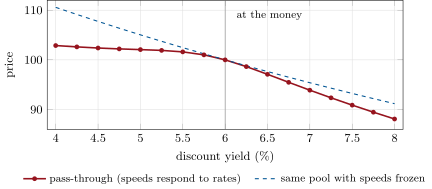
An ordinary bond has positive convexity (Chapter 3): as rates fall its duration lengthens and its price accelerates. A pass-through does the opposite near the money, because every borrower holds a call option on the loan. As rates fall the option moves into the money, prepayments accelerate, principal comes back at par and the price is capped near par plus a little. Figure 12.3 shows it on the chapter’s pool: the pass-through gains 2.07 points on a 100-basis-point fall and loses 6.11 on a 100-basis-point rise, while the same pool with its speed frozen would gain 5.04 and lose 4.60.
Proposition 12.8 (The convexity hedge)
A holder who keeps a pass-through portfolio of face hedged to zero duration must, after a rate move from to , change its hedge by
with the price and the effective duration: after a fall, the holder’s DV01 shrinks and it must buy duration (receive fixed or buy bonds); after a rise, sell it. The trades go in the direction of the move.
Proof. The portfolio’s DV01 is ; a zero-duration holder’s hedges carry the opposite DV01, which must follow any change in it. ∎
This is the mechanism of the hook. Not every holder hedges, and some buy options (Chapter 13) rather than trade dynamically, but the dealers, servicers and mortgage investors who do hedge dynamically all trade in the direction the market has just moved, and in size. The Federal Reserve economists who made the 2003 estimate found that the volatility implied by swap options rises when the mortgage market’s prepayment risk rises, as if investors expected the hedging to amplify rate moves. They also recalled 1994, when long rates rose 133 basis points between October 1993 and May 1994 while the Fed tightened 125, a move attributed at the time to mortgage holders selling Treasuries as their duration surged.
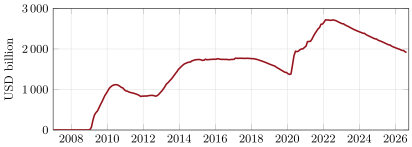
The central bank’s holdings change the picture. A central bank does not hedge the duration of its holdings as a bank or a servicer does, so its purchases take convexity hedging out of the market, and its run-off puts it back. The figure is also a reminder that the largest owner of the asset can change its mind.
12.5 Tutorial: pass-through cash flows and effective duration
Goal. Project the monthly cash flows of a pass-through under any prepayment function, price it, and measure its effective duration and convexity with a refinancing S-curve; price a dollar roll. End state: Figures 12.2 and 12.3, Examples 12.3 and 12.6 and the numbers of the weekend problem.
Cash flows: level payment on the remaining balance and term, scheduled principal, then prepayment of a fraction SMM of what is left.
def cash_flows(balance: float, wac: float, coupon: float, term: int, age: int,
               cpr: Callable[[int], float]) -> list[Flow]:
    """Monthly flows of a pass-through; cpr(loan_age) gives the annual prepayment rate."""
    out, r = [], wac / 12.0
    for k in range(1, term - age + 1):
        if balance <= 1e-9:
            break
        pay = level_payment(balance, r, term - age - k + 1)
        sched = pay - balance * r
        pre = (balance - sched) * smm(cpr(age + k))
        interest = balance * coupon / 12.0
        balance -= sched + pre
        out.append(Flow(k, interest, sched, pre, balance))
    return out
Listing 12.1. Monthly cash flows of a pass-through. code/firm/prepay/firm_prepay.py Speeds and risk: the S-curve, the effective duration and convexity by re-running the cash flows at shifted rates, and the roll’s financing rate of Proposition 12.5.
def refi_cpr(incentive: float, base: float = 0.06, top: float = 0.50, slope: float = 250.0,
             centre: float = 0.0075) -> float:
    """Refinancing S-curve: annual CPR as a function of the rate incentive (WAC minus the current
    mortgage rate), from `base` deep out of the money to `top` deep in it."""
    return base + (top - base) / (1.0 + math.exp(-slope * (incentive - centre)))


def effective_risk(p: Callable[[float], float], y: float, dy: float = 0.0025) -> dict[str, float]:
    """Effective duration and convexity from prices at y - dy, y and y + dy, the prepayment
    model being re-run at each rate."""
    down, mid, up = p(y - dy), p(y), p(y + dy)
    return {"price": mid, "down": down, "up": up, "duration": (down - up) / (2.0 * mid * dy),
            "convexity": (down + up - 2.0 * mid) / (mid * dy * dy)}


def roll_financing_rate(front: float, back: float, coupon: float, paydown: float, days: int = 30) -> float:
    """Implied financing rate of a dollar roll: selling the front month at `front` and buying the
    back month at `back` gives up the month's coupon and the paydown returned at par."""
    end_value = (1.0 - paydown) * back + 100.0 * paydown + 100.0 * coupon / 12.0
    return (end_value / front - 1.0) * 360.0 / days
Listing 12.2. Refinancing S-curve, effective risk and the dollar roll. code/firm/prepay/firm_prepay.py - Run
mbs_demo.risk_table(),mbs_demo.convexity_hedge(),mbs_demo.roll_example()andfig_mbs.py.
What to change next. Flatten the S-curve (a smaller slope) and watch the negative convexity shrink; season the pool from zero months and see the ramp delay the refinancing response.
12.6 Build: the pass-through engine
Purpose. The miniature firm makes markets in TBAs, finances them with rolls and hedges their duration: it needs cash flows under any speed, prices, weighted average lives, effective durations, and roll financing rates.
Interface. psa_cpr(age, speed); smm(cpr); level_payment; cash_flows(balance, wac, coupon, term, age, cpr) returning Flow records; price(flows, y, face); wal; refi_cpr(incentive, …); effective_risk(p, y, dy); roll_financing_rate(front, back, coupon, paydown, days).
Rules. Monthly periods; prepayment applied after scheduled principal; interest to investors at the net coupon on the opening balance; discounting at a monthly-compounded yield without the payment delay; one static rate path.
Acceptance tests. code/firm/prepay/tests/: the PSA ramp’s defining points; with no prepayment a level-payment mortgage fully amortised; all principal returned and the price at par when the yield equals the coupon, at any speed; negative convexity with the S-curve and positive with frozen speeds; a roll with no drop and no paydown finances at the coupon.
Stretch. A payment delay; rate paths simulated from a short-rate model and an option-adjusted spread (chapter 21 and One Quant Book 6); pool-level speeds by loan size and age; the TBA cheapest-to-deliver across pools.
Sources and further reading
- Ginnie Mae, Base Offering Circular, definition of the PSA prepayment assumption.
- A. Fuster, D. Lucca and J. Vickery, “Mortgage-backed securities”, Federal Reserve Bank of New York Staff Report 1001, 2022.
- R. Perli and B. Sack, “Does mortgage hedging amplify movements in long-term interest rates?”, Finance and Economics Discussion Series 2003-49, Federal Reserve Board.
- SIFMA, US mortgage-backed securities statistics; FRED series WSHOMCB and MORTGAGE30US.
12.7 Exercises
Exercise 12.1 ★
Give the CPR at 100% PSA in a loan’s tenth month, at 150% PSA in its twentieth, and at 200% PSA in its fortieth.
Solution
Solution of Exercise 12.1.
2% (); 6% (); 12% (, the ramp being over after thirty months).
Exercise 12.2 ★
Convert a CPR of 6% into a single monthly mortality. A pool has USD 50 million left after scheduled principal: how much prepays this month?
Solution
Solution of Exercise 12.2.
a month; USD 257 151 prepays.
Exercise 12.3 ★
Name the six parameters of a TBA trade. Which pools will a seller deliver, and why do some pools trade separately?
Solution
Solution of Exercise 12.3.
Agency, coupon, maturity, price, face value, settlement month. The seller delivers the least valuable pools that meet the good-delivery guidelines, those expected to prepay in the way that hurts the holder most. Pools worth more than that, because their borrowers are expected to prepay more slowly, are kept back and sold as specified pools at a pay-up.
Exercise 12.4 ★★
In the model of Example 12.6, give the roll’s implied financing rate if the drop were zero, and explain why it is close to the coupon.
Solution
Solution of Exercise 12.4.
5.90%. With no drop, rolling gives up the month’s coupon (6% a year on par) and the paydown, returned at par rather than at 100.50; financing 100.50 of cash at a little under the coupon is what that costs.
Exercise 12.5 ★★
From Figure 12.3, why is the pass-through’s price at 4% only 102.88 when the frozen-speed pool is worth 110.58?
Solution
Solution of Exercise 12.5.
At 4% the incentive is two and a half points and the pool prepays at a CPR of 48%: its principal comes back quickly at par and cannot be reinvested at 6%. The frozen-speed pool keeps paying 6% on a balance that runs off at the at-the-money speed, which is worth far more at a 4% discount rate.
Exercise 12.6 ★★
Give the effective duration and convexity of the chapter’s pass-through at 5.5%, 6% and 6.5%, and explain where the negative convexity is strongest.
Solution
Solution of Exercise 12.6.
At 5.5%: 1.77 years and ; at 6%: 4.73 and ; at 6.5%: 6.51 and . Negative convexity is strongest near the money, where the S-curve is steepest and a small rate move changes speeds the most; out of the money speeds hardly respond and the pool behaves more like a bond.
Exercise 12.7 ★★★
Coding. With cash_flows give the weighted average life of the new pool at 0, 50, 100, 200 and 300% PSA.
Solution
Solution of Exercise 12.7.
19.62, 14.73, 11.49, 7.73 and 5.77 years.
Exercise 12.8 ★★★
Find the flaw. “Agency mortgages are guaranteed by the government, so they are as safe as Treasuries and should yield the same.” Correct it.
Solution
Solution of Exercise 12.8.
The guarantee removes credit risk, not prepayment risk. The holder is short the borrowers’ option to repay at par, so agency securities must yield more than Treasuries of similar life to pay for that option, for their uncertain cash flows and for their negative convexity. For Fannie Mae and Freddie Mac the guarantee is that of the enterprises, not the full faith and credit of the United States that stands behind Ginnie Mae.
12.8 Problem: The Refinancing Wave
Problem 12.1
Weekend problem — how a rally turns into a bid for duration
An investor holds USD 10 billion face of the chapter’s seasoned 6% pass-through (6.5% loans, 36 months old), hedged to zero duration by paying fixed on ten-year swaps. The discount yield is 6%, the primary mortgage rate 6.5%, and speeds follow the chapter’s S-curve. Ten-year swaps are priced on a flat 6% annual curve.
Part I — At the money.
- Give the pool’s CPR, price and effective duration.
- Give the portfolio’s DV01.
- Give the DV01 of USD 100 million of the ten-year swap.
- What notional of swaps is the investor paying fixed on?
- Give the effective convexity, and say what its sign means.
Part II — The rally.
- Rates fall 50 basis points. Give the new CPR, price and effective duration.
- Give the portfolio’s new DV01.
- By how much must the hedge change, and in which direction?
- What notional of ten-year swaps must be received?
- Give the effective duration if rates instead rise 50 basis points.
Part III — The market.
- The 2003 estimate for the whole market was USD 289 billion of ten-year swaps for a 50-basis-point move. What does the investor’s trade represent of it?
- Why does the hedge push rates further in the direction of the move?
- Who takes the other side?
- How would buying options instead change the investor’s trading?
- Why did the Federal Reserve’s purchases reduce this effect?
Part IV — Judgement.
- Why does the model overstate the precision of the answer?
- Why does a new pool respond less to the rally?
- What would a servicer, paid a fee on the outstanding balance, do after the rally?
- State the named result: the convexity hedge for USD 10 billion after a 50-basis-point rally.
- In one sentence: why do mortgage holders buy duration after rates fall?
Solution
Solution of Problem 12.1.
1. CPR 11.9%, price 100.00, effective duration 4.73 years. 2. USD 4.73 million per basis point (). 3. USD 73 601. 4. About USD 6.42 billion. 5. : the duration shortens as rates fall and lengthens as they rise, so the hedge must be traded in the direction of every move. 6. CPR 21.3%, price 101.61, effective duration 1.77 years. 7. USD 1.80 million per basis point. 8. By USD 2.93 million per basis point: the investor is short too much duration and must buy it back. 9. About USD 3.97 billion, received fixed. 10. 6.51 years: the hedge would have to be increased instead. 11. About 1.4%. 12. After a fall, hedgers receive fixed or buy bonds, pushing rates lower still; after a rise, they pay or sell. 13. Investors with the opposite need, such as those who pay fixed to hedge rising rates, and dealers, who charge for it; when they are scarce, rates move further. 14. Options bought in advance deliver the duration automatically as rates fall, so the investor trades less after the move; the convexity has been passed to the option seller. 15. It bought pools and did not hedge them, so less of the market’s negative convexity was being hedged dynamically. 16. The S-curve, its slope and the spread between mortgage and discount rates are assumptions; real speeds also depend on loan age, size, borrowers’ credit and the lenders’ capacity. The answer’s order of magnitude is robust, its digits are not. 17. The PSA-like ramp: new borrowers rarely refinance in their first months whatever the incentive. 18. It loses fee income as the balance prepays, so its asset loses value in a rally and it too must buy duration to hedge it. 19. Named result: the convexity hedge for USD 10 billion after a 50-basis-point rally is to receive fixed on about USD 4.0 billion of ten-year swaps, as the effective duration falls from 4.73 to 1.77 years. 20. Because borrowers refinance, their securities shorten, and hedged holders must replace the duration they lost.
12.9 Interview questions
Interview question 12.1 ★ trader, researcher
Why does a mortgage-backed security have negative convexity?
Solution
Solution of Interview question 12.1.
Borrowers can repay at par at any time, so the holder is short a call option on the loan. When rates fall the option moves into the money, prepayments accelerate and the price is capped near par: duration shortens. When rates rise, prepayments slow and duration lengthens. A price that rises less than it falls is negative convexity.
What the interviewer is looking for: the embedded option and the duration changes it causes.
Interview question 12.2 ★ trader, bank
What is a TBA, and why does the market trade mostly TBAs rather than pools?
Solution
Solution of Interview question 12.2.
A forward trade in agency pass-throughs on six parameters (agency, coupon, maturity, price, face, settlement month), with the pools named two days before settlement. It pools a million heterogeneous securities into a few fungible contracts, which makes them liquid and cheap to trade; pools with valuable characteristics trade separately as specified pools.
What the interviewer is looking for: fungibility, and the cheapest-to-deliver consequence.
Interview question 12.3 ★★ trader
Explain a dollar roll. When is a roll special, and what do you do if it is?
Solution
Solution of Interview question 12.3.
Sell the front-month TBA and buy the back month: the roll seller gives up the coupon and paydown for a month and keeps the cash. The drop implies a financing rate; when it is below repo, the roll is special. If you own the securities, roll them and invest the cash; if you need the front-month pools, expect to pay for them.
What the interviewer is looking for: the implied financing rate and the comparison with repo.
Interview question 12.4 ★★ researcher
How would you build a prepayment model, and how would you know it is good?
Solution
Solution of Interview question 12.4.
Separate the drivers: house sales (seasoning, season of the year), refinancing as a function of the incentive, burnout, loan size, credit, and lenders’ capacity; fit on loan-level or pool-level history; validate out of sample, especially through past refinancing waves, and on the dispersion of speeds across pools, not only their average. Watch that the model’s durations hedge well in practice.
What the interviewer is looking for: the drivers, out-of-sample validation and a hedging test.
Interview question 12.5 ★★ researcher, trader
How do mortgage hedging flows affect the Treasury and swap markets?
Solution
Solution of Interview question 12.5.
After a rally, mortgage durations shorten and hedgers receive fixed or buy Treasuries; after a sell-off they pay or sell. The flows are in the direction of the move, so they add momentum and raise realised and implied volatility, particularly when much of the market is near the money. Central bank holdings and options hedging reduce the effect.
What the interviewer is looking for: direction, size, and what damps it.
Interview question 12.6 ★★★ developer, researcher
Design the system that computes the effective duration of a book of a hundred thousand pools every hour.
Solution
Solution of Interview question 12.6.
Group pools by characteristics that drive speeds, or use the prepayment model vectorised over pools; reuse a common set of rate scenarios (up, down and base, or simulated paths) and compute cash flows once per scenario; parallelise across pools; cache results for pools whose inputs did not change; recompute only the market-dependent parts intraday. Reconcile against a slower full run nightly, and monitor the model’s durations against realised hedge performance.
What the interviewer is looking for: vectorisation, scenario reuse, caching and reconciliation.