Markets II: Rates, FX and Credit · Markets
28Getting Access: Rates and Credit
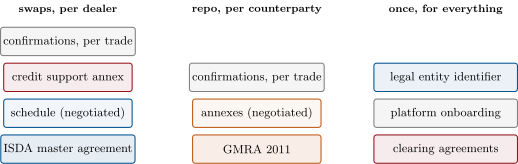
A swap is agreed in a second on a screen. Before the first one, a fund needs a master agreement with each dealer, negotiated schedule by schedule, a credit support annex that says what collateral moves and when, an identifier that tells regulators who it is, and accounts with a clearing broker for the swaps that must be cleared. Treasury repo needs its own master agreement and, increasingly, a way into the clearing house: the United States requires eligible repo to be cleared from June 2027. For each piece the fund chooses between renting someone else’s balance sheet and membership, and building its own. This chapter explains the documents, the status a firm has on the trading platforms, how non-banks reach the inter-dealer markets, sponsored repo and clearing membership, and swap clearing brokers, and builds a model of what each route costs.
28.1 Documentation before the first trade
Definition 28.1 (ISDA master agreement, Global Master Repurchase Agreement)
An ISDA master agreement is the standard contract, published by the International Swaps and Derivatives Association, that governs all the over-the-counter derivatives two parties trade with each other: a printed form, a schedule negotiated between them, and a confirmation for each trade, all forming one agreement. The Global Master Repurchase Agreement (GMRA) is the corresponding standard for repo, published by the International Capital Market Association.
The ISDA master agreement exists in 1992 and 2002 versions; its central provision is close-out netting: on a default, every outstanding trade between the two parties is replaced by one early termination amount owed by one to the other. That is what lets a dealer’s credit department and its regulators measure exposure net rather than trade by trade, as long as the netting is enforceable under the insolvency law of the counterparty’s country. The credit support annex of chapter 10 sits on top of it and sets the collateral. The GMRA, first published in 1992 and last revised in 2011, does the same for repo, with legal opinions on its enforceability in many jurisdictions published by its sponsor (Figure 28.1).
Definition 28.2 (Legal entity identifier)
A legal entity identifier (LEI) is a unique 20-character code, under the ISO 17442 standard, that identifies a legal entity in trade reports and regulatory filings, with public reference data on who the entity is and who owns it.
The LEI came out of the 2008 crisis, when regulators could not tell who owed what to whom: the G20 endorsed the system’s charter in 2012, and a Swiss foundation, GLEIF, administers it. Regulators use the LEI to identify the parties in trade reports, so a fund obtains one before it trades.
28.2 Dealer and client status on the platforms
Rates and credit trade on two kinds of electronic platform (chapters 4 and 22): the inter-dealer markets, where dealers and a few large non-banks trade with each other, mostly on order books; and the dealer-to-client platforms, where clients request quotes from dealers. A firm’s status decides what it sees and whom it can trade with: as a client, it asks for prices; as a dealer, it answers requests and may see flows that clients do not.
In swaps, the rules push against closed clubs: an American swap execution facility must give any eligible contract participant impartial access to its markets, under criteria that are impartial, transparent and applied in a fair and non-discriminatory manner, with comparable fees for comparable access. Access to a platform is still not access to trading: the counterparties on it must accept the firm’s credit, directly or through its clearing broker.
28.3 Inter-dealer access for non-banks
The inter-dealer Treasury market is no longer a dealers’ club. Chapter 4 showed that, on 15 October 2014, principal trading firms, non-banks trading for their own account, accounted for more than half of the volume in the inter-dealer cash and futures markets studied. They reach the order books through the platforms’ own onboarding and, for credit and settlement, through a bank or a clearing member that stands behind their trades, the same pattern as the FX prime brokerage of the last chapter. For a non-bank, the order book gives anonymous access to the tightest prices; the price of it is the credit arrangement, and the obligation to settle and clear what it trades.
28.4 Sponsored repo and clearing membership
Definition 28.3 (Sponsored member)
A sponsored member is a firm admitted to a clearing house through a sponsoring member, which submits the sponsored member’s trades for clearing and guarantees its obligations to the clearing house.
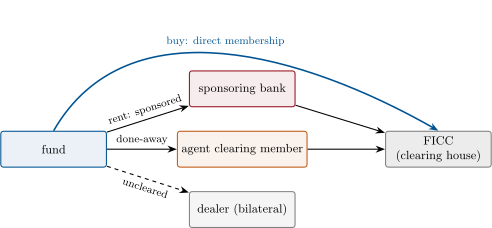
Chapter 5 described sponsored repo. The Fixed Income Clearing Corporation, the clearing house for Treasury repo, offers three routes to a fund (Figure 28.2). It can become a sponsored member of a bank that is a sponsoring member: in November 2024 the SEC approved rule changes that removed the requirement that sponsored members be qualified institutional buyers, and bank sponsors must have equity capital of at least USD 5 billion and be well capitalised. It can use a member’s agent clearing service, which FICC now presents as a “done-away” model: the fund trades with anyone and the agent clears. Or it can apply for membership itself, with the capital, operations and contributions to the clearing fund that brings. A fourth route, uncleared bilateral repo, narrows as the clearing mandate takes effect.
As of September 2026 — Treasury clearing and sponsored access
SEC Treasury clearing rule: compliance dates 31 December 2026 for eligible cash transactions and 30 June 2027 for eligible repo (chapter 4). FICC’s Sponsored Service: average daily volume of USD 2.3 trillion in the second quarter of 2026, by DTCC. SEC approval of FICC’s access rule changes, including the removal of the qualified institutional buyer requirement for sponsored members: 21 November 2024.
28.5 Swap clearing brokers
Definition 28.4 (Clearing broker (swaps))
A clearing broker for swaps is a clearing member of a swap clearing house that clears its clients’ swaps, posts their margin to the clearing house, and guarantees their performance to it; in the United States it is a futures commission merchant registered for swaps.
Swaps subject to the clearing mandate of chapter 10 must be cleared, so a fund needs a clearing broker at the clearing houses where its dealers want to face it. The broker charges fees on the notional or per ticket, requires initial margin, often with an add-on for the fund’s risk, and limits the fund’s positions by its own credit appetite. Becoming a clearing member directly is possible for large firms, but brings default-fund contributions, default-management duties and operational requirements that only large books justify.
Proposition 28.5 (When to buy access)
Let a route have a fixed annual cost and a variable annual cost per unit of repo balance, for a book whose swap notional is a fixed multiple of its repo balance. If building access costs but against renting it, building is cheaper exactly when the repo balance exceeds
Proof. The annual costs are and ; the second is smaller when . ∎
Example 28.6 (Three routes)
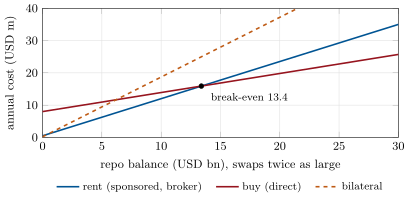
In the chapter’s illustrative model, renting costs USD 0.5 million a year fixed and 11.5 basis points a year per dollar of repo balance, including the swaps and funded margin; buying costs USD 8 million fixed and 5.9 basis points, including the capital in the clearing fund; bilateral costs 0.2 million and 18.5 basis points. A fund with USD 5 billion of repo and 10 billion of swaps pays 6.25 million a year renting, 10.95 million buying and 9.45 million bilaterally. Bilateral beats renting only below USD 0.43 billion of repo; buying beats renting above USD 13.4 billion (Figure 28.3).
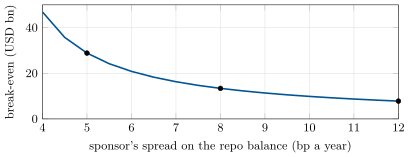
The break-even is only as good as its inputs, and the most uncertain is the spread the sponsor charges, which depends on its balance sheet and its appetite (Figure 28.4).
28.6 Tutorial: three ways to access repo and swaps
Goal. Cost three routes to Treasury repo and swaps for a mid-size fund, find the break-even sizes, and see how they move with the sponsor’s spread and the fixed cost of membership. End state: Figures 28.3 and 28.4, Example 28.6 and the numbers of the weekend problem.
The model: routes, annual costs, unit costs, break-evens.
@dataclass(frozen=True)
class Route:
    name: str
    fixed: float                 # USD a year
    repo_bp: float               # fees or spread, bp a year on the repo balance
    swap_bp: float               # clearing fees, bp a year on swap notional
    repo_margin: float = 0.0     # margin posted per unit of repo balance
    swap_margin: float = 0.0     # initial margin per unit of swap notional
    fund_share: float = 0.0      # clearing-fund contribution per unit of repo balance
    capital_rate: float = 0.10   # cost of the capital tied up in the clearing fund, a year


def annual_cost(route: Route, repo: float, swaps: float, funding: float) -> float:
    """Total cost a year, USD; margin is funded at `funding` (a spread over the cash it earns)."""
    return route.fixed + variable_cost(route, repo, swaps, funding)


def variable_cost(route: Route, repo: float, swaps: float, funding: float) -> float:
    variable = route.repo_bp * 1e-4 * repo + route.swap_bp * 1e-4 * swaps
    margin = funding * (route.repo_margin * repo + route.swap_margin * swaps)
    capital = route.capital_rate * route.fund_share * repo
    return variable + margin + capital


def unit_cost(route: Route, swaps_per_repo: float, funding: float) -> float:
    """Variable cost a year per USD of repo balance, for a book with a fixed swap-to-repo mix."""
    return variable_cost(route, 1.0, swaps_per_repo, funding)


def breakeven(a: Route, b: Route, swaps_per_repo: float, funding: float) -> float | None:
    """Repo balance at which routes a and b cost the same, or None if one is always cheaper."""
    du = unit_cost(a, swaps_per_repo, funding) - unit_cost(b, swaps_per_repo, funding)
    if du == 0:
        return None
    size = (b.fixed - a.fixed) / du
    return size if size > 0 else None


def cheapest(routes: list[Route], repo: float, swaps: float, funding: float) -> Route:
    return min(routes, key=lambda r: annual_cost(r, repo, swaps, funding))
Listing 28.1. The access-cost model. code/firm/clearcost/firm_clearcost.py - Run
access_cost_demo.tutorial(),access_cost_demo.problem()andfig_access_cost.py.
What to change next. Make the sponsor’s spread rise with the fund’s balance, as a bank’s balance-sheet cost would, and find whether the break-even still exists; then add the value of the netting a direct member gets across all its counterparties.
28.7 Build: the access-cost model
Purpose. The miniature firm decides how it reaches each market, and revisits the decision as it grows.
Interface. Route(name, fixed, repo_bp, swap_bp, repo_margin, swap_margin, fund_share, capital_rate); annual_cost(route, repo, swaps, funding); variable_cost; unit_cost(route, swaps_per_repo, funding); breakeven(a, b, swaps_per_repo, funding); cheapest(routes, repo, swaps, funding).
Rules. Costs a year in dollars; fees in basis points of balance or notional; margin funded at a spread; clearing-fund capital at a cost of capital; costs linear in the book’s size beyond the fixed part.
Acceptance tests. code/firm/clearcost/tests/: the cost is fixed plus linear; at the break-even the two routes cost the same, below it renting is cheaper and above it buying is; a dominated route has no break-even.
Stretch. Costs that rise with size; the value of netting and of anonymity; default-fund and loss-allocation exposures of a direct member; stress costs when a sponsor withdraws (One Quant Book 16 on the firm).
Sources and further reading
- ISDA, “Legal guidelines for smart derivatives contracts: the ISDA Master Agreement”, February 2019.
- ICMA, Global Master Repurchase Agreement; GLEIF, introducing the legal entity identifier.
- SEC, Release No. 34-101694 (21 November 2024) approving FICC’s access rule changes; DTCC, FICC Sponsored Service.
- 17 CFR 37.202, access requirements for swap execution facilities.
28.8 Exercises
Exercise 28.1 ★
What does close-out netting do, and why does a dealer care whether it is enforceable in its client’s country?
Solution
Solution of Exercise 28.1.
On a default it replaces every outstanding trade between the two parties by a single amount owed one way, so the survivor loses only the net value. If the netting is not enforceable where the client is, a liquidator could claim the trades the dealer owes while leaving it to claim, as an unsecured creditor, those the client owes: the dealer’s exposure, and the capital held against it, would be gross.
Exercise 28.2 ★
List the documents a fund needs before its first cleared swap.
Solution
Solution of Exercise 28.2.
An LEI; an ISDA master agreement, schedule and credit support annex with each executing dealer; account and clearing agreements with a swap clearing broker; onboarding with the execution platforms; and confirmations for each trade.
Exercise 28.3 ★
What does an LEI identify, and what two questions does its reference data answer?
Solution
Solution of Exercise 28.3.
A single legal entity, by a 20-character code; its reference data answer who is who and who owns whom.
Exercise 28.4 ★★
Rent costs 0.5 million a year and 11.5 basis points; buy costs 8 million and 5.9 basis points. Compute the break-even from the formula.
Solution
Solution of Exercise 28.4.
billion.
Exercise 28.5 ★★
What is the difference between sponsored clearing and a done-away agent clearing service, from the fund’s point of view?
Solution
Solution of Exercise 28.5.
Sponsored clearing ties the fund to its sponsor, which trades with it or submits its trades and guarantees them; a done-away agent clears trades the fund does with anyone, so the fund can choose its trading counterparties apart from its clearing member. The agent still guarantees the fund to the clearing house and charges for it.
Exercise 28.6 ★★
Why does the Treasury clearing mandate change the comparison between bilateral repo and the cleared routes?
Solution
Solution of Exercise 28.6.
Once eligible repo must be cleared, from June 2027, much of the bilateral route is no longer available whatever it costs; the choice is between the cleared routes, and the bilateral costs matter only for trades outside the mandate.
Exercise 28.7 ★★★
Coding. Remove the swaps (a repo-only fund) and find the break-even between renting and buying. Then raise the fixed cost of membership to USD 12 million, swaps back in. Explain both changes.
Solution
Solution of Exercise 28.7.
Without swaps the break-even is USD 15.0 billion: the swaps’ lower fees at the direct route no longer help pay the fixed cost. With membership at 12 million it is USD 20.5 billion: the extra fixed cost must be paid from the same saving per dollar.
Exercise 28.8 ★★★
Find the flaw. “Direct membership is always cheaper in the long run: the fees are lower, and fixed costs are paid only once.” Correct it.
Solution
Solution of Exercise 28.8.
The fixed costs recur every year: staff, systems, legal and the capital in the clearing fund. Direct membership is cheaper only above the break-even size, which depends on the spread sponsors charge; it also brings obligations the model leaves out, such as loss-sharing and default management, and it cannot be switched off quickly if the book shrinks.
28.9 Problem: Build or Rent
Problem 28.1
Weekend problem — when direct membership pays
A fund’s rates book has a repo balance and a swap notional . Renting access (sponsored repo, a swap clearing broker) costs USD 0.5 million a year, 8 basis points a year on the repo balance, 0.5 on swap notional, with margin of 2% of the repo and 1.5% of the swaps funded at 0.5% a year. Buying it (direct memberships) costs USD 8 million a year, 1 and 0.2 basis points, the same margin, and a clearing-fund contribution of 0.2% of the repo balance that costs 10% a year in capital. Bilateral, uncleared, costs 0.2 million, 12 and 1 basis points, with margin of 3% on both. All figures are illustrative.
Part I — Unit costs.
- Compute each route’s variable cost per dollar of repo balance, in basis points.
- What does each route cost for USD 5 billion of repo and 10 billion of swaps?
- Which is cheapest at that size?
- Below which size is bilateral cheapest?
- Why does the clearing-fund contribution count as a cost?
Part II — The break-even.
- Find the repo balance above which buying beats renting.
- What does either route cost at that size?
- What would buying save at USD 20 billion of repo?
- How does the break-even change for a repo-only fund?
- How does it change if membership costs 12 million a year?
Part III — Sensitivity.
- What is the break-even if the sponsor charges 5 basis points? 12?
- Why is the sponsor’s spread the most uncertain input?
- What costs of direct membership does the model leave out?
- What does renting cost that the model does not show?
- How does the clearing mandate change the bilateral route?
Part IV — Judgement.
- The fund expects to grow from 5 to 20 billion over three years. When should it start building?
- Why might a fund rent even above the break-even?
- What documents must be in place whichever route it chooses?
- State the named result: the balance-sheet size at which direct membership beats a clearing broker, and its cost.
- In one sentence: what does a fund buy when it becomes a member?
Solution
Solution of Problem 28.1.
1. Rent 11.5, buy 5.9, bilateral 18.5 basis points a year per dollar of repo. 2. USD 6.25 million, 10.95 million and 9.45 million a year. 3. Renting. 4. Below USD 0.43 billion of repo. 5. It is capital the fund cannot use elsewhere, and it is at risk if another member defaults. 6. USD 13.4 billion. 7. USD 15.9 million a year. 8. USD 3.7 million a year. 9. It rises to USD 15.0 billion. 10. It rises to USD 20.5 billion. 11. USD 28.8 billion at 5 basis points; USD 7.8 billion at 12. 12. It depends on the sponsor’s balance sheet, its capital rules and appetite, and the fund’s size and behaviour, and it can change in a stress. 13. Default-fund loss sharing, liquidity calls from the clearing house, default management duties, and the cost of meeting membership standards as they change. 14. Dependence on the sponsor, which can raise its price or cut the fund’s limits in a stress, and less netting across counterparties than a member gets. 15. Eligible repo must be cleared from June 2027, so the bilateral route shrinks to what the mandate does not cover. 16. Building takes time (applications, systems, staff), so it should start before the book passes the break-even, while renting continues, if growth is likely enough. 17. For flexibility, to avoid fixed commitments and default-fund exposure, or because the sponsor’s netting and balance sheet serve it better than its own. 18. The LEI, master agreements with dealers and repo counterparties, credit support annexes, and clearing agreements. 19. Named result: build or rent: direct membership beats a clearing broker above USD 13.4 billion of repo, with swaps twice as large, where each route costs USD 15.9 million a year. 20. Lower costs per unit and control of its access, paid for with fixed costs and a share of the clearing house’s risks.
28.10 Interview questions
Interview question 28.1 ★ trader, developer
What is an ISDA master agreement, and why does close-out netting matter?
Solution
Solution of Interview question 28.1.
The standard contract governing all OTC derivatives between two parties, with a negotiated schedule and per-trade confirmations forming one agreement. Close-out netting replaces all trades by one amount on a default, so exposure and capital are measured net, provided it is enforceable in the counterparty’s insolvency.
What the interviewer is looking for: single agreement, netting, enforceability.
Interview question 28.2 ★ trader, bank
How does a hedge fund get access to cleared Treasury repo?
Solution
Solution of Interview question 28.2.
As a sponsored member through a bank sponsoring member of FICC, which submits and guarantees its trades; through a member’s agent clearing (done-away) service; or, for a very large firm, by direct membership. Bilateral uncleared repo is an alternative that the clearing mandate narrows.
What the interviewer is looking for: the routes and the mandate.
Interview question 28.3 ★★ researcher, risk
Build a model to decide between a clearing broker and direct membership.
Solution
Solution of Interview question 28.3.
List each route’s fixed costs and its variable costs per unit of business: fees, funded margin, capital in clearing funds; compute annual costs as the book grows; the break-even is the fixed-cost difference over the unit-cost difference; test the sensitivity to the sponsor’s spread and to growth, and add what the model leaves out.
What the interviewer is looking for: fixed versus variable, break-even, sensitivity.
Interview question 28.4 ★★ trader
What does a swap clearing broker do, and what can it do to you in a stress?
Solution
Solution of Interview question 28.4.
It clears the fund’s swaps at the clearing house, posts margin and guarantees the fund, charging fees and setting limits. In a stress it can raise margin add-ons, cut limits, ask the fund to reduce positions or move them, and, if the fund defaults, close them out.
What the interviewer is looking for: clearing, margin, limits and their use in stress.
Interview question 28.5 ★★ trader, researcher
How do non-banks reach the inter-dealer Treasury market?
Solution
Solution of Interview question 28.5.
Principal trading firms trade on the inter-dealer order books through the platforms’ onboarding and with a bank or clearing member standing behind their credit and settlement; in 2014 they were more than half of the inter-dealer volume studied on 15 October.
What the interviewer is looking for: platform access plus credit intermediation.
Interview question 28.6 ★★★ developer
Design the onboarding system that tracks, for each counterparty, the documents signed, their key terms and what they allow the firm to trade.
Solution
Solution of Interview question 28.6.
One record per counterparty and legal entity: documents signed (master agreements, schedules, annexes, clearing and platform agreements) with versions and dates, the key terms extracted (eligible collateral, thresholds, termination events, allowed products), and the permissions they give; expose them to the order path as limits and to risk as netting sets; alert on expiries, missing documents and changes.
What the interviewer is looking for: structured terms feeding trading permissions.