Markets II: Rates, FX and Credit · Markets
20Settlement Risk
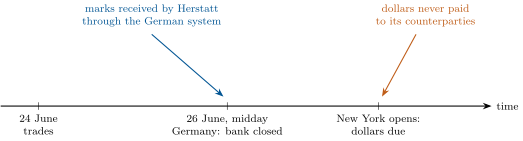
On 26 June 1974 the German banking supervisor closed Bankhaus Herstatt, a German bank that had lost heavily on speculative currency positions. It did so in the middle of the German business day, before the markets in New York had opened. By then Herstatt had received, through the German payment system, the Deutsche marks it had bought two days earlier; it had not yet paid the dollars it had sold, which were due later that day in New York. Its counterparties had paid and would not be paid. Several banks were hit, and the main American clearing system for dollar payments closed for a day. Until then, a currency trader’s risk had been thought to be the price; Herstatt showed that the whole principal of a trade could be lost between two payments in two time zones (Figure 20.2). Half a century later, the central banks’ survey of April 2025 found that about USD 1.4 trillion a day was still settled in a way fully exposed to that risk. This chapter explains settlement risk, the payment-versus-payment system built to remove it, the netting that reduces it, and what remains.
20.1 Herstatt
Definition 20.1 (Settlement risk, Herstatt risk)
The settlement risk of a foreign exchange trade is the risk that a party pays the currency it sold and does not receive the currency it bought. In its time-zone form, the payment of one leg becoming irrevocable hours before the other leg is due, it is called Herstatt risk.
The risk is not the market move, which is small over a day, but the principal. A bank that sells yen for dollars pays its yen in the Asian morning and receives its dollars in the American afternoon; if its counterparty fails in between, it has lost the yen and does not get the dollars. The exposure lasts from the moment its own payment can no longer be recalled until the moment it knows the other payment has arrived.
Definition 20.2 (Unilateral irrevocable payment time)
The unilateral irrevocable payment time of a currency, for a given bank, is the deadline after which it can no longer cancel a payment it has instructed in that currency. A trade’s settlement exposure runs from the irrevocable time of the currency sold to the confirmed, final receipt of the currency bought, and may be extended by the time it takes to check the receipt and by a failed payment.
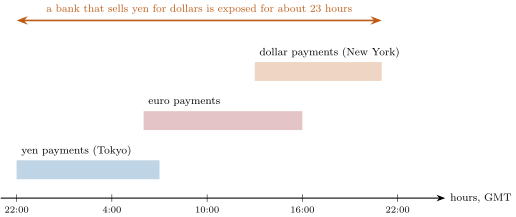
The central banks of the G10 answered in 1996 with a strategy on three tracks: banks should measure and control their settlement exposures like any credit exposure; industry groups should build services that settle both legs together; central banks should push both and adapt their payment systems. The industry’s answer was CLS, which began operating in September 2002.
20.2 Payment versus payment
Definition 20.3 (Payment versus payment)
Payment versus payment (PvP) is a settlement mechanism in which the final payment of one currency occurs if, and only if, the final payment of the other currency occurs.
PvP is to currencies what delivery versus payment is to securities (One Quant Book 1, chapter 5). CLS operates it for 18 of the main currencies: it settles each trade’s two legs together, or not at all. Settlement risk disappears; in its place each member must pay in, on time, the currencies it owes, a liquidity demand that is smaller when many trades are settled against one another.
Proposition 20.4 (What PvP removes and what it leaves)
Under PvP a failed counterparty’s trades are not settled and the survivor keeps the currency it would have paid: its loss is the cost of replacing the trade at the new market rate, the replacement risk, not the principal. Replacement risk is of the order of the day’s exchange-rate move, a small fraction of principal.
Proof. If the counterparty’s leg is not paid, the survivor’s leg is not paid either, so no principal leaves it. It must still buy the currency it needed elsewhere, at the rate of that moment instead of the agreed one: the difference is its loss. ∎
20.3 Netting
Definition 20.5 (Payment netting)
Payment netting is the settlement, between two parties and for each currency and value date, of only the net of the amounts they owe each other, in place of every trade’s gross payment.
A bank that sells EUR 400 million for dollars to a counterparty and buys back EUR 300 million from it on the same value date need pay only EUR 100 million net; its exposure falls from the full 400 million to 100 million. The BIS estimated that pre-settlement netting removed about USD 1.3 trillion a day of payments in April 2022. Netting reduces the amount at risk but not its nature: what is still paid gross can still be lost.
Example 20.6 (One bank’s settlement day)
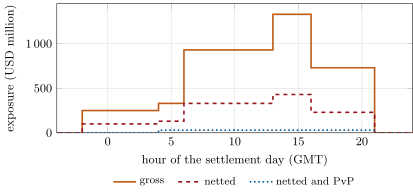
A bank’s book for one value date has eight trades with four counterparties, USD 1.53 billion in all: with A, it sells EUR 400 million and buys EUR 300 million against dollars; with B, it sells yen for USD 250 million and buys yen for USD 150 million; with C, it sells euros for sterling (200 million) and dollars for euros (100 million); with D, it sells an emerging-market currency outside CLS for USD 80 million and buys it back for USD 50 million. Settled gross with the illustrative hours of Figure 20.1, its exposure peaks at USD 1.33 billion in the afternoon, when the dollar payments are due and the euro ones have gone. Netted per counterparty and currency, the payments fall to USD 430 million and the peak to USD 430 million; settled through PvP in every currency but the last, the peak is USD 30 million, the net of D’s trades (Figure 20.3).
20.4 What remains unprotected
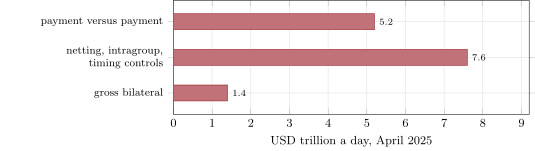
Settlement risk has not gone. In April 2022, by the BIS’s estimate, USD 2.2 trillion of the day’s deliverable FX turnover, almost a third, was still settled at risk; in the largest trading centres 20–40% of turnover, in some smaller ones more than three quarters. The 2025 survey measured it differently, by settlement method: just over a third of the day’s settlement, USD 5.2 trillion, went through PvP; USD 7.6 trillion used methods that mitigate the risk without removing it, such as netting, settlement within a group, or bank accounts with timing controls; and USD 1.4 trillion, 10%, was settled gross between the two parties. The main reasons given were that the counterparty had no access to PvP or that the currency was not supported (Figure 20.4).
Measuring one’s own exposure is itself a discipline. A bank’s exposure to a trade does not end when the currency it bought is due, but when it knows it has arrived; the ECB described, in 2007, the irrevocable period that ends with final receipt, an uncertain period while the bank has not yet checked it, and a failed period if the payment did not come. A bank that reconciles its incoming payments only the next morning carries its whole purchases overnight in the uncertain period, and a failed payment extends the exposure until it is resolved.
The losses are not only history. The BIS article of 2022 recalled KfW’s loss of EUR 300 million when Lehman Brothers failed in 2008 and Barclays’s loss of USD 130 million to a small currency exchange in March 2020. The pattern is Herstatt’s: a payment made on the assumption that the other would follow.
As of September 2026 — Settlement today
BIS Triennial Survey, April 2025: USD 5.2 trillion a day settled by PvP, USD 7.6 trillion by methods that mitigate the risk, USD 1.4 trillion gross bilateral (10%). CLS settles 18 currencies, on average more than USD 8 trillion a day, for more than 75 settlement members.
20.5 Tutorial: the settlement-exposure timeline
Goal. Compute a book’s settlement exposure through the day, gross, netted and with PvP, from each currency’s cancellation deadline and confirmation time. End state: Figure 20.3, Example 20.6 and the numbers of the weekend problem.
The exposure window of a trade and the exposure at a time.
def window(trade: Trade, times: dict[str, tuple[float, float]]) -> tuple[float, float]:
    """(start, end) of the exposure: the sold currency's cancellation deadline to the bought
    currency's confirmation; empty if the latter comes first."""
    start, end = times[trade.sell][0], times[trade.buy][1]
    return (start, end) if end > start else (start, start)


def exposure_at(t: float, trades: list[Trade], times: dict[str, tuple[float, float]]) -> float:
    return sum(tr.value_usd for tr in trades if window(tr, times)[0] <= t < window(tr, times)[1])
Listing 20.1. Exposure window of a trade and a book’s exposure at a time. code/firm/settlerisk/firm_settlerisk.py Netting and the day’s profile, with PvP currencies removed.
def net_by_counterparty(trades: list[Trade]) -> list[Trade]:
    """Payment netting: per counterparty and currency, pay only the net amount. Net flows are
    re-paired, largest first, into trades that sell a net-paid currency and buy a net-received one."""
    out = []
    by_cp: dict[str, dict[str, float]] = defaultdict(lambda: defaultdict(float))
    for tr in trades:
        by_cp[tr.counterparty][tr.sell] -= tr.value_usd
        by_cp[tr.counterparty][tr.buy] += tr.value_usd
    for cp, flows in by_cp.items():
        pays = sorted(((c, -v) for c, v in flows.items() if v < -1e-9), key=lambda x: -x[1])
        gets = sorted(((c, v) for c, v in flows.items() if v > 1e-9), key=lambda x: -x[1])
        i = j = 0
        while i < len(pays) and j < len(gets):
            amt = min(pays[i][1], gets[j][1])
            out.append(Trade(cp, pays[i][0], gets[j][0], amt))
            pays[i], gets[j] = (pays[i][0], pays[i][1] - amt), (gets[j][0], gets[j][1] - amt)
            i += pays[i][1] <= 1e-9
            j += gets[j][1] <= 1e-9
    return out


def profile(trades: list[Trade], times: dict[str, tuple[float, float]], pvp: set[str] = frozenset(),
            step: float = 0.25, start: float = -12.0, end: float = 24.0) -> list[tuple[float, float]]:
    """Exposure through the day; trades whose two currencies are both in `pvp` carry none."""
    live = [tr for tr in trades if not (tr.sell in pvp and tr.buy in pvp)]
    n = int(round((end - start) / step))
    return [(start + k * step, exposure_at(start + k * step, live, times)) for k in range(n + 1)]


def peak(prof: list[tuple[float, float]]) -> float:
    return max(v for _, v in prof)
Listing 20.2. Payment netting per counterparty, and the exposure profile. code/firm/settlerisk/firm_settlerisk.py - Run
settle_demo.summary()andfig_settle.py.
What to change next. Add an uncertain period, the hours before the bank confirms a receipt, to each currency, and a failed payment that extends a trade’s exposure to the next day; see how the peak moves.
20.6 Build: the settlement-exposure calculator
Purpose. The miniature firm settles its own FX trades and those of its clients: it must know, hour by hour, how much it could lose if a counterparty failed, set limits on it, and see what netting and PvP would save.
Interface. Trade(counterparty, sell, buy, value_usd); window(trade, times); exposure_at(t, trades, times); net_by_counterparty(trades); profile(trades, times, pvp); peak(profile).
Rules. Times per currency as (cancellation deadline, confirmation) in GMT hours of the settlement day; values in dollars; netting per counterparty and currency; trades between two PvP currencies carry no settlement exposure.
Acceptance tests. code/firm/settlerisk/tests/: the yen-for-dollar window and the empty reverse window; exposure summed and zero after the last confirmation; PvP removes it; netting reduces payments and the peak.
Stretch. Per-counterparty limits and alerts; uncertain and failed periods; PvP liquidity: the pay-ins a member needs by currency and hour.
Sources and further reading
- European Central Bank, Financial Stability Review, December 2007, Box 19, “More than thirty years after the Herstatt case”.
- M. Glowka and T. Nilsson, “FX settlement risk: an unsettled issue”, BIS Quarterly Review, December 2022.
- M. Drehmann, P. McGuire, T. Shirakami, M. Conway and N. Lovell, “Uncovering FX settlement risk: new measures from the 2025 BIS Triennial Survey”, BIS Quarterly Review, June 2026.
- CLS Group, company information.
20.7 Exercises
Exercise 20.1 ★
With the illustrative hours of Figure 20.1, how long is a bank exposed when it sells yen for dollars, and when it sells dollars for yen?
Solution
Solution of Exercise 20.1.
Selling yen for dollars: from the yen deadline at 22:00 the evening before to the dollar confirmation at 21:00, 23 hours. Selling dollars for yen: with these hours the yen arrive before the dollar payment becomes irrevocable, so there is no window; in practice earlier instruction deadlines can create one.
Exercise 20.2 ★
What does a bank lose if its counterparty fails during the exposure window, under gross settlement and under PvP?
Solution
Solution of Exercise 20.2.
Gross: the whole principal of the currency it paid, since the counterparty’s leg never comes. Under PvP: only the cost of replacing the trade at the new rate, since its own payment is not made either.
Exercise 20.3 ★
Two banks have ten trades in EURUSD for the same value date: the first sells EUR 1 billion in total and buys EUR 900 million. What is paid under payment netting?
Solution
Solution of Exercise 20.3.
The first bank pays EUR 100 million net, and the dollars are netted in the same way: one payment in each currency instead of twenty.
Exercise 20.4 ★★
In Example 20.6, give the net payments with each counterparty.
Solution
Solution of Exercise 20.4.
A: the bank sells EUR for USD 100 million net. B: sells yen for USD 100 million. C: sells euros for sterling, 100 million, and dollars for sterling, 100 million. D: sells the emerging currency for USD 30 million. USD 430 million in all.
Exercise 20.5 ★★
Why does PvP create a liquidity need, and how does settling many trades together reduce it?
Solution
Solution of Exercise 20.5.
Each leg is paid only when both are, so members must have each currency they owe at CLS in time, without first receiving what they are owed in the other; that is a funding need across currencies and hours. Settling many trades together lets payments in and out offset, so only net pay-ins are needed.
Exercise 20.6 ★★
Why is settlement risk higher in emerging-market currencies and with smaller counterparties?
Solution
Solution of Exercise 20.6.
Many emerging-market currencies are not settled in PvP systems, their payment systems’ hours may not overlap with the dollar’s, and smaller institutions often lack direct or affordable access to PvP or netting services: their trades settle gross, over correspondent accounts.
Exercise 20.7 ★★★
Coding. With profile, give the exposure of the book at 05:00, 08:00, 14:00 and 17:00, gross and netted.
Solution
Solution of Exercise 20.7.
Gross: USD 330, 930, 1 330 and 730 million at 05:00, 08:00, 14:00 and 17:00; netted: 130, 330, 430 and 230 million.
Exercise 20.8 ★★★
Find the flaw. “Our FX exposure to a counterparty is the market value of our open forwards with it, a few million; settlement risk is negligible.” Correct it.
Solution
Solution of Exercise 20.8.
The market value of the forwards is the replacement cost, the exposure before settlement. On the settlement date the exposure is the whole principal of the currency paid until the other arrives, often hundreds of times larger, and it recurs every value date. Settlement exposures need their own limits.
20.8 Problem: The Unsettled Trillion
Problem 20.1
Weekend problem — a bank’s settlement day
A bank has the book of Example 20.6 for tomorrow’s value date, with the illustrative payment hours of Figure 20.1 (yen from 22:00 the evening before to 07:00, euro and sterling 06:00–16:00 and 07:00–16:00, dollar 13:00–21:00, the emerging currency 04:00–12:00).
Part I — Gross.
- Give the day’s gross purchases and the peak exposure.
- When is the peak, and why then?
- Which single trade is exposed longest, and for how long?
- What is the exposure at 05:00?
- If counterparty A failed at 14:00, what would the bank lose?
Part II — Netting.
- Give the net payments with each counterparty.
- Give the netted peak.
- What would the bank lose if A failed at 14:00 after netting?
- What does netting need legally to hold in a failure?
- What remains with D after netting, and why?
Part III — PvP.
- Give the peak with PvP for every currency but the emerging one.
- What does the bank now risk with A, B and C?
- What does PvP cost the bank?
- How could the last USD 30 million be protected?
- Why do many banks still settle some trades gross?
Part IV — Judgement.
- How should a bank set a settlement limit for a counterparty?
- What did the Herstatt case change in how banks see FX risk?
- What does the 2025 survey’s 10% mean for the market as a whole?
- State the named result: the book’s peak exposure gross, netted and with PvP.
- In one sentence: what is settlement risk, and what removes it?
Solution
Solution of Problem 20.1.
1. USD 1.53 billion of purchases; a peak of USD 1.33 billion. 2. From 13:00, when the dollar payments become irrevocable, to 16:00, when the euros and sterling are confirmed: sales of dollars are then exposed while the earlier sales of euros and yen still await their dollars. 3. The sale of yen for USD 250 million to B: 23 hours. 4. USD 330 million: B’s yen sale and D’s sale of the emerging currency. 5. USD 700 million: the euros sold for dollars (400 million, awaiting the dollars) and the dollars sold for euros (300 million, awaiting the euros). 6. As in exercise 4: USD 100, 100, 200 and 30 million with A, B, C and D. 7. USD 430 million. 8. USD 100 million. 9. A netting agreement enforceable in the counterparty’s insolvency, so that a liquidator cannot claim the gross amounts owed to the failed bank while not paying those it owes. 10. USD 30 million: the net sale of the emerging currency, because that currency is not settled by PvP. 11. USD 30 million. 12. Only replacement risk, a fraction of the principal, since their trades settle payment against payment. 13. Fees and membership or access costs, the liquidity to pay in each currency on time, and the operations to meet the deadlines. 14. By a PvP arrangement for that currency if one exists, by asking D to pay first, by collateral or a limit, or by settling through a bank that offers the currency with loss protection. 15. Because the counterparty has no access to PvP, the currency is not supported, or the cost is judged too high for the trade. 16. As a credit limit on the peak settlement exposure per value date, sized to the counterparty’s credit quality and the bank’s capital, and checked before trades are accepted. 17. It showed that FX trades carry principal risk, not only price risk, and led to settlement limits, netting and in time PvP. 18. That about USD 1.4 trillion a day still depends on each payer trusting that the other currency will arrive: a large, recurring exposure concentrated in certain currencies and counterparties. 19. Named result: the unsettled day: the book’s peak exposure is USD 1.33 billion settled gross, USD 430 million netted, and USD 30 million with PvP for every currency but one. 20. It is the risk of paying one currency and not receiving the other, and payment versus payment removes it.
20.9 Interview questions
Interview question 20.1 ★ bank, developer
What is Herstatt risk, and how does CLS remove it?
Solution
Solution of Interview question 20.1.
The risk that one leg of an FX trade is paid irrevocably, in its own time zone, while the other, due later elsewhere, is not received because the counterparty fails, as in Herstatt’s closure in 1974. CLS settles both legs across its books at the same moment, or neither, so no principal is exposed.
What the interviewer is looking for: the time-zone mechanism and PvP.
Interview question 20.2 ★ bank
What is the difference between settlement risk and replacement risk?
Solution
Solution of Interview question 20.2.
Settlement risk is the loss of the full principal when one leg is paid and the other never arrives. Replacement risk is the loss from having to redo an unsettled trade at a worse rate after the counterparty fails: a fraction of principal, related to price moves.
What the interviewer is looking for: principal versus market move.
Interview question 20.3 ★★ developer
How would you compute a bank’s intraday settlement exposure to each counterparty?
Solution
Solution of Interview question 20.3.
For each trade due, find the time its sold currency’s payment becomes irrevocable and the time its bought currency is confirmed received; the exposure to the counterparty at time is the sum of bought amounts with in that window, after netting where agreements apply and excluding PvP-settled trades; extend by unconfirmed and failed receipts; compute it by value date and in real time as confirmations arrive.
What the interviewer is looking for: windows from the payment schedules, netting, and confirmations.
Interview question 20.4 ★★ bank, trader
Why is not all FX settled through PvP?
Solution
Solution of Interview question 20.4.
PvP covers only some currencies and time windows; some counterparties lack access directly or through a member; joining or using it costs fees and liquidity; some trades (same-day, late, certain products) do not fit its schedule; and some banks judge the risk acceptable within limits.
What the interviewer is looking for: access, coverage, cost and timing.
Interview question 20.5 ★★ researcher, bank
How much can payment netting reduce settlement exposure, and what limits it?
Solution
Solution of Interview question 20.5.
By as much as the two parties’ flows offset: for dealers trading both ways all day, by a large share; for one-way clients, little. It needs trades on the same value date and currencies, a legally enforceable netting agreement, and operations that agree the net amounts in time.
What the interviewer is looking for: offsetting flows and the legal basis.
Interview question 20.6 ★★★ developer, bank
Design a system that blocks new trades with a counterparty when its projected settlement exposure on a value date would exceed its limit.
Solution
Solution of Interview question 20.6.
Maintain, per counterparty and value date, the projected exposure profile from booked trades, the payment schedules and netting; on each new trade, compute the profile with it and compare its peak with the limit before acceptance, in the pre-trade path; update as confirmations arrive; escalate or reject when a limit would be breached; test against historical days and failure scenarios.
What the interviewer is looking for: pre-trade check on the projected peak, updated by confirmations.