Markets II: Rates, FX and Credit · Markets
4The Treasury Market
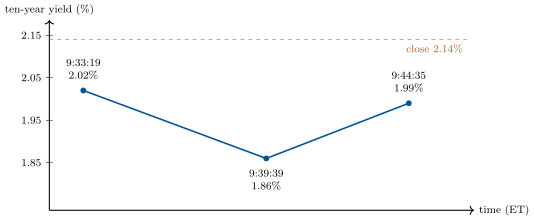
At 9:33:19 New York time on 15 October 2014 the yield of the ten-year US Treasury note stood at 2.02%. Six minutes later, at 9:39:39, it was 1.86%; at 9:44:35 it was back at 1.99%. No economic release, no statement, no headline explained either move. The note is the benchmark of the dollar yield curve, and for twelve minutes it moved like a small stock. The official report that followed found that more than half of the trading that day, in the cash market’s electronic order books and in the futures, had been done by principal trading firms, not by the banks that had once made the market. This chapter describes how Treasuries are sold, where they trade and who trades them, and what two of the market’s most studied days showed about its structure.
4.1 Auctions and primary dealers
The Treasury sells its securities in auctions on a published calendar. Bids are yields, not prices; the coupon of a new note is set only afterwards.
Definition 4.1 (Uniform-price auction)
In a uniform-price auction (single-price auction) noncompetitive bids, for a limited amount, are filled first at whatever the auction’s yield turns out to be; competitive bids, each a yield and an amount, are then accepted from the lowest yield upwards until the offering is filled. The highest accepted yield is the stop-out (high) yield: every winning bidder pays it, and bids exactly at it are filled pro rata.
Method 4.2 (Running an auction)
(1) Cap each bidder’s recognised bids at 35% of the offering, lowest yields first. (2) Subtract noncompetitive awards from the offering. (3) Sort competitive bids by yield and accumulate; the yield at which the cumulative amount reaches what remains is the stop-out. (4) Fill bids below it in full; fill bids at it by the percentage that completes the offering, rounded up to a hundredth of a percent. (5) Set the coupon to the eighth of a percent that gives a price closest to, but not above, par at the stop-out yield.
Definition 4.3 (Primary dealer)
A primary dealer is a firm that the Federal Reserve Bank of New York has designated as a counterparty for its operations, in exchange for obligations: to bid on a pro-rata basis in every Treasury auction at reasonably competitive prices, to make markets for the Bank on behalf of its official account holders, and to report on its activity.
The obligation to bid makes the dealers the auction’s underwriters: if investors stay away, the dealers’ bids fill it, at a yield high enough to be worth their risk. How much of an auction the dealers had to take is therefore read, like the auction’s other statistics, as a measure of demand.
Definition 4.4 (Bid-to-cover ratio and auction tail)
The bid-to-cover ratio is the amount bid divided by the amount offered. The auction tail is the stop-out yield minus the when-issued yield (Definition 4.6) at the bid deadline: positive, the auction cleared cheaper than the market (it tailed); negative, richer (it stopped through).
Example 4.5 (A synthetic ten-year auction)
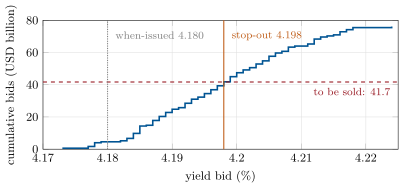
USD 42 billion of ten-year notes are offered; USD 300 million of noncompetitive bids leave USD 41.7 billion for 76.1 billion of competitive bids. The when-issued note trades at 4.180% at 13:00. The bids of Figure 4.1 reach 41.7 billion at 4.198%: that is the stop-out, bids there are filled at 95.02%, the tail is 1.8 basis points and the bid-to-cover ratio 1.82. Indirect bidders (investors bidding through a dealer) take 51.1%, direct bidders 10.6% and dealers 38.3%. The coupon is set at 4.125%, and every winner pays 99.409 for a note that the market valued at 4.180% a minute before. The auction is simulated; the procedure is the Treasury’s.
As of September 2026 — Treasury auctions and primary dealers
Single-price auctions for all marketable securities since November 1998. Noncompetitive bids up to USD 10 million per bidder, filled in full. No competitive bidder is recognised for more than 35% of the offering. Bids usually close at 12:00 (noncompetitive) and 13:00 (competitive) New York time. The Federal Reserve Bank of New York lists 26 primary dealers, the most recent added on 15 January 2026.
4.2 When-issued, on-the-run and off-the-run
Definition 4.6 (When-issued trading)
When-issued trading is trading in a security that has been announced but not yet auctioned or issued, for settlement on its issue date. Because the coupon is not yet known, it is quoted in yield.
Definition 4.7 (On-the-run and off-the-run)
The most recently auctioned security of each original maturity is on-the-run (the benchmark); all earlier issues of that maturity are off-the-run. Each new auction makes the previous benchmark off-the-run.
When-issued trading lets dealers pre-sell the auction to clients and hedge their bids: a dealer that expects to be awarded a billion short-sells a billion when-issued and buys it back in the auction. It also makes the tail observable, since there is a market price at the deadline to compare with the result. Once issued, the new note becomes the market’s reference: most electronic trading, most hedging and most repo specialness (Chapter 5) concentrate in it. It usually yields a little less than an off-the-run note of nearly the same maturity. The difference pays for liquidity and for the cheaper financing that its specialness brings, and trading it, long the cheap off-the-run against the rich benchmark, is one of the oldest relative-value trades in the market (One Quant Book 9).
4.3 Inter-dealer and dealer-to-client
Definition 4.8 (Inter-dealer broker and dealer-to-client platform)
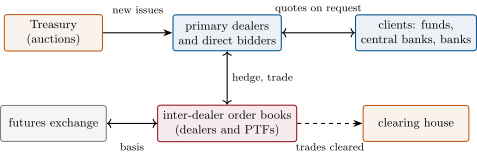
An inter-dealer broker operates the venue on which dealers, and increasingly non-dealers, trade with one another, anonymously: for benchmark Treasuries, a central limit order book; for off-the-run issues, mostly voice-assisted brokers. A dealer-to-client platform lets a client request quotes from several dealers at once and trade on the best (Chapter 22).
The two tiers price differently. In the order books, a price is firm and anyone who hits it trades; at the client tier, a dealer quotes a client it knows, for a size the client names, and hedges the result in the order book. In 2014 the inter-dealer order books for benchmark securities were BrokerTec and eSpeed. The first offers a workup: after a trade in the book, all participants may trade more at that price for a short window, and the report found that most of BrokerTec’s volume happened in workups.
4.4 Principal trading firms and the electronic market
Principal trading firms (proprietary trading firms, One Quant Book 1, chapter 1) trade their own capital, mostly electronically, mostly at short horizons, and mostly in the benchmark securities and the futures. On 15 October 2014 they accounted for more than half of the volume in the inter-dealer cash market and the futures that the regulators analysed, and their activity was concentrated: the ten most active did more than 90% of all principal-trading-firm trading in the cash market. They provided most of the displayed depth, and they took it away when they chose. A market whose liquidity is supplied by firms without an obligation to supply it, the dealers’ auction obligation having no counterpart in the secondary market, is deep in normal times and can be thin on the days it is needed.
4.5 15 October 2014 and March 2020
Definition 4.9 (Flash rally)
A flash rally is a large, fast rise in prices (fall in yields) that reverses within minutes without news to explain either move, the mirror image of a flash crash (One Quant Book 1, chapter 31).
The ten-year note’s twelve minutes on 15 October 2014 (Figure 4.3) followed a weak retail sales release at 8:30 that had already pushed yields down and depth out of the books. In the event window the order books thinned to a fifth of their usual depth in the ten-year, trading volume surged, and self-trading by single firms was unusually high. The report found no single cause. The yield closed at 2.14%, six basis points below the previous close, after a range of 37 basis points, a range seen only three times since 1998 and each time after significant news.
Definition 4.10 (Dash for cash)
A dash for cash is a rush by investors of all kinds to sell liquid assets, including the safest government bonds, to raise cash, so that the securities normally bought in a crisis are sold instead.
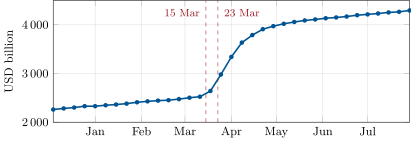
In March 2020, as the pandemic closed economies, investors of every kind sought cash. The international review of the episode found that substantial sales of Treasuries by some leveraged non-bank investors and by foreign holders met dealers who could not, or would not, absorb them; the combination became self-reinforcing, and prices that normally move together, on-the-run and off-the-run notes, Treasuries and their futures, came apart. On 15 March the Federal Reserve cut its rate to zero and announced purchases of at least USD 500 billion of Treasuries; on 23 March it changed the instruction to purchases “in the amounts needed” for the market to function. Its holdings rose from USD 2 523 billion on 11 March to USD 3 789 billion on 15 April, 1 266 billion in five weeks (Figure 4.4). The central bank became, for a month, the market’s dealer of last resort, the role the clearing mandate and the regulators’ other reforms since then are meant to make less necessary.
As of September 2026 — The US Treasury clearing mandate
Adopted by the SEC in December 2023, the rule requires members of Treasury clearing agencies to clear eligible secondary-market trades: eligible cash transactions from 31 December 2026 and eligible repo from 30 June 2027 (dates extended by a year in February 2025). On 22 September 2026 an SEC commissioner said the SEC did not intend to extend them again. Two clearing agencies were approved to act as central counterparties for Treasury cash and repo trades.
4.6 Tutorial: running an auction
Goal. Run the synthetic ten-year auction of Example 4.5 from its bid book and compute every statistic the market reads at 13:01. End state: Figure 4.1 and the numbers of the example.
Cap and sort. Each bidder’s bids count up to 35% of the offering.
def cap_bids(bids: list[Bid], offering: float, max_share: float = MAX_SHARE) -> list[Bid]:
    """Recognise each bidder's bids from the lowest yield up to max_share of the offering."""
    left: dict[str, float] = defaultdict(lambda: max_share * offering)
    out = []
    for b in sorted(bids, key=lambda b: b.yld):
        amt = min(b.amount, left[b.bidder])
        if amt > 0:
            out.append(Bid(b.bidder, b.yld, amt))
            left[b.bidder] -= amt
    return out
Listing 4.1. Recognising each bidder’s bids up to the cap. code/firm/tsyauction/firm_tsyauction.py Fill to the stop-out, with the pro-rata percentage rounded up as the regulation says.
def run_auction(offering: float, noncompetitive: float, bids: list[Bid]) -> Result:
    capacity = offering - noncompetitive
    book = cap_bids(bids, offering)
    tendered = sum(b.amount for b in book)
    if tendered < capacity:
        raise ValueError("auction not covered")
    levels = sorted({b.yld for b in book})
    filled = 0.0
    for y in levels:
        at = sum(b.amount for b in book if b.yld == y)
        if filled + at >= capacity:
            stop, pct = y, math.ceil((capacity - filled) / at * 1e4 - 1e-9) / 1e4
            break
        filled += at
    awards: dict[str, float] = defaultdict(float)
    for b in book:
        if b.yld < stop:
            awards[b.bidder] += b.amount
        elif b.yld == stop:
            awards[b.bidder] += b.amount * pct
    return Result(stop, pct, dict(awards), tendered, (tendered + noncompetitive) / offering)
Listing 4.2. The uniform-price auction: stop-out yield, allotment at the stop, awards. code/firm/tsyauction/firm_tsyauction.py - Read the result.
tsy_auction_demo.summary()gives the stop-out 4.198%, the tail of 1.8 basis points against the when-issued 4.180%, the bid-to-cover ratio 1.82, the allotment at the stop 95.02% and the award shares;coupon_from_high_yield(0.04198)gives 4.125. - Draw the demand curve with
fig_tsy_auction.py.
What to change next. Move every indirect bid one basis point higher and see how far the stop-out moves (Exercise 4.7); then give one bidder 60% of the book and watch the cap bite.
4.7 Build: the auction analyser
Purpose. The miniature firm’s rates desk bids in auctions and trades around them; its research reads every auction’s statistics. This component runs an auction from a bid book and scores a result against the when-issued market.
Interface. Bid(bidder, yld, amount); run_auction(offering, noncompetitive, bids) returning Result(stop, allotment_at_stop, awards, competitive_tendered, bid_to_cover); cap_bids; tail_bp(stop, when_issued); cumulative_demand; coupon_from_high_yield.
Rules. Noncompetitive first; 35% cap per bidder; stop-out at the yield where cumulative bids reach the remainder; pro-rata percentage rounded up to 0.01%; an uncovered auction is an error; coupon rounded down to an eighth, minimum one eighth.
Acceptance tests. code/firm/tsyauction/tests/: every winner pays the stop-out; noncompetitive awards reduce the competitive capacity; the cap; an uncovered book; the sign of the tail; the coupon rule.
Stretch. Read the Treasury’s published auction results and compute the tail against a when-issued feed; add the bidder categories the Treasury publishes; price the new note with the bond library (Section 3.6).
Sources and further reading
- US Treasury, How Auctions Work and Auctions In Depth (TreasuryDirect); 31 CFR 356.20.
- Federal Reserve Bank of New York, Primary Dealers.
- US Department of the Treasury, Board of Governors of the Federal Reserve System, Federal Reserve Bank of New York, SEC and CFTC, Joint Staff Report: The U.S. Treasury Market on October 15, 2014, July 2015.
- Financial Stability Board, Holistic Review of the March Market Turmoil, 17 November 2020.
- Federal Reserve press release, 15 March 2020; Federal Reserve Bank of New York, FAQs: Treasury Purchases, 23 March 2020; H.4.1 via FRED.
- SEC, press release 2025-43; M. T. Uyeda, remarks at the 2026 U.S. Treasury Market Conference, 22 September 2026.
4.8 Exercises
Exercise 4.1 ★
USD 30 billion are offered; noncompetitive bids total 3 billion. Four bidders bid 10 billion at 4.100%, 8 billion at 4.105%, 10 billion at 4.110% and 6 billion at 4.115%. Give the stop-out yield, the allotment at the stop, and the bid-to-cover ratio.
Solution
Solution of Exercise 4.1.
27 billion are left for competitive bids. 10 + 8 = 18 billion are filled below 4.110%; the 10 billion at 4.110% are needed for 9: stop-out 4.110%, allotment at the stop 90.00%. Bid-to-cover . No bidder reaches the 35% cap (10.5 billion).
Exercise 4.2 ★
The when-issued yield at 13:00 is 4.285%. Give the tail if the stop-out is 4.292%, and if it is 4.281%. Which result would the market call strong?
Solution
Solution of Exercise 4.2.
basis points: a tail. : a stop-through, the strong result, since the Treasury sold at a lower yield (higher price) than the market was paying a minute before.
Exercise 4.3 ★
Give the coupon of a new note whose auction stops at 4.198%, and at 3.999%. Is the new note issued above or below par?
Solution
Solution of Exercise 4.3.
4.125% and 3.875%: the eighths just below the stop-out yields. Priced at a yield above its coupon, the note is issued slightly below par (99.409 for the first, a ten-year).
Exercise 4.4 ★★
An on-the-run ten-year yields 4.18% and the previous ten-year, three months older, 4.21%. Give three reasons for the gap and describe the trade that bets on it closing. What can go wrong?
Solution
Solution of Exercise 4.4.
The benchmark is the most liquid issue (tighter bid–ask, deeper books); it is the one everybody hedges with and shorts, so it is often special in repo and its holders finance it cheaply; and demand for the newest issue from index-tracking and liquidity-seeking investors. The trade: buy the off-the-run, short the on-the-run in the same DV01, finance the long in repo and borrow the short through a reverse repo, and wait for the new issue to become old at the next auction. What goes wrong: the spread widens further in a flight to liquidity (March 2020 did exactly this); the short becomes more special and the financing costs more than the spread earns; leverage and margin force an exit at the worst time.
Exercise 4.5 ★★
In Example 4.5, what is a primary dealer’s pro-rata share of the offering? The dealers took 38.3% of the auction. What does that number tell the market that the bid-to-cover ratio does not?
Solution
Solution of Exercise 4.5.
million per dealer. The dealers’ 38.3% is what the investors did not take: a high dealer share means the market’s end buyers were thin and the dealers must now distribute the notes, usually at a price concession. The bid-to-cover ratio counts every bid, including dealer bids far above the stop-out that never had a chance to be filled.
Exercise 4.6 ★★
A single investor wants USD 20 billion of a 42-billion auction. How much of its bid is recognised? How could it still end up owning 20 billion?
Solution
Solution of Exercise 4.6.
The cap is 35% of the offering: 14.7 billion. It can buy the remaining 5.3 billion in the secondary market, when-issued before the auction or after issue, or from dealers who were awarded more than they wanted.
Exercise 4.7 ★★★
Coding. In tsy_auction_demo.bid_book(), move every indirect bidder’s yield one basis point higher. Report the new stop-out and tail. Why does the stop-out move by less than, or as much as, the shift?
Solution
Solution of Exercise 4.7.
The stop-out moves from 4.198% to 4.200%, the tail from 1.8 to 2.0 basis points: two tenths, not a whole basis point. The indirect bids are only part of the book; as they move up, the dealer and direct bids that sat between 4.198 and 4.208 are reached first and fill most of the gap. The stop-out moves by the full shift only if the whole book shifts.
Exercise 4.8 ★★★
Find the flaw. “In a uniform-price auction, bid a yield a little above what you think the note is worth, because you pay what you bid.” Correct the statement. Who does have a reason to shade their bids, and why?
Solution
Solution of Exercise 4.8.
In a uniform-price auction a winning bidder pays the stop-out, not its bid. A small bidder whose bid cannot move the stop-out has no reason to shade: it should bid the yield at which it is indifferent, since bidding higher only risks missing the award. A large bidder has a reason: a bid that sets the stop-out moves the price it pays on its whole award, so it shades the part of its demand that might be marginal. In a pay-your-bid auction everybody shades, because every bid is its own price.
4.9 Problem: Tailing
Problem 4.1
Weekend problem — a primary dealer’s auction
Primary dealer D07 takes part in the auction of Example 4.5. At 12:59 it has sold USD 1 billion of the new note when-issued at 4.180% to clients, and it bids USD 500 million at 4.188%, 500 million at 4.195% and 615 million at 4.205%. Its round-trip costs are a quarter of a basis point of DV01. The new note’s DV01 at the stop-out is USD 807 per million.
Part I — The auction.
- How much is available to competitive bidders?
- Give the stop-out yield and the tail.
- Give the bid-to-cover ratio and the allotment at the stop.
- Give the shares of indirect bidders, direct bidders and dealers.
- Give the coupon and the price every winner pays.
Part II — The dealer.
- What is D07’s pro-rata share of the offering? Does its bid meet the obligation?
- Which of its bids are filled, and how much is it awarded?
- What is the DV01 of its award?
- It is short 1 billion when-issued at 4.180% and long 1 billion at the stop-out. What is its P&L after costs?
- What would it have been had the auction stopped through by 0.2 basis points (at 4.178%), with the same award?
Part III — Reading the result.
- At what tail does the dealer’s position break even?
- Why does the market read a large tail as weak demand, and what does the when-issued note do in the minute after the result?
- Why did the dealer bid part of its share above the when-issued yield at all?
- Had the indirect bidders all bid one basis point higher, where would the auction have stopped?
- What would the dealer have wished to do differently, knowing the tail in advance, and why can it not?
Part IV — Judgement.
- Why does the Treasury use a uniform-price rather than a discriminatory (pay-your-bid) auction?
- Why do the clients who bought when-issued from D07 not simply bid in the auction themselves?
- What does the dealer’s auction obligation cost it in a weak auction, and what does it get in return?
- State the named result: the dealer’s P&L per basis point of tail on its award, its P&L in this auction, and the break-even tail.
- In one sentence: what is a tail?
Solution
Solution of Problem 4.1.
1. million. 2. Stop-out 4.198%; tail basis points. 3. Bid-to-cover 1.82; allotment at the stop 95.02%. 4. Indirect 51.1%, direct 10.6%, dealers 38.3%. 5. Coupon 4.125%; price 99.409 per 100. 6. million; it bids 1 615 million at three yields, which meets the obligation if the yields are reasonably competitive. 7. The bids at 4.188% and 4.195% are below the stop-out and filled in full; the bid at 4.205% is above it and gets nothing: award 1 000 million. 8. per basis point. 9. It sold at 4.180% and bought at 4.198%: 1.8 basis points in its favour, less 0.25 of costs, on 806 797 per basis point: . 10. A stop-through of 0.2 basis points: . 11. At a tail of basis points, the cost. 12. The end buyers bid for less than was offered at the market price, so the Treasury had to sell deeper into the dealers’ backstop bids; the when-issued note, now the issued note, cheapens towards the stop-out as the market absorbs the notes left with dealers. 13. To meet the pro-rata obligation, and because a bid a few tenths of a basis point above the market is the price of underwriting: it wins if the auction is weak, and then it is paid for the risk. 14. At 4.200%, a tail of 2.0 basis points (Exercise 4.7). 15. It would have bid less and sold less when-issued, or bid lower to be filled only in a weak auction. It cannot know the tail: the when-issued level is the market’s best estimate of the stop-out, and the dealer’s P&L is a bet on the difference. 16. A uniform price removes most bidders’ reason to shade, draws more bidders (small bidders need not guess the others’ bids), and makes every winner pay the same price, the one the market cleared at. The Treasury has used it for all its auctions since November 1998. 17. Some cannot bid directly or do not want to reveal their demand; buying when-issued from a dealer fixes their price in advance, and the dealer takes the auction risk for them. 18. In a weak auction it is filled on bids it would rather lose and carries the notes at a loss until they are distributed. In return: primary dealer status, a counterparty relationship with the central bank, and client flow. 19. Named result: the dealer’s tail P&L: USD 806 797 per basis point of tail on its USD 1 billion award; USD 1 250 536 in this auction (tail 1.8 basis points); break-even at a tail of 0.25 basis points. 20. The difference between what the auction paid and what the market was paying at the deadline.
4.10 Interview questions
Interview question 4.1 ★ trader, researcher
What is an auction tail, and what does a large one tell you?
Solution
Solution of Interview question 4.1.
The stop-out yield minus the when-issued yield at the bid deadline. A large positive tail means the auction had to reach up into higher yields than the market was trading at to be filled: end demand was weak, dealers took more than usual, and the market usually cheapens after the result.
What the interviewer is looking for: the definition with its sign, and the link to dealer takedown.
Interview question 4.2 ★ trader, bank
Why does an on-the-run Treasury usually yield less than an off-the-run of almost the same maturity?
Solution
Solution of Interview question 4.2.
Liquidity (the benchmark is where trading, hedging and futures delivery concentrate), specialness in repo (it is the most shorted issue, so owning it lets you borrow cash cheaply), and demand from investors who need the benchmark. Holders give up a little yield for these; the spread moves with the premium on liquidity, and widens in stress.
What the interviewer is looking for: liquidity and financing, not only “it is newer”.
Interview question 4.3 ★★ trader, researcher
How does a uniform-price auction change a bidder’s strategy compared with a pay-your-bid auction?
Solution
Solution of Interview question 4.3.
In a pay-your-bid auction every winner pays its own bid, so bidders shade towards the expected stop-out and must guess others’ bids; winners regret (winner’s curse). In a uniform-price auction winners pay the clearing yield, so small bidders bid their true reservation yields; only bidders large enough to set the price have a reason to shade.
What the interviewer is looking for: who pays what, and which bidders still shade.
Interview question 4.4 ★★ researcher, developer
What happened in the Treasury market on 15 October 2014, and what would you look for in order-book data to understand a day like it?
Solution
Solution of Interview question 4.4.
After a weak retail-sales release, depth in the ten-year order books fell to a fraction of normal; between 9:33 and 9:45 yields fell 16 basis points and retraced with no news, while principal trading firms did more than half of the volume. In order-book data: depth at the best levels and within a few ticks over time, cancellation and order-to-trade ratios, the share of volume by participant type, self-trades, aggressive versus passive volume by participant, and the futures-cash lead–lag.
What the interviewer is looking for: depth, not volume, as the variable, and a concrete list of measurable quantities.
Interview question 4.5 ★★ trader, bank
In March 2020 Treasuries sold off while equities crashed. Why did the safest asset fall?
Solution
Solution of Interview question 4.5.
Because everyone needed cash, and Treasuries are what can be sold: leveraged investors unwinding, foreign holders raising dollars and funds meeting redemptions sold them, and dealers could not absorb the flow within their balance sheets. The safe asset was liquid, so it was sold first; the central bank’s purchases, over a trillion dollars in five weeks, restored function.
What the interviewer is looking for: the distinction between safety and liquidity, and the intermediation capacity of dealers.
Interview question 4.6 ★★★ developer, researcher
Design the data model and the tests for a system that ingests Treasury auction results and computes each auction’s tail in real time.
Solution
Solution of Interview question 4.6.
Entities: security (CUSIP, term, dated and maturity dates), announcement (offering, dates), when-issued quotes (time-stamped, source), result (high yield, allotment at high, bid-to-cover, bidder shares, coupon, price), computed tail. Real-time path: subscribe to the result release, parse, look up the when-issued quote at the deadline from a time-indexed store, compute, publish. Tests: parse the published results of past auctions and compare with their published statistics; a when-issued quote exactly at the deadline and missing quotes; reopened issues (coupon already known, quoted in price); bills (discount rates, not yields); clock and time-zone handling of the deadline.
What the interviewer is looking for: the deadline timestamp as the crux, and tests against published history.